EMI Notification Deadline Under FA 2024: The 6 July Rule and the End of the 92-Day Window
For EMI options granted on or after 6 April 2024, the notification deadline is 6 July following the tax year end. Here is what changed and how to comply.

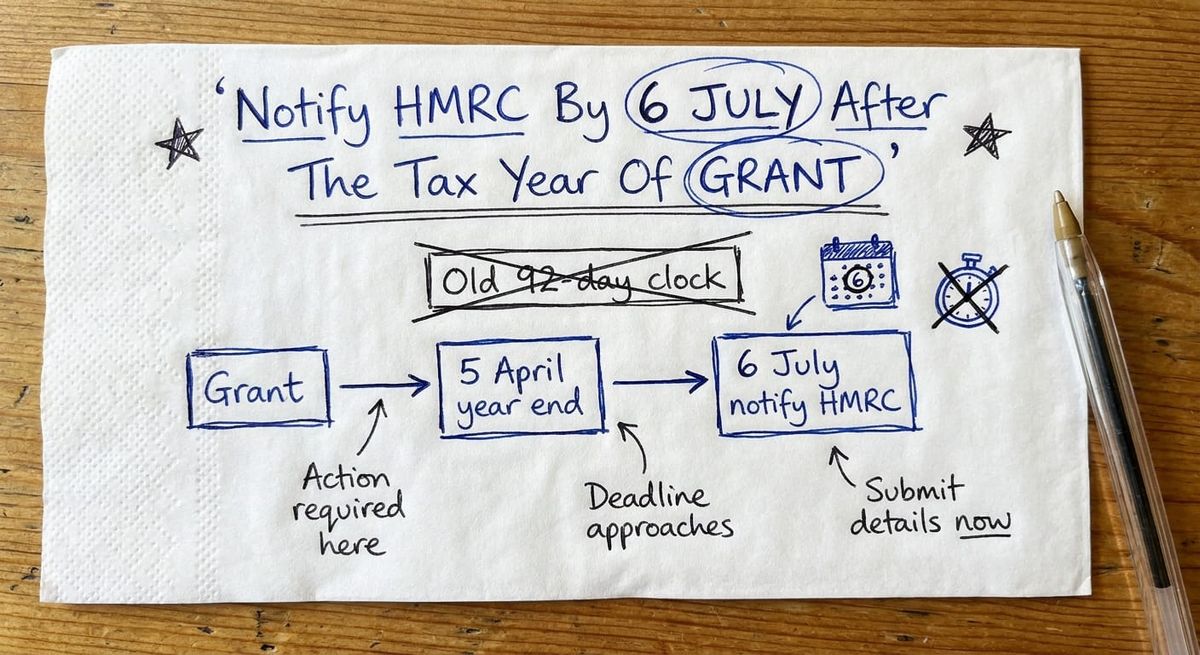
For EMI options granted on or after 6 April 2024, the company has until 6 July following the end of the tax year of grant to notify HMRC. The old "within 92 days of grant" rule has been abolished by Finance Act 2024 . The statute makes notice in time a condition of an option being a qualifying option, so a missed deadline puts the EMI treatment at risk.
Contents
- What is the EMI notification deadline under FA 2024?
- What did the 92-day rule say and why was it changed?
- How do you work out the 6 July deadline for a specific grant?
- What happens if you miss the 6 July deadline?
- How does the 6 July rule interact with replacement options?
- What are the common errors with EMI notification?
- What is changing again in April 2027?
- Frequently asked questions
- About Steve Livingston FCA
What is the EMI notification deadline under FA 2024?
The current rule requires notice of the option to be given to HMRC on or before 6 July following the end of the tax year in which the option was granted, and the notice must be given by the employer company and given electronically. In practice that means entering the details via the Employment Related Securities online service on HMRC's portal.
The change moves EMI notification onto an annual cycle that matches the ERS annual return, which is also required on or before 6 July in the following tax year. The notification of grant and the annual return now share the same date and in practice the same online service.
The amendment has effect only for options granted on or after 6 April 2024. For options granted before that date, the old "within 92 days after the date of the grant" wording is the test. The change is not retrospective.
What did the 92-day rule say and why was it changed?
For options granted before 6 April 2024, required notice of the option within 92 days after the date of grant. That meant a separate compliance event for every single grant, regardless of how small or how routine.
The change in Finance Act 2024 s 13(2) replaced the words "within 92 days after the date of the grant of the option" with "on or before 6 July following the end of the tax year in which the option was granted". The effect is to remove the per-grant clock and put grants onto the same annual cycle as the ERS return. Older practitioner notes, online guides, and template files may still cite the 92-day rule, so anything written before the change needs to be checked against the current wording.
How do you work out the 6 July deadline for a specific grant?
There are three steps.
- identify the tax year of grant. The UK tax year runs from 6 April to 5 April. So a grant on 1 March 2027 falls in tax year 2026/27. A grant on 15 May 2027 falls in tax year 2027/28.
- find the end of that tax year. For 2026/27 that is 5 April 2027. For 2027/28 that is 5 April 2028.
- apply the deadline. Notification is due on or before 6 July following the year end. So a 2026/27 grant is notified by 6 July 2027. A 2027/28 grant is notified by 6 July 2028.
| Grant date | Tax year | Year end | Notification deadline |
|---|---|---|---|
| 15 January 2027 | 2026/27 | 5 April 2027 | 6 July 2027 |
| 10 April 2027 | 2027/28 | 5 April 2028 | 6 July 2028 |
| 1 September 2027 | 2027/28 | 5 April 2028 | 6 July 2028 |
For a grant made early in a tax year (April, May, June) the window runs to roughly 13 to 15 months. For a grant made late in a tax year (February, March) it is roughly four months. The new window is never shorter than the old 92 days, but the discipline of getting the date into the diary is what catches people out. It is also sensible to notify soon after grant rather than waiting for the deadline.
What happens if you miss the 6 July deadline?
For a share option to be a qualifying option, notice of the option must be given to HMRC on or before 6 July following the end of the tax year of grant. If notice is not given in time, the option does not meet that requirement and the EMI treatment is at risk, even if every other condition was met. The practical consequence is that the option falls outside the EMI regime and the ordinary rules for employment-related share options apply instead, so the position on exercise needs specialist review.
There is no late-notification provision or extension. HMRC can correct obvious errors or omissions in a notice that has been given (within 9 months of the notice), but that is a different matter from a notice that was never given. If a deadline has been missed, take advice before assuming anything about whether HMRC will exercise any discretion.
Two other points sit alongside this:
- HMRC has 12 months from the 6 July date to give a notice of enquiry into the option, and later if it discovers that information in the notice was false or misleading in a material respect.
- A company that fails to deliver its ERS annual return by 6 July faces an automatic penalty of £100, with further penalties if the failure continues.
For founders and finance directors, the practical fix is to put the 6 July notification date in the diary the moment a grant is made, and to confirm both the notification and the ERS annual return have been filed before the deadline.
What are the common errors with EMI notification?
Three are worth guarding against.
Citing the old 92-day rule. This can persist in template engagement letters, draft option agreements, in-house compliance calendars, and online practitioner guides. Anything written before the change should be checked against the current rules.
Confusing the 6 July deadline with the 90-day AMV validity window. These are two completely separate clocks. The 90 days is the window during which an HMRC-agreed actual market value remains valid for executing the option deeds (counted from the date HMRC writes back confirming the valuation). The 6 July is the notification of grant, due in the tax year cycle after the grant has actually been made. Confusing the two leads to either rushing the grant (under the misapprehension that there is a 92-day clock) or missing the notification (under the assumption that 90 days inside the AMV window is the only deadline that matters).
Treating the notification as optional or curable. It is neither. The deadline is statutory and paragraph 44 provides no extension. If it has been missed, take advice on the position and on what other share scheme route might be available.
What is changing again in April 2027?
The government has signalled, in the Autumn Budget 2025 documents and HMRC's ERS Bulletin 62, that the EMI notification of grant requirement is intended to be removed from April 2027, leaving only the annual ERS return to capture EMI grants. If that goes ahead as signalled, there would be no separate notification for the affected grants and the annual ERS return would become the single touchpoint.
If you are planning grants close to April 2027, confirm the position at the time and do not assume the requirement has already gone.
Frequently asked questions
What is the deadline to notify HMRC of an EMI option grant?
For grants on or after 6 April 2024, it is 6 July following the end of the tax year of grant. For options granted before 6 April 2024, the old "within 92 days after the date of the grant" wording applies.
Where do you notify HMRC of an EMI grant?
Notice must be given electronically, in practice through HMRC's Employment Related Securities online service, the same service used for the annual ERS return. The notification of grant and the annual return now share the same 6 July date.
What happens if the EMI notification is filed late?
Notice in time is a condition of the option being a qualifying option, so a late notice puts the EMI treatment at risk. Paragraph 44 contains no late-notification provision. Take advice before assuming anything about the position.
Does the 6 July rule apply to existing EMI options?
No. The change applies to options granted on or after 6 April 2024. Options granted before that date are subject to the old 92-day rule.
Is the 6 July deadline the same as the ERS annual return deadline?
Both fall on 6 July. The notification of a grant is due on or before 6 July following the tax year of grant and the annual return for a tax year is due on or before 6 July in the following tax year. They are separate filings with the same date.
Does the notice of grant need to include a working time declaration?
No. The working time condition still has to be met, so the company should still confirm that each option holder satisfies it.
What is the AMV 90-day window and how does it differ from the 6 July deadline?
HMRC's published position is that an agreed valuation is valid for 90 days from the date of the agreement, provided there are no changes in the company's circumstances, so the option deeds should be executed within that period. The 6 July deadline is a separate annual notification of grants made during the previous tax year. The two clocks are unrelated.
Get specialist help with EMI grant timing and notification
EMI is a powerful relief, but the compliance cost of getting the timing wrong is disproportionate to the work involved in getting it right. Most EMI notification problems are not exotic. They are basic timing or notification slips on schemes that were otherwise well designed.
If you are planning EMI grants, restructuring options through a share exchange, or unsure whether a historic grant was notified correctly, get in touch. I work with founders and finance teams directly, and with accountants and professional advisers on a referral basis for EMI scheme design, valuation submissions, and HMRC SAV correspondence.
Suggested schema markup (JSON-LD)
{
  "@context": "https://schema.org",
  "@type": "FAQPage",
  "mainEntity": [
    {
      "@type": "Question",
      "name": "What is the deadline to notify HMRC of an EMI option grant under FA 2024?",
      "acceptedAnswer": {
        "@type": "Answer",
        "text": "For grants on or after 6 April 2024, the deadline is 6 July following the end of the tax year of grant. The basis is paragraph 44(1) of Schedule 5 ITEPA 2003, as amended by Finance Act 2024 s 13(2). For options granted before 6 April 2024, the old 'within 92 days after the date of the grant' wording applies."
      }
    },
    {
      "@type": "Question",
      "name": "What happens if the EMI notification is filed late?",
      "acceptedAnswer": {
        "@type": "Answer",
        "text": "Under paragraph 44(1) of Schedule 5 ITEPA 2003, notice in time is a condition of the option being a qualifying option, so a late notice puts the EMI treatment at risk. Paragraph 44 contains no late-notification provision."
      }
    },
    {
      "@type": "Question",
      "name": "What is the time limit for HMRC to enquire into an EMI option?",
      "acceptedAnswer": {
        "@type": "Answer",
        "text": "Under paragraph 46(5) of Schedule 5 ITEPA 2003, HMRC may not give a notice of enquiry more than 12 months after the 6 July date in paragraph 44(1), unless it discovers that information in the notice was false or misleading in a material respect. Finance Act 2024 s 13(3)(a) amended paragraph 46(5) to follow the new deadline."
      }
    },
    {
      "@type": "Question",
      "name": "Is the EMI 6 July deadline the same as the ERS annual return deadline?",
      "acceptedAnswer": {
        "@type": "Answer",
        "text": "Both fall on 6 July. The notification of a grant is due on or before 6 July following the tax year of grant, and the annual ERS return for a tax year is due on or before 6 July in the following tax year. They are separate filings with the same date."
      }
    },
    {
      "@type": "Question",
      "name": "Is the EMI notification rule changing again in April 2027?",
      "acceptedAnswer": {
        "@type": "Answer",
        "text": "The government has signalled that the EMI notification of grant requirement is intended to be removed from April 2027, leaving only the annual ERS return. The change is not yet enacted. Until the legislation lands, the 6 July rule under Finance Act 2024 s 13 remains in force for options granted from 6 April 2024."
      }
    }
  ]
}