SEIS and EIS for Software and SaaS Companies: A Practical UK Guide
SEIS and EIS for software and SaaS companies: IP ownership, licence income, risk to capital, knowledge-intensive status and funding applications.

By Steve Livingston FCA, founder of IP Tax Solutions. Technical sources reviewed: 21 September 2026.
Software and SaaS companies can qualify for SEIS and EIS. Software is not an excluded sector, but eligibility depends on what the company actually does, how it earns its income, its ownership of intellectual property and the proposed investment terms.
For a software funding round, four questions deserve particular attention: whether any income comes from excluded activities, who created the IP, how the investment supports growth and whether the company meets the relevant age and size tests. An advance assurance application should explain those points using the same commercial facts presented to investors.
Are software and SaaS businesses eligible?
A company developing and selling software may carry on a qualifying trade. A group can also qualify, subject to the group trading and subsidiary rules. Neither a technology label nor an R&D claim settles the SEIS or EIS analysis.
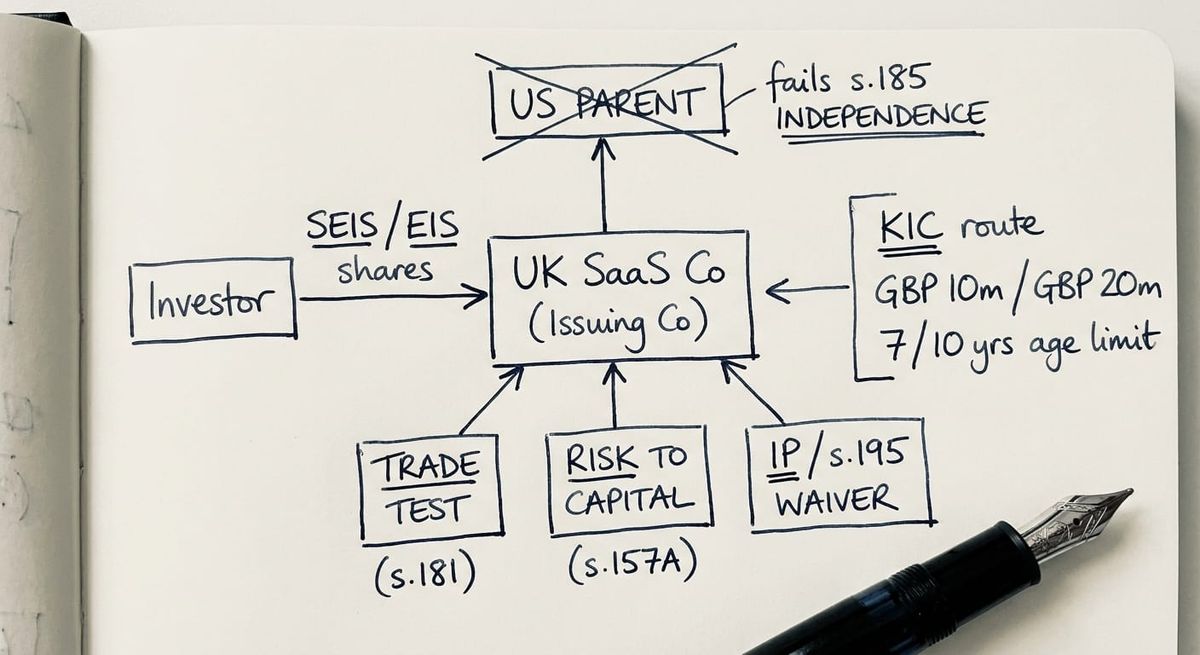
For EIS, the trading requirement is in ITA 2007 s.181. For SEIS, use s.257DA, together with the new qualifying trade requirement in s.257HF. A company preparing to trade or undertaking qualifying R&D needs a separate qualifying-business-activity analysis; absence of sales is not itself a disqualification.
Our SEIS eligibility guide covers the general company and investor conditions. The discussion below concentrates on the software-specific points.
Subscription revenue, licence fees and IP ownership
Receiving royalties or licence fees is an excluded activity, subject to a statutory exception for relevant intangible assets. The exception can apply where the company, or an appropriately qualifying subsidiary, created the whole or greater part of the asset by value. For intellectual property, the right to exploit it must vest in the creator in the circumstances specified by the legislation. ITA 2007 s.195.
Start with the customer contracts. A SaaS subscription may contain services, software access, licensing and support. Its treatment depends on those rights and the commercial substance. Do not assume that every subscription is a service or that every payment described as a licence automatically prevents qualification.
For a platform developed internally, record who performed the development, who contracted with developers and where the exploitation rights sit. For acquired or licensed-in software, examine subsequent development and the value created by the company. Purchasing IP is not automatically fatal, but simply acquiring an asset and passing on licence rights does not establish that the company created the greater part of it. A holding-company insertion also needs the specific rule in s.195(7) checked.
The amount of excluded activity matters. HMRC normally accepts that excluded activities are not substantial where they account for no more than 20% of the trade using a measure reasonable in the circumstances. Turnover and capital employed are examples, not an exclusive menu or a choice to select whichever produces the preferred answer. VCM3010.
FinTech and hardware businesses
A software product used by financial institutions is not necessarily a financial activity. The relevant question is whether the company itself lends money, underwrites risk or undertakes comparable activities. Advice and intermediary services can fall outside the financial-activities exclusion where the provider is commercially and economically independent of those bearing the financial risk. Regulatory status helps identify the facts, but does not replace the tax analysis. VCM3040.
Hardware bundled with software is not excluded merely because the hardware revenue is substantial. Ordinary wholesale or retail distribution is distinguished from other dealing in goods. Leasing equipment, financing customers and licensing acquired IP raise different questions and should be analysed separately. ITA 2007 s.192.
Recurring revenue and the risk-to-capital condition
The company must have objectives to grow and develop its trade over the long term. There must also be a significant risk of capital loss exceeding the net investment return, taking account of the available income tax relief. Both limbs are assessed at the share issue using all the relevant circumstances. SEIS s.257AAA and EIS s.157A.
Contracted recurring revenue does not automatically fail this condition. A company can have customers, positive margins and a credible growth plan while investors remain exposed to commercial loss. Equally, describing a raise as growth funding will not cure arrangements that protect investors' capital.
Explain what the money changes: product development, engineering capacity, customer acquisition, infrastructure or entry into a new market. Connect those plans to realistic costs and risks. Address customer concentration, retention, competition, technical delivery and any contractual limits on the company's revenue. HMRC expressly recognises that securing future income does not necessarily indicate capital preservation. VCM8542.
A lean team or outsourced development does not automatically fail either. Explain who directs the business, owns the customer relationships and takes the commercial decisions. Our risk-to-capital guide explains the assessment in more detail.
Could the company be knowledge-intensive?
Knowledge-intensive company status can increase relevant EIS limits. It is not automatic for software companies and is not established simply by employing developers or claiming R&D relief.
The company must meet an operating-cost condition and either the innovation condition or the skilled-employee condition. The operating-cost alternatives are R&D or innovation expenditure of at least 15% in one of the relevant three years, or at least 10% in each of those years. The relevant periods and group costs must be calculated under the legislation, rather than assumed to be the latest three filed accounts. ITA 2007 s.252A.
The innovation route requires qualifying IP creation and a reasonable expectation that exploitation of that IP, or business using it, will form the greater part of the relevant business within ten years. The skilled-employee route requires the prescribed proportion of appropriately qualified staff engaged directly in R&D or innovation throughout Period B. These are separate evidential tests.
For investments from 6 April 2026, the standard annual and lifetime EIS limits are generally £10 million and £24 million, increasing to £20 million and £40 million for knowledge-intensive companies. Lower limits continue for specified Northern Ireland companies. The employee test is fewer than 250 FTE, or fewer than 500 for a qualifying knowledge-intensive company. Check the applicable gross-assets, group and use-of-funds rules as well. Current HMRC EIS guidance.
Pivots and earlier development
For SEIS, the new qualifying trade test examines when the trade began, including under a previous owner. It also restricts earlier other trades in the issuing company and relevant subsidiaries. Incorporating a new vehicle does not reset an acquired trade's history. A pivot needs a factual analysis of whether there is a continuing trade or a genuinely different one. ITA 2007 s.257HF.
For EIS, the initial investing period is generally seven years from the relevant first commercial sale, with special rules for knowledge-intensive companies and statutory routes for certain later investments. Transferred trades and group history can affect that date. Our multi-round funding guide explains why the first EIS round is not the only relevant event.
Preparing the application
Put the business plan, forecasts, cap table, articles and investor documents beside the IP and customer contracts. Check they describe the same business and funding proposal. Explain acquisitions, licensing arrangements and any excluded activities rather than leaving HMRC to infer them from the accounts.
Keep the R&D tax narrative consistent with the underlying development facts, while recognising that R&D relief and SEIS/EIS have different tests. Review investor eligibility separately: SEIS and EIS apply different rules to employees and directors, and company advance assurance does not approve each investor.
Use our advance assurance application guide for the submission documents and current HMRC response aims. After the investment, complete the appropriate compliance process; the SEIS1 guide explains the SEIS stage.
Frequently asked questions
Does profitable SaaS fail SEIS or EIS?
No. Profitability alone is not the test. Review the proposed investment, commercial risks, growth objectives and all the other scheme conditions.
Does bought-in IP prevent qualification?
Not automatically. Establish the nature and extent of the income, the creation-by-value position and any applicable statutory exception. Do not assume that a purchase alone satisfies the IP condition.
Does software development automatically make a company knowledge-intensive?
No. Calculate the relevant costs and establish either the innovation or skilled-employee condition using the statutory definitions.
Discuss the proposed round
IP Tax Solutions advises software founders and their advisers on SEIS/EIS eligibility, advance assurance, compliance statements and HMRC challenges. Contact us about your funding round with the proposed amount, timing, business model and any IP or investor-rights issue.
This article provides general information. The company's facts, transaction documents and each investor's position require separate consideration.