Can a Company Use SEIS, EIS and EMI at the Same Time?
How SEIS, EIS and EMI work together: share rights, optional HMRC valuation agreement, founder interests, funding sequence and employee buybacks.

By Steve Livingston FCA, founder of IP Tax Solutions. Technical sources reviewed: 21 September 2026.
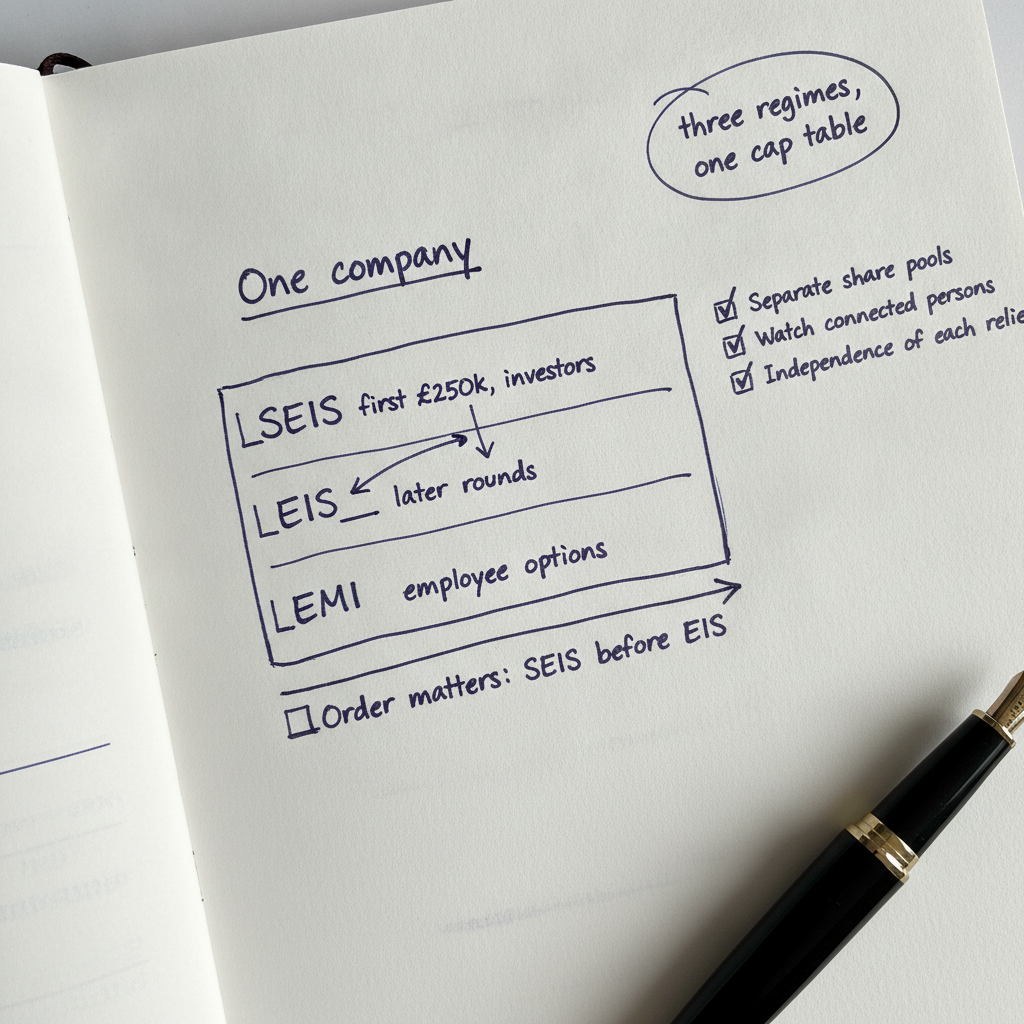
A company can use SEIS, EIS and Enterprise Management Incentives together. The investor reliefs and employee option rules are separate regimes, so each transaction must satisfy its own conditions. The main coordination points are share rights, investor and employee eligibility, valuation, funding sequence and any later buyback.
There is no general requirement to use one share class for all three schemes or to grant EMI options before every funding round. Those may be practical choices, but the right structure depends on the company and the rights being created.
How the three schemes fit together
SEIS and EIS provide relief to qualifying investors subscribing for qualifying shares. EMI provides tax advantages for qualifying employee share options. A valid EMI grant does not by itself establish SEIS or EIS eligibility, and company advance assurance for an investment does not approve the option scheme.
The investor reliefs sit in Parts 5 and 5A of the Income Tax Act 2007. EMI is governed principally by Schedule 5 ITEPA 2003. The company, trade, group and individual tests overlap in some respects but are not interchangeable.
Our SEIS eligibility guide provides the starting investment checks. An EMI review must also cover eligible employees, working time, material interests, option limits, exercise provisions and notification.
Company limits do not settle eligibility
SEIS generally requires no more than £350,000 gross assets immediately before issue and fewer than 25 FTE employees, together with its trade-history and funding conditions. EIS has larger limits and separate rules for knowledge-intensive and specified Northern Ireland companies. HMRC SEIS guidance and EIS guidance.
For most companies, the EMI limits increased from 6 April 2026 to gross assets of £120 million or less, fewer than 500 employees and a £6 million limit on the value of unexercised qualifying EMI options. The increased company limits do not apply to specified companies with a Northern Ireland registered office trading in goods or the provision of electricity. The individual £250,000 EMI option limit remains relevant. Current HMRC EMI guidance.
A company falling within those size limits still needs a complete eligibility review. For example, separate activities, group ownership or employee interests can cause problems even when the financial thresholds are comfortably met.
Check the share rights together
SEIS and EIS shares must satisfy the ordinary-share, cash subscription and payment requirements. They must not carry prohibited redemption or winding-up preferences. Dividend preferences are more nuanced: the legislation prohibits the specified discretionary or cumulative preferences, rather than every possible preferential dividend right. SEIS s.257CA and EIS s.173.
EMI options must be over ordinary, non-redeemable shares that satisfy the full-payment requirement. EMI does not impose precisely the same share-rights conditions as SEIS and EIS. ITEPA Schedule 5 paragraph 35.
Using the same ordinary class can make administration simpler. Different classes can also be possible, but a growth-share hurdle or distribution waterfall may give another class preferential rights. Read the articles as a whole, including what happens on winding up, sale, redemption and conversion. Then read the shareholder agreement and side letters alongside them.
The issue is not whether the documents use the word “ordinary”. It is what rights the shares carry and what arrangements accompany the investment. Commercial investor protections also need a separate risk-to-capital and other qualifying-arrangements review.
EMI valuation before or after a funding round
An EMI grant needs a supportable valuation for applying the relevant tax and option-limit rules. Advance agreement with HMRC is optional, although it can provide useful certainty on the agreed facts. HMRC's service asks for actual and unrestricted market values where relevant and ordinarily gives an EMI valuation agreement a 90-day validity period. HMRC share valuation service.
A priced funding round is important evidence, but its price is not automatically the correct value of every employee share. The rights, size of the holding, restrictions and circumstances all matter. Equally, a valuation cannot ignore a round already under discussion or other material information simply because completion has not occurred.
Early planning gives the company time to obtain advice, disclose relevant negotiations and grant options using current facts. It does not guarantee a lower exercise price. A later round does not by itself prove that an earlier properly supported valuation was wrong; the question is what was known and relevant at the valuation and grant dates.
Before granting options, check that the factual basis of any agreement remains accurate and that the option documents use the intended share class and terms. Do not treat an agreed number as a substitute for reviewing a material change.
SEIS and EIS share issues need different days
Where a company raises under both schemes, SEIS shares must be issued on an earlier day than EIS shares. An EIS issue later on the same day is still caught. The restriction also covers VCT investment and relevant qualifying subsidiaries. ITA 2007 s.257DK.
An EMI option grant is not itself an EIS investment and does not consume SEIS/EIS funding headroom. However, the options and their exercise can affect ownership, voting rights and other eligibility calculations. Keep one transaction timetable recording subscriptions, actual share issues, option grants, exercises and compliance submissions.
The multi-round funding guide explains investment sequencing. The advance assurance guide and SEIS1 guide cover the company submissions.
Founder and employee interests
EMI generally excludes an employee with a material interest exceeding the statutory 30% tests, including attributed associate interests. SEIS and EIS also have substantial-interest restrictions, but the calculations, time windows and other investor conditions must be applied separately.
Under the EMI rules, shares obtainable under a qualifying EMI option are left out of the material-interest calculation until acquired. That specific exclusion should not be carried across into SEIS or EIS: their rules include rights to acquire shares and can therefore produce a different result. ITEPA Schedule 5 paragraph 30, SEIS s.257BF and EIS s.170.
Exactly 30% is not the same as more than 30%, but passing one percentage test does not establish eligibility. Historical holdings, control, subsidiaries, associates and employment or director status can still matter. Our SEIS connected-persons guide explains the investor side.
Leaver buybacks and value received
A company buyback after an employee exercises options needs an investor-relief review before implementation. For EIS, repayments of share capital to other shareholders can affect existing investors under s.224, subject to its exceptions and related provisions. This is distinct from the investor personally receiving value under s.213.
Do not assume the SEIS rules mirror every EIS rule. Identify the recipient, any associate relationship, the relevant period and the applicable SEIS provisions separately. The documents should not promise a company-funded leaver exit without considering these consequences.
The answer may involve a commercially appropriate alternative purchaser or different arrangements, but that should follow a review of the facts. Simply postponing a payment or changing its label is not a reliable solution.
A practical coordination example
A company planning an angel raise and recruitment options should first review its trade, group and investor eligibility. It can then settle the proposed investment share rights and option class together, obtain a supportable EMI valuation and grant options when the necessary facts and documents are ready.
If the raise contains SEIS and EIS, schedule the SEIS issue on an earlier day. After issue, track the investment compliance process separately from EMI grant notification and annual reporting. Review later exercises and leaver transactions against both the option rules and the continuing investor conditions.
Frequently asked questions
Must all three schemes use the same share class?
No. Each class must meet the applicable requirements, and interactions between classes must be checked. One class may simplify the structure but is not a statutory requirement.
Must HMRC agree the EMI value before grant?
No. Agreement is optional. The valuation and disclosures still need to be supportable, and a pre-grant agreement can help manage uncertainty.
Can a founder receive EMI and investor relief?
Potentially, but the separate material-interest, substantial-interest, employment/director and other conditions need checking. Ownership below 30% does not settle the answer.
Review the whole structure before signing
Contact IP Tax Solutions if you are combining an employee option scheme with an investment round or considering a buyback while investor relief remains at risk. We can review the cap table, share rights, timetable and proposed employee arrangements together.
This article provides general information and is not a substitute for advice on the company's documents and each participant's circumstances.