EMI Share Valuations: Getting HMRC Agreement Without Surprises
EMI share valuation explained: what HMRC's Shares and Assets Valuation team checks, why valuations get challenged and how to get agreement first time.

EMI share valuations look simple on paper. They are not. We regularly see option schemes pulled apart at the eleventh hour because the EMI share valuation came back agreed at a number nobody on the board was expecting, or because the agreement lapsed before the option deeds were executed, or because a funding round closed two months later and quietly invalidated the whole thing.
This article walks through what HMRC's Shares and Assets Valuation (SAV) team actually checks, why valuations get challenged, and what a submission needs to go through cleanly the first time.
What HMRC's Shares and Assets Valuation team actually does
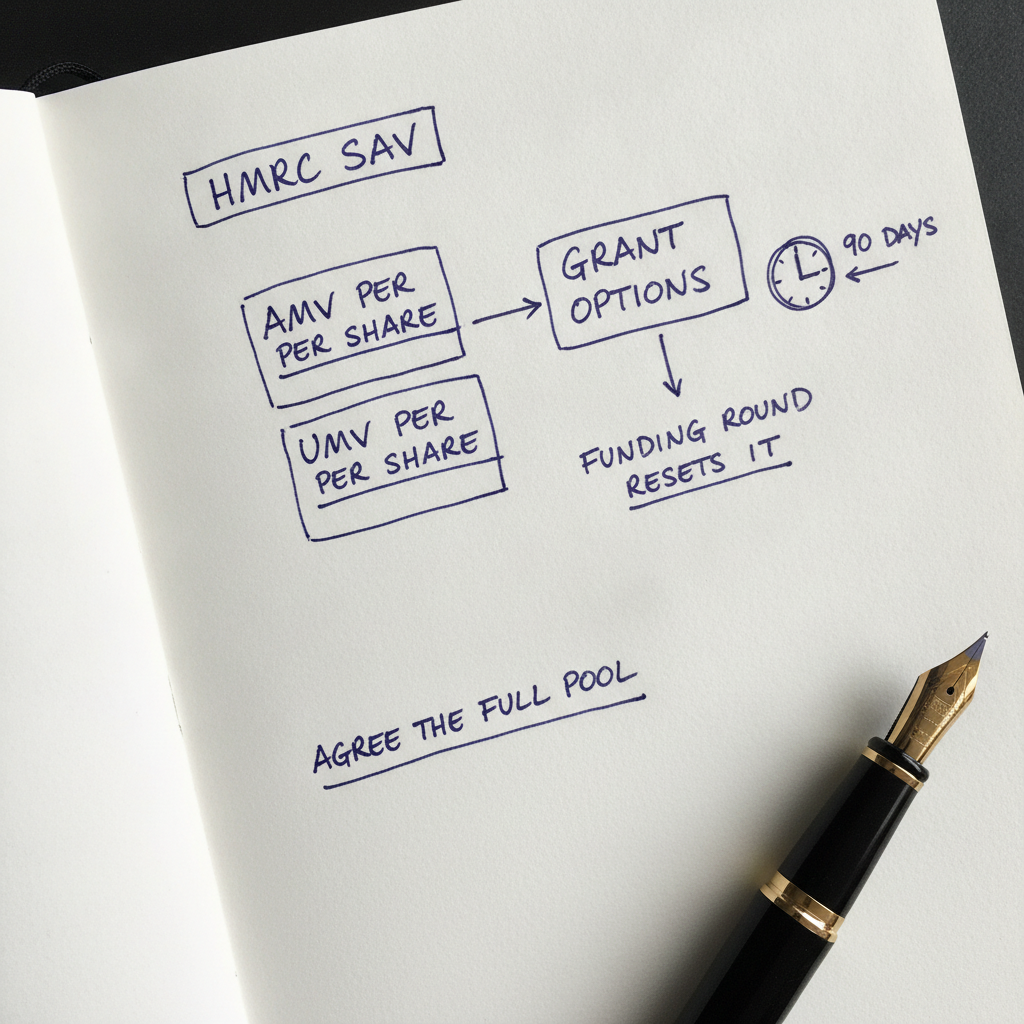
EMI options are governed by Schedule 5 ITEPA 2003. The tax advantage depends on the option being granted at an exercise price not below the Actual Market Value (AMV) at the date of grant, with the unrestricted equivalent (UMV) used to test the £250,000 individual limit and the £6 million scheme limit (the company-wide limit was increased from £3 million by Finance Act 2025-26 with effect from 6 April 2026).
The submission goes to HMRC's Shares and Assets Valuation team (formerly via VAL231, now through HMRC's online valuation service). SAV reviews two values:
- Actual Market Value (AMV). The value of the actual share being granted, taking into account restrictions (transfer restrictions, pre-emption, vesting).
- Unrestricted Market Value (UMV). The value of the same share with restrictions stripped out.
The starting point is HMRC's own internal manual, SVM110050. Anything you submit will be measured against the six worked examples there. If the proposed AMV is not consistent with any of them, expect challenge.
Why EMI share valuations get challenged
Most challenges come down to a small number of recurring issues.
The recent funding round price. A recent arm's length investment round is the strongest indicator of value. If investors paid £10 a share six weeks ago, that is the AMV starting point unless ordinary shares are economically different. Discounts are typically applied to reflect minority interest, lack of marketability etc.
Discount levels that are not justified. Practitioner guidance varies wildly. SAV pushes back hard on the upper end unless the discount is supported by structural facts: a liquidation preference, a sub-5% holding, a real cash burn argument.
Restrictions claimed but not present in the Articles. Many submissions list "transfer restrictions" and "lack of marketability" as generic line items. SAV will read the Articles. If the restrictions are not in the document, the discount comes off.
Forecasts that have not been stress-tested. If the cover letter relies on a DCF showing the company loss-making for three years, but the management deck two months earlier showed break-even in twelve, that inconsistency will be picked up.
The structure of a valuation HMRC will accept
A clean EMI share valuation submission has four pieces.
1. The anchor. State the basis of value: Price of Recent Investment, Net Assets, or earnings-based. For pre-revenue and loss-making companies, earnings-based methods should be ruled out. For companies with a recent round, the round price is the anchor. For bootstrapped companies, Net Assets is usually the floor.
2. The methodology. For pari passu structures, apply DLOM and minority discounts to the round price to derive AMV, then uplift (by typically 10%) to UMV.
3. The discount stack. Show DLOM (typically 20-25%, HMRC's accepted range to 35%) and minority discount (typically 10%) as separate line items. If you go above this, justify each step against the facts.
4. The reconciliation to SVM110050. Reference the example that most closely matches. Example 1 covers preferred/ordinary start-ups with "at least 30%" discount. Example 6 (Rosalind Ltd) covers loss-making development companies with LP structures and explicitly endorses OPM. Anchoring to a published example tells SAV you are operating within their own framework.
Most EMI share valuation challenges fail at the methodology stage, not the arithmetic. Submissions that anchor explicitly to SVM110050, structure the AMV-to-UMV uplift in HMRC's own preferred direction, and use the OPM for multi-class structures get agreed faster and at better numbers.
When the recent funding round complicates things
A round closing within three months of the EMI grant is a different problem from a round twelve months ago.
Recent rounds (under three months). SAV will anchor hard. For preferred/ordinary structures, use the OPM and let the LP waterfall produce a low ordinary value naturally.
Older rounds with cash burn. If the last investment was nine months ago at £10 a share but the company has spent 70% of that cash with no revenue increase, the round price is no longer current. Frame it as: "the asset base has depleted and the round price no longer reflects current value." SAV accepts this where the facts support it.
Pre-revenue biotech and food-tech. SVM110050 Example 6 was written for this case. Loss-making companies with professional investors holding shares ahead of ordinary shares on liquidation can run "potentially significant" discounts with no floor specified. This is the strongest case for OPM. We see it regularly in life sciences and biotech companies navigating R&D tax credits alongside EMI grants.
Active sale process. SVM110050 Example 5 covers sale talks. Discounts of 20-40% from expected proceeds are accepted to reflect execution risk.
How long the agreement lasts and what to watch for
The 90-day rule is the one most often forgotten. Once SAV agrees the AMV in writing, the company has 90 days from the date of agreement to grant the options at that price, subject to nothing material changing.
What counts as material? A new funding round, a significant change in trading position, the loss of a major customer, a corporate transaction. Any of these invalidates the agreement and a fresh submission is needed. We have seen schemes derailed because a board signed a term sheet 88 days into the 90-day window and the option deeds had not yet been signed.
Following grant, EMI notification timing changed under FA 2024 s 13. For grants made on or after 6 April 2024, notification is due by 6 July following the end of the tax year of grant (Sch 5 ITEPA 2003 para 44 as amended). The previous 92-day rule no longer applies. Build both windows into the engagement timeline.
What happens if HMRC disagrees
SAV will set out the points of disagreement. The standard response process runs through three stages.
Stage one: clarify, do not concede. If the objection is "the discount is too high", ask which specific parameter SAV considers excessive (DLOM, minority, LP weighting, sigma, time to exit). Do not retreat from the methodology. Concede on parameters within a pre-built concession table.
Stage two: deploy supporting analysis. Case law belongs here, in response, not in the original submission. Clark v Green [1995] SpC 5 (3.16% holding, 70% discount) sits at the outer boundary of decided cases at SVM113130. Frame it analytically: the combined discount is within the range established in decided cases, and the LP structure is materially worse than Clark v Green which had no LP.
Stage three: agree UMV only if necessary. SVM110050 confirms "both values do not need to be agreed provided the price agreed represents at least UMV". If the AMV negotiation is going nowhere, agreeing UMV alone is permissible. The exercise price is then set at UMV, removing the income tax advantage of the lower AMV but preserving the rest of the scheme. This is a fallback, not a first option.
Frequently asked questions
What is the difference between AMV and UMV for EMI options?
AMV (Actual Market Value) is the value of the actual share, taking restrictions into account. UMV (Unrestricted Market Value) is the same share with restrictions stripped out. AMV sets the minimum exercise price. UMV is used for the £250,000 individual limit and £6 million company-wide scheme limit (raised from £3 million for grants on or after 6 April 2026 under Finance Act 2025-26). HMRC's preferred formula is UMV = AMV × 1.10 for start-up cases.
How long does HMRC take to agree an EMI share valuation?
For straightforward pari passu submissions, allow 2-4 weeks for initial response. For complex structures using OPM or for large aggregate values, allow 4-8 weeks and expect at least one round of follow-up queries.
What discount can I apply to my EMI share valuation?
Example 1 supports "at least 30%" discount and OPM analysis often justifies 60-75% combined discount. For loss-making development companies (SVM110050 Example 6) "potentially significant" discounts are endorsed with no specific floor.
Does HMRC accept AMV at face value or always negotiate?
SAV reviews every submission on its merits. Smaller grants attract less scrutiny. Larger schemes are negotiated harder. Submissions that anchor to SVM110050 examples and use HMRC's own UMV formula are agreed more often without challenge.
What happens if I grant EMI options without agreeing the valuation with HMRC?
HMRC agreement is not a legal precondition, but it is the only way to fix AMV and UMV with certainty before grant. If you grant without agreement and HMRC later disagrees, the income tax exposure on any shortfall falls on the option holder. The cost of getting this wrong is borne by the employees the scheme was designed to motivate.
How long is an HMRC EMI share valuation agreement valid for?
90 days from the date of agreement, subject to no material change in the company's circumstances. A new funding round, a significant change in trading position or any corporate transaction will invalidate the agreement and a fresh submission is required.
Do I need to use the Option Pricing Model for EMI valuations?
For pari passu structures the OPM is not necessary; a percentage discount approach to AMV is acceptable.
Where this leaves you
If you are about to grant EMI options and the company has a multi-class capital structure, a recent funding round at a price the founders consider too high, or a complex set of restrictions, the EMI share valuation submission is not the place to economise. The cost of getting agreement first time is a fraction of the cost of fixing a contested submission, and a fraction again of an option deed signed against an invalid valuation.
We act for companies on EMI share valuations across SaaS, biotech, food-tech and manufacturing, and represent companies in SAV correspondence where valuations have been challenged. To discuss your scheme, please contact Steve Livingston FCA at IP Tax Solutions.
This is a highly complex area and should not be acted on without professional advice specific to your circumstances.