Value Shifting and Family Share Carve-Outs: The CGT Charge With No Sale
Value shifting under s.29 TCGA 1992 can trigger a CGT charge when family share rights change, even with no sale. See how to carve out value safely.

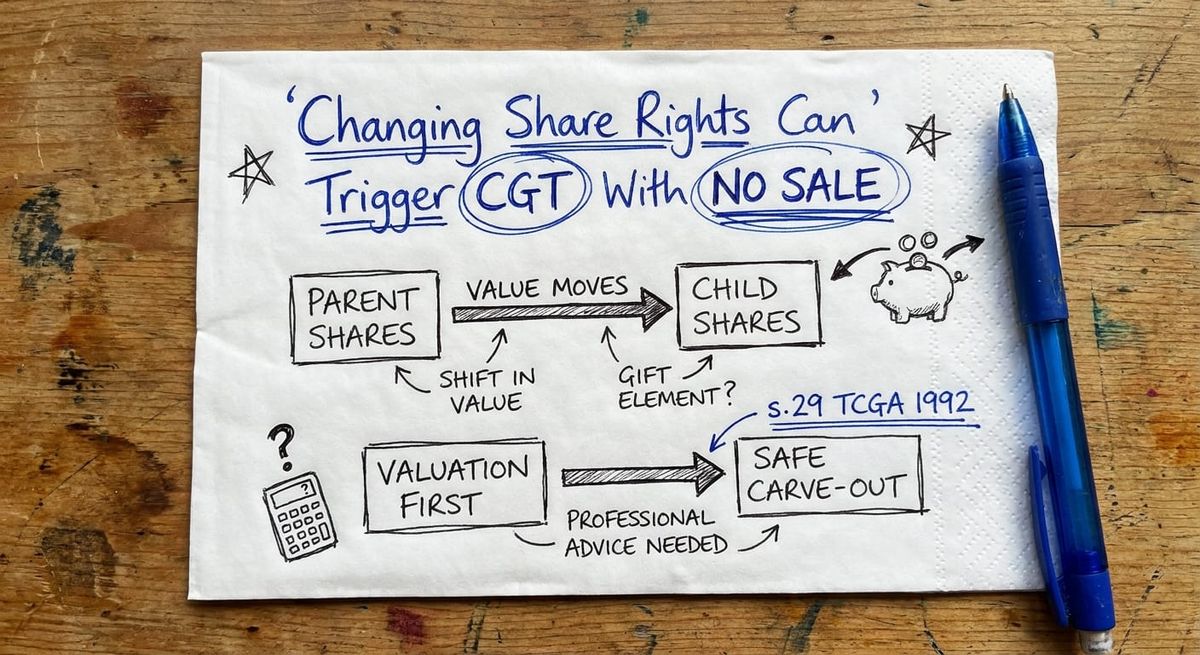
Value shifting is the movement of value out of one person's shares into another person's shares without a disposal in the ordinary sense. Under s.29 TCGA 1992, if you control a company and exercise that control so value passes out of your shares into other shares, HMRC can treat you as having made a disposal of the value given up. A CGT charge can arise with no cash and no share transfer.
This is the trap that catches families restructuring their cap table. A father creates a new class for his daughter. Rights on the existing shares are varied. A dividend waiver runs for years. Each of these can shift value between shareholders, and where the person making the change controls the company, s.29 TCGA 1992 can deem a disposal. The charge is rarely intended and is easily missed at the planning stage. This article explains how value shifting works on a family share carve-out, when s.29 bites, how the valuation is evidenced, and where the planning needs specialist input before anything is signed.
Table of Contents
- What is value shifting under s.29 TCGA 1992?
- How does a family share carve-out trigger value shifting?
- When does HMRC treat a rights change as a disposal?
- How do you evidence the valuation on a carve-out?
- How do you structure a family carve-out to manage value shifting?
- Frequently asked questions
- Getting the carve-out right before you sign
What is value shifting under s.29 TCGA 1992?
Value shifting under s.29 TCGA 1992 is a deemed disposal rule. It applies where a person who controls a company exercises that control so that value passes out of shares owned by one person and into shares owned by another. The shareholder who loses value is treated as making a disposal, and HMRC measures the amount of value transferred under its value shifting guidance (CG58855), applying the market value rule in s.17 TCGA 1992.
The point most founders miss is that there is no sale, no transfer and no document of disposal. The trigger is the shift in value itself. Family shareholders are normally connected persons but s.29 is directed at the exercise of control, so the absence of a formal connection does not of itself keep a shift outside the rule (HMRC guidance at CG58853 deals with control of a company).
So a parent can reduce the value of their own holding, intending to benefit a child, and create a CGT charge on themselves in the same act. The lost value is what the charge is measured on.
How does a family share carve-out trigger value shifting?
A carve-out is any arrangement that hives off a slice of future value, or a defined economic right, into a separate share class. In family companies the common forms are growth shares with a hurdle, freezer shares that cap the senior generation, alphabet shares carrying tailored dividend rights and/or varied voting or capital rights on a class reorganisation.
Each of these can move value. If a controlling parent agrees to vary the rights on the existing ordinary shares so the new class held by a child captures future growth, value has passed from the parent's shares to the child's shares. Where the parent controls the company and procures that variation, s.29 TCGA 1992 can deem the parent to have made a disposal of the value given up.
Dividend waivers are the quieter version of the same problem. A long-running waiver that channels income to one family member, with no commercial reason and insufficient distributable reserves to pay everyone, can raise both a settlements question for income tax and a value shifting question for CGT. The carve-out and the settlements code often sit on the same set of facts, which is why these arrangements need to be looked at as a whole. The interaction with the settlements code on family dividend structures is a recurring theme in this kind of planning.
Key takeaway: A family share carve-out is not a neutral act. If you control the company and the reorganisation moves value from your shares to a relative's shares, s.29 TCGA 1992 can deem you to have disposed of that value, with a CGT bill and no cash to pay it.
When does HMRC treat a rights change as a disposal?
The question HMRC asks is straightforward.
Did value leave one shareholder's shares and arrive in another's, and was that brought about by the exercise of control?
A rights change is most exposed where three features line up. The shareholders are connected, as family members normally are. The person bringing about the change controls the company. The change has a real economic effect, not merely a cosmetic relabelling of a class. A reorganisation that genuinely alters who is entitled to future growth or to capital on a winding up is the kind of change HMRC will test.
There are limits: where new shares are issued for full value, or where the carve-out is structured so the new class has no current value because it sits genuinely out of the money behind a properly set hurdle, there may be little or no value to shift on day one. The analysis turns on the facts and on the valuation. The same scrutiny of valuation evidence arises in any HMRC enquiry, which is the kind of HMRC enquiry defence work I do, and it is the taxpayer's file that has to show the value did not move.
A carve-out done in tranches should be assessed as a whole rather than step by step, because HMRC will look at what the arrangement achieved overall.
How do you evidence the valuation on a carve-out?
Valuation is where these arrangements are won or lost. The measure is open market value, meaning the price a hypothetical willing buyer would pay a hypothetical willing seller, on the hypothetical willing buyer and willing seller basis. For a private trading company HMRC's Shares and Assets Valuation team will usually build the figure from maintainable earnings, taking a weighted average of recent results and applying a multiple.
Three evidential pillars carry the position.
- a contemporaneous professional valuation prepared before the reorganisation, not reconstructed afterwards.
- a clear articulation of the rights being created or varied, so the valuer is pricing the actual economic entitlement and not a generic share.
- supporting financial evidence, including the accounts and any factors suppressing value such as a loss-making year, so the maintainable earnings figure is defensible.
Where the carve-out uses a hurdle, the hurdle must be set with care. A hurdle pitched at a small premium above current market value supports the argument that the new growth shares are out of the money and carry little or no value to shift. Set it too low and value moves on day one.
Minority discounts matter too. A holding that confers no control over dividends or strategy is worth materially less per share than a pro-rata slice of the whole, so a defensible discount reduces the value treated as shifted.
How do you structure a family carve-out to manage value shifting?
The strongest position is to remove the shift rather than to argue about its size. That usually means issuing a new class that genuinely has little or no current value, set behind a properly evidenced hurdle, so that future growth accrues to the next generation from the outset without value leaving the senior shares today.
Five points carry most of the weight in practice.
- Create the new class by a fresh issue for value where possible, rather than by stripping rights off existing shares.
- Set and evidence the hurdle before the shares are issued.
- Commission a contemporaneous valuation that prices the real rights.
- Keep the family-relationship motive clear and documented, which also helps on the employment-related securities side where a working relative is involved.
- Where the recipient is or may be an employee or director, consider a protective s.431 ITEPA 2003 election within fourteen days of acquisition, signed jointly by the company and the recipient and kept in the company's own files.
The reliefs do not cancel value shifting, but they shape the outcome. A gift of existing shares can carry s.165 TCGA 1992 holdover relief, deferring the gain into the recipient's base cost. A carve-out that shifts value, by contrast, is not always a transfer of a chargeable asset that qualifies for holdover, so the interaction has to be mapped before anything is implemented.
Frequently asked questions
What is value shifting in UK tax?
Value shifting is the movement of value out of one person's asset into another person's asset without an ordinary disposal. For shares, s.29 TCGA 1992 can deem the person who loses value to have made a disposal of the value given up, creating a CGT charge even though no shares were sold and no cash changed hands.
Does creating a new share class for a family member trigger CGT?
It can. If you control the company and the new class captures value that previously belonged to your shares, s.29 TCGA 1992 may treat you as disposing of that value. Whether a charge arises depends on whether value actually moved, which is a valuation question decided on the facts.
How does HMRC value a family company for a share carve-out?
HMRC's Shares and Assets Valuation team usually values a private trading company on maintainable earnings, taking a weighted average of recent profits and applying a sector multiple, then adjusting for the specific rights and for any minority discount. Open market value, on the hypothetical willing buyer and willing seller basis, is the standard.
Can you avoid value shifting with growth shares?
Growth shares can manage the risk where the hurdle is set above current value so the new class is out of the money and carries little or no value to shift on day one. The hurdle must be evidenced by a contemporaneous valuation. Set the hurdle too low and value shifts immediately, which defeats the purpose.
Is a dividend waiver caught by value shifting rules?
A dividend waiver can raise both a value shifting question for CGT and a settlements question for income tax, particularly where it runs for a long period, lacks a commercial reason, or the company has insufficient reserves to pay the waived dividend to all shareholders. Waivers in family companies need to be reviewed on both fronts before they are put in place.
Does s.165 holdover relief solve a value shifting charge?
Not directly. Holdover under s.165 TCGA 1992 defers a gain on a gift of qualifying shares into the recipient's base cost. A carve-out that shifts value is not always a transfer of a chargeable asset eligible for holdover, so the two have to be analysed together rather than assumed to cancel out.
Getting the carve-out right before you sign
Value shifting is the rare CGT charge that arises from doing nothing more than changing the rights on your own company. The cure is not complicated, but it has to be in place before the reorganisation, not after HMRC raises an enquiry. A contemporaneous valuation, a properly set hurdle, a clear family motive on the file, and a protective election where employment is in the frame are the foundations of a defensible position.
If you are planning a family share carve-out, a freezer or growth share reorganisation, or you have inherited a long-running dividend waiver you are unsure about, the time to look at the value shifting position is before anything is signed. I work both directly with founders and alongside accountants and solicitors on structuring. You can get in touch to discuss a family share carve-out.
This article is general guidance, not advice for your specific circumstances. Value shifting and family share planning turn on the detailed facts and the valuation. Take advice before acting.