Subscriber Shares on Incorporation: Why the ERS Annual Return Exemption Saves Founders (Mostly)
Subscriber shares allotted on incorporation fall within HMRC's ERS annual return exemption (ERSM20210). Find out what it covers and when it ends.

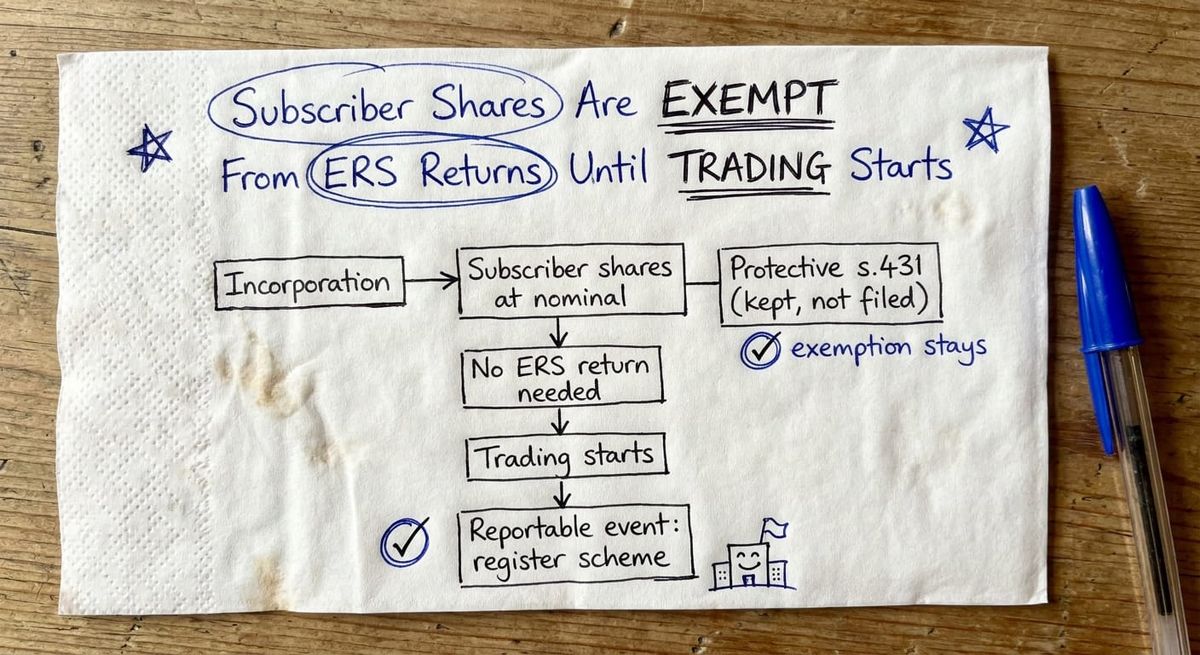
Two founders incorporate a company. Each takes 50 ordinary shares at £1 nominal. They sign a protective s.431 election within fourteen days, file it in the statutory book, and get on with building the business. Six months later their accountant runs the annual compliance checklist and asks: "Have you registered an ERS scheme and filed your annual return?"
The answer is no. Subscriber shares allotted on incorporation sit within a published HMRC exemption from the ERS annual return, and the protective s.431 election does not void that exemption. Registering an ERS scheme on the strength of an incorporation and a protective election creates a compliance obligation that the founders did not need, and an annual return that will follow the company until someone notices it should never have been registered.
This article sets out what the published exemption covers, why the s.431 election leaves it intact, where the exemption stops, and the events that do trigger ERS scheme registration. Get this right and the founder share issue is a one-page job.
What HMRC means by subscriber shares on incorporation
The phrase has a specific meaning in HMRC's ERS reporting guidance. It covers shares allotted to the first members of a newly incorporated company, where those members are directors (or prospective directors) and subscribe at nominal value. In Companies House terms these are the shares listed on the incorporation application.
HMRC's list of events that do not need to be reported on the annual return (ERSM140040) is short. For a newly incorporated company it covers the allocation of initial subscriber shares on incorporation, the allotment of further shares before the company commences trading, and shares acquired directly from the agent forming the company. The categories are narrow and fact-specific, but for the standard two-founder limited company the first is the paradigm case.
The exemption is published HMRC guidance. It is not in statute. That matters, because the exemption can be lost on facts that would not be obvious from the legislation alone.
The default position: s.421B(3) catches almost every founder share
The reason the exemption matters at all is that the underlying legislation, ITEPA 2003 s.421B(3), starts from a deeming rule that catches nearly every founder share. Securities are treated as acquired by reason of employment where the right or opportunity to acquire them was made available by the employer (or a person connected with the employer). In Vermilion Holdings [2023] UKSC 37 the Supreme Court treated that deeming rule as a bright-line test, applied first and without a causation enquiry.
The two founders in the opening example are appointed directors on incorporation. They subscribe for shares as part of the incorporation process. The deeming rule applies. Their shares are employment-related securities (ERS) within Part 7 of ITEPA 2003 by default, with the tax and reporting consequences that follow. ERSM20210 is HMRC's manual page setting out the "by reason of employment" principle and that starting position.
Without a published exemption or a successful technical argument, every founder share issue would be reportable on the annual return and would require ERS scheme registration with HMRC. The exemption avoids that outcome for the standard incorporation, which is why understanding its scope matters.
The published exemption: what it covers
HMRC's published list (ERSM140040) carves two classes of acquisition out of the annual return. Read together they cover the common founder fact pattern:
The first is the initial subscriber shares allotted on incorporation, including shares acquired directly from the agent forming the company, which deals with the shelf-company route where the agent holds the shares and transfers them to the founders.
The second is further shares allotted in the newly incorporated company before it commences trading. This catches the scenario of an additional founder joining in the weeks or months between incorporation and the first sale.
Both carve-outs have conditions:
- The shares must be acquired at nominal value, and
- the recipient must be a director or prospective director (or a person acquiring the subscriber shares from one), and
- the shares must not be acquired by reason of another employment.
An allotment above nominal value, or to someone who does not fit that description, falls outside the exemption.
The cut-off is the commencement of trading, not the arrival of funding. HMRC's own worked example (ERSM140040, Example 3) treats a further allotment to two directors made shortly after the company began trading as reportable on the "Other" return, even though the company had not raised priced capital. There is no de minimis: a handful of shares is as reportable as a large issue. Reportable is also not the same as taxable. A post-trading allotment at full market value can be reportable with no tax due.
The protective s.431 election does not void the exemption
There is a common anxiety that signing a s.431 election somehow elevates a quiet incorporation into a reportable scheme. It does not.
The election under s.431(1) ITEPA 2003 is a joint election by employer and employee (or director) to be taxed on the unrestricted market value of the shares at acquisition, ignoring any s.423 restrictions. For a nominal-value subscriber issue in a company with no assets, no IP and no investors, the unrestricted market value can defensibly be taken as the nominal value paid, so the election crystallises a nil income tax charge. The benefit is that future growth is locked into the capital gains tax regime rather than being exposed to income tax on a later chargeable event.
The election does not have to be filed with HMRC. It is signed jointly by the company and the founder within 14 days of acquisition, dated, and kept in the statutory book. It is produced on enquiry or in due diligence. There is no separate ERS reporting event for the election itself: it is an attribute of the underlying share acquisition, and where that acquisition is within the published exemption, there is no reportable event for the election to attach to. Registering an ERS scheme to "report the election" is an unnecessary step that pulls the founder into the annual return cycle.
The election is a defensive document. It does not, by itself, create a reporting obligation.
Key takeaway: Subscriber shares on incorporation are inside HMRC's published ERS reporting exemption. A protective s.431 election keeps the capital gains tax treatment of the upside and does not void that exemption. The two pieces of paper sit together in the statutory book until a genuinely reportable event happens.
When does ERS scheme registration actually start?
The right question is not "does the s.431 election trigger registration" but "what is the first genuinely reportable event after incorporation". The common triggers are:
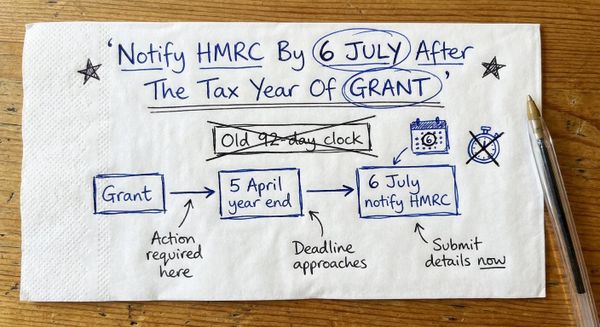
- The first EMI grant: The company registers the EMI scheme on HMRC's online service and notifies the grant by 6 July following the end of the tax year of grant (FA 2024 s.13, for grants on or after 6 April 2024). The annual ERS return is then due each year by 6 July.
- The first unapproved option grant. This registers an "Other" ERS scheme. An annual return, including a nil return, is due each 6 July while the scheme remains open, until it is formally closed.
- A share issue to a director or employee after the company has commenced trading, or above nominal value. A further allotment at nominal value to a director after trading has started is reportable on the "Other" return, even if no tax is due. Once a priced round has set a market value above nominal, the same allotment can also create an income tax charge on the difference. The s.431 election from incorporation does not cover that later acquisition.
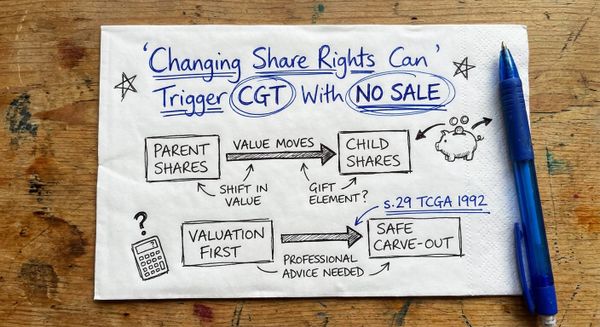
A Chapter 2 chargeable event on restricted securities, such as the lifting or variation of a restriction. Corporate events such as a buy-back, restructure or alphabet share rearrangement can bring this into play, and each needs its own analysis.
None of these is triggered by an incorporation and a protective election. Each is a separate event that warrants ERS scheme registration on its own merits.
Six traps that turn an exempt incorporation into a reportable scheme
- Trap one is the assumption that the Model Articles mean "unrestricted". Article 26(5) gives the board discretion to refuse to register a transfer, and that is treated as a s.423 restriction. The "no restrictions" argument therefore fails from the start, which is why the protective s.431 election is the prudent default even where the rest of the deal documents are silent.
- Trap two is relying on the "not ERS at all" argument as the primary position. The argument has merit and is covered below, but HMRC has applied the bright-line deeming firmly since Vermilion. The published reporting exemption is the front-line position. This a fall-back, and it does not help with a post-trading top-up, which is squarely reportable.
- Trap three is registering an ERS scheme on the strength of the protective election alone. The election is not a reportable event and the exemption is not voided. Registering anyway creates a recurring annual return obligation and gives HMRC a permanent record of a scheme that need not have existed.
- Trap four is issuing further founder shares at nominal value after the company has started trading, and particularly after a priced round. The exemption is lost on commencement of trading. Once an SEIS or EIS round has established a market value materially above nominal, a fresh subscription at nominal by a director or employee also creates an income tax charge on the difference (and NIC where the shares are readily convertible assets). Each fresh acquisition needs its own s.431 election within its own 14-day window and is separately reportable.
- Trap five is conflating SEIS or EIS investor shares with ERS. Shares held by a genuinely external investor are not ERS, because there is no employment or office connection, and an SEIS or EIS round does not by itself trigger ERS scheme registration. The position reverses for a director or employee who subscribes in the round. The opportunity is made available by the company, so s.421B(3) can deem it employment-related even where the director pays the same price as the outside investors. A protective s.431 election within 14 days is the prudent course where the shares are restricted, and the acquisition is reportable. The leaver provisions and option grants that investors require alongside a round are what typically trigger registration for the wider team.
- Trap six is assuming the s.431 election needs filing with HMRC. It does not. The election lives in the statutory book and is produced on enquiry or in due diligence. Treating it as a filing obligation drives some firms towards registering an ERS scheme to "report" it, which is the trap this article is trying to close.
If you would like a second view on any of these scenarios, our SEIS and EIS advisory team deals with the founder-side equity sequencing in priced-round structures, and we work with accountants advising founders through our professional referral channel.
Frequently asked questions
Do I need to file an ERS annual return for founder subscriber shares?
No, not for the initial subscriber share allotment on incorporation. HMRC's published list of events that do not need to be reported (ERSM140040) covers the allocation of initial subscriber shares on a newly incorporated company. The shares must be acquired at nominal value by a director or prospective director, and not by reason of another employment. The exemption is not in statute, but it is published HMRC guidance.
Does signing a protective s.431 election trigger ERS scheme registration?
No. The s.431 election is an attribute of the underlying share acquisition. It is signed jointly by founder and company, kept in the statutory book, and produced on request. There is no contemporaneous filing requirement and no separate ERS reporting event for the election. Where the underlying acquisition is within the published reporting exemption, there is no reportable event for the election to attach to. Registering an ERS scheme purely because a protective election has been signed is an unnecessary step.
When do I actually need to register an ERS scheme?
On the first genuinely reportable event after incorporation. The common triggers are the first EMI grant (which registers the EMI scheme, with notification by 6 July following the tax year of grant under FA 2024 s.13), the first unapproved option grant, a share issue to a director or employee once the company has commenced trading or at above nominal value, or a Chapter 2 chargeable event such as the lifting of a restriction. None of these is triggered by incorporation and a protective election alone.
What is ERSM20210?
ERSM20210 is the page in HMRC's Employment Related Securities Manual that sets out the "by reason of employment" principle and the s.421B(3) deeming rule. It is the starting point for the default position that founder-director share acquisitions are within the ERS net. The published list of events that do not need to be reported (ERSM140040) is separate guidance that sits alongside it and takes the standard incorporation fact pattern out of annual return reporting.
Are SEIS or EIS investor shares ERS?
Not where the investor is genuinely external. ERS requires an employment or office connection, and an external investor has none. An SEIS or EIS round does not by itself trigger ERS scheme registration. The position is different for a director or employee who subscribes in the round, because s.421B(3) can deem the opportunity employment-related and the acquisition is reportable. Leaver provisions and option grants that investors require alongside the round are what typically trigger registration for the wider team.
What if I issue more founder shares before the company starts trading?
A further allotment before the company commences trading can still be within the published exemption, provided it is at nominal value, to a director or prospective director, and not by reason of another employment. The cut-off is the commencement of trading, not the arrival of funding. Once trading has started, a further nominal-value allotment to a director or employee is reportable even if no tax is due. An allotment above nominal value is outside the exemption.
What if I missed the 14-day s.431 election window?
The 14-day deadline is fixed and HMRC has no discretion to extend it, so a late election is not valid. The published reporting exemption is about whether the issue needs reporting. It does not cure a missing election. The fall-back is to rely on the unrestricted market value analysis at acquisition, and to make sure every later acquisition (option exercise, post-funding subscription, restricted share grant) carries its own valid s.431 election. If a later exit reclassifies part of the proceeds as employment income, the absence of the election will be a material factor, and specialist advice is worth taking early.
This is an overview article for information only. ERS and S.431 elections are a complex area so seek professional advice specific to your circumstances.