Budget 2026 for Founders: BADR Halves to £500,000, Founders' Relief Is Proposed, and What to Do Before 6 April 2027
Budget 2026 cuts the BADR lifetime limit to £500,000 from 6 April 2027 and proposes a 10% Founders' Relief. What is announced, what is law, and what to do first.

Written 3 November 2026. Everything below is announced policy or draft legislation. Nothing in it is law until the Finance Bill receives Royal Assent.
Founders are asking two questions this week. Should a sale be brought forward, and will the new relief help? This guide separates what the Government has announced from what has been enacted, and sets out the decisions that are worth making now.
In this guide
- What did Budget 2026 change for founders?
- How much does the BADR cut cost a founder?
- Should you bring a sale forward to beat 6 April 2027?
- What is Founders' Relief and who can qualify?
- Will your company meet the Founders' Relief company tests?
- Why does the Founders' Relief R&D test put your R&D claim at risk?
- How do Founders' Relief and BADR fit together?
- What happens to the 25% test if you have been diluted?
- What changes for EMI and share options from April 2027?
- What changed for SEIS and EIS?
- What should founders do now?
- Frequently asked questions
- Where to go from here
What did Budget 2026 change for founders?
Budget 2026 cut one relief, proposed one new relief and loosened the employee share scheme rules.
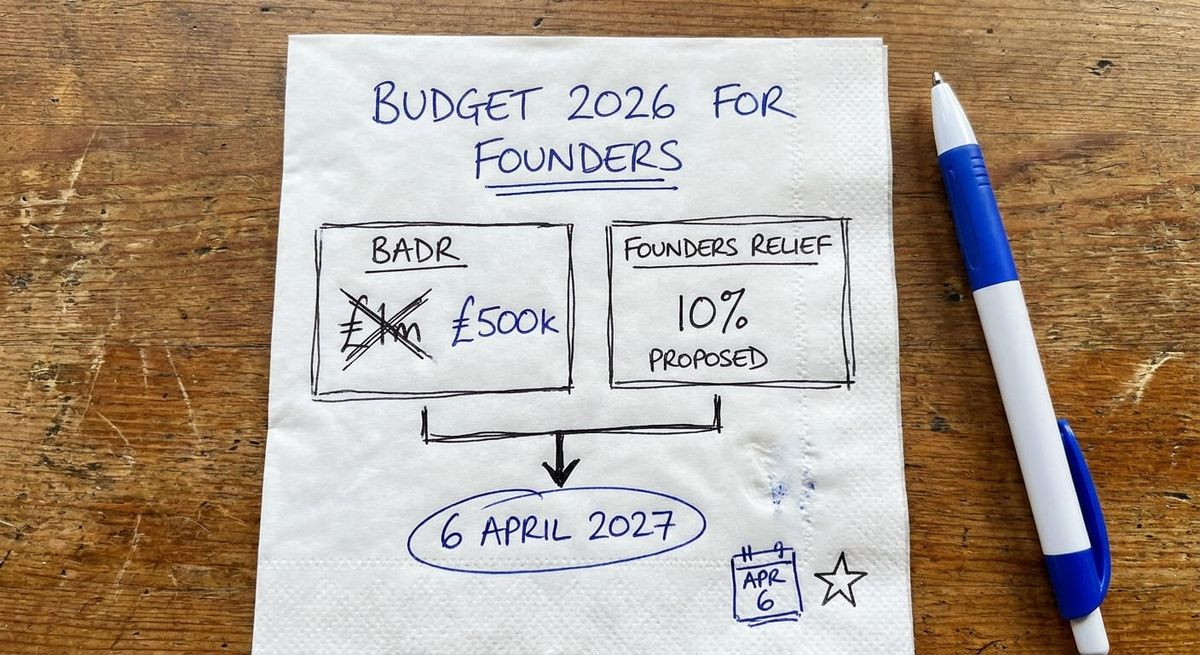
- The BADR lifetime limit halves from £1,000,000 to £500,000.
- A new 10% CGT Founders' Relief is proposed, up to £10 million of lifetime gains.
- Employee share schemes get more generous, and
- The EMI notification step is removed.
| Measure | Status at 4 November 2026 | Start date |
|---|---|---|
| BADR lifetime limit £1,000,000 to £500,000 (rate stays 18%) | Announced, legislation in Finance Bill 2026-27 | Disposals on or after 6 April 2027 |
| Founders' Relief, 10% on gains up to £10 million | Announced, technical consultation open until 30 November 2026 | Disposals on or after 6 April 2027 |
| EMI2 (CSOP) individual limit £60,000 to £120,000 | Announced, legislation in Finance Bill 2026-27 | Options granted on or after 6 April 2027 |
| EMI exercise window after a disqualifying event 90 to 180 days | Announced, legislation in Finance Bill 2026-27 | Disqualifying events on or after 6 April 2027 |
| EMI grant notification removed, grants reported in the annual return | Announced, draft legislation published 13 July 2026 | Options granted on or after 6 April 2027 |
| R&D Claim Notification Form removed | Announced | Claims made on or after 1 April 2027 |
The main CGT rates of 18% and 24% were not changed. The BADR rate stays at 18% (Budget 2026 overview of tax legislation and rates).
How much does the BADR cut cost a founder?
The cut costs a higher rate taxpayer up to £30,000 per person. The full £30,000 arises only where lifetime BADR gains reach £1,000,000, and nothing arises where they stay at or below £500,000, on a disposal on or after 6 April 2027. BADR is taxed at 18% against 24% for higher rate taxpayers on the main rate, a gap of six points. Six points on the £500,000 of lost limit is £30,000.
Take a founder with a £1,000,000 gain that qualifies for BADR, ignoring the annual exempt amount and assuming a higher rate taxpayer:
| Disposal date | Gain taxed at 18% | Gain taxed at 24% | CGT |
|---|---|---|---|
| Before 6 April 2027 | £1,000,000 | nil | £180,000 |
| On or after 6 April 2027 | £500,000 | £500,000 | £210,000 |
The Government's own rationale is that three-quarters of BADR claimants will still receive relief on their whole gain, so the change is aimed at larger exits. If your lifetime gains are well under £500,000, the cut does not touch you.
Should you bring a sale forward to beat 6 April 2027?
Only if the commercial case already supports it. Do not let a tax date drive the timing of a sale. The tax saving from beating the cut is capped at approx £30,000 per founder, and that is before the cost of a rushed deal. A buyer who senses a deadline will use it...
If a sale is already likely in the next 12 months, three points are worth settling now:
- Disposal date. The new limit applies to qualifying disposals made on or after 6 April 2027. The official overview says special provisions apply to contracts entered into before that date but not completed, and to certain share reorganisations and exchanges of securities not completed by then. The wording of those provisions is not yet published. Do not assume an exchanged but uncompleted deal is safe or unsafe until it is.
- BADR conditions. The limit only matters if you qualify. Check the 5% holding, the officer or employee status and the two-year periods, particularly if growth shares or new share classes have diluted you.
- Staged payments. Earn-outs and deferred consideration need their treatment checked against the limit, because the sources do not yet cover how they interact with the new date.
What is Founders' Relief and who can qualify?
Founders' Relief is a proposed 10% rate of CGT on qualifying share disposals from 6 April 2027, up to a lifetime limit of £10 million of gains per individual. It is aimed at founders, and significant early investors, of companies that have scaled.
The tests are demanding and look back over several years. The Government estimates only approx 600 individuals a year will be eligible!
- The individual must have held 25% of the ordinary share capital (with matching voting rights and rights to profits and assets on a winding up) at the point the trade, or preparation for the trade, commenced.
- They must have held the shares for at least five years and been UK resident under the Statutory Residence Test for at least five continuous tax years before disposal. Only individuals can claim.
- The company must be in scope of UK corporation tax with a substantial UK presence for the five accounting periods before disposal.
- It must be a trading company or the holding company of a trading group, and it must not carry on the excluded activities that apply to the Enterprise Investment Scheme, such as dealing in land, financial services and property development.
All of this comes from the Treasury's policy paper and technical consultation. The design may change after the consultation closes on 30 November 2026.
But the above is just the start, there are more criteria to meet (see below).
Will your company meet the Founders' Relief company tests?
The majority of owner-managed companies will not meet the criteria today, because the thresholds are high.
The company needs turnover of at least £10 million and at least 15 qualifying full-time equivalent employees in the accounting period ending in the year before disposal. It must also pass two of three growth and innovation tests.
The three tests are:
- Turnover growth. At least 25% annual average compound growth across three consecutive accounting periods within the ten years before disposal, with turnover of at least £10 million in the period before the first of the three.
- Headcount growth. At least 25% annual average compound growth in qualifying full-time equivalent employees across three consecutive periods within the ten years before disposal, with at least 15 in the period before the first of the three.
- Innovation. At least £1.5 million of qualifying R&D expenditure for which all the conditions for an R&D tax relief claim were met, with R&D relief claimed on it for an accounting period or periods ending within the three years before disposal.
A qualifying full-time equivalent employee works at least 35 hours a week and is paid at least the National Minimum Wage. The consultation says directors, contract workers and agency workers are excluded. A small founder-led team can therefore sit below 15 even when everyone works full time. The sources do not say whether the headcount growth test uses the same definition.
Why does the Founders' Relief R&D test put your R&D claim at risk?
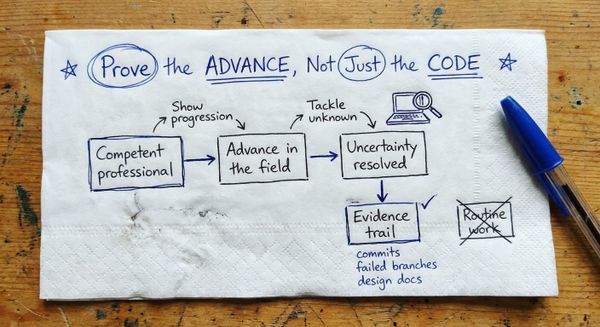
If you rely on the innovation test and HMRC later defeats the company's R&D claim, you might lose Founders' Relief and pay the extra tax with interest. The consultation gives this as an example of the compliance challenge it wants views on (paragraph 4.6). It is a proposal, but it ties a founder's personal tax to the quality of a company-level claim.
For a founder who plans to rely on the innovation test, the practical consequence is evidence. A claim that would survive an enquiry now protects a personal gain years later. The evidence is cheapest to build while the work is being done. It is the same discipline as any claim, with a larger downside on the other side of it. Separately, from 1 April 2027 the R&D claim notification form is removed for claims made on or after that date, which lightens the paperwork and does nothing to the underlying conditions.
The consultation also proposes a statutory right for the individual to ask the company for the information needed to claim, and it says targeted anti-avoidance rules will be considered against restructuring that brings assets into scope. Confidentiality of company tax data is an open question.
What happens to the 25% test if you have been diluted?
The 25% test is a snapshot at the start, not a continuing requirement, on a reading of the wording as published. The condition is to have held 25% of the ordinary share capital when the trade, or preparation for the trade, commenced. The consultation says the relief is not restricted to the original shares or the original shareholding.
On that reading, a founder diluted by later funding rounds is not excluded for that reason alone. The reverse is the risk. A founder who held less than 25% at commencement is out, and so is a co-founder who joined after the trade began. A pre-trade round that took you below 25% before trading started can count against you.
Proceed with caution: the consultation does not state in terms that the stake can fall afterwards, and it asks respondents whether the individual conditions identify founders effectively (question 1). The practical step now is to find the original share issue, work out the date the trade or preparation for the trade began, and see what you held on that date. That is a cap table history exercise, and it is easier now than after a restructuring.
What changes for EMI and share options from April 2027?
Employee share schemes get more generous from 6 April 2027. The Company Share Option Plan (CSOP) has been known as EMI2 since 28 October 2026 (the legislation keeps the CSOP name), and from 6 April 2027 its individual limit doubles from £60,000 to £120,000 and options under it no longer count against the EMI limit. The EMI exercise window after a disqualifying event goes from 90 to 180 days, and the separate EMI grant notification is removed.
The changes in the Treasury's policy paper are:
- EMI2 limit and exercise period. The individual limit rises from £60,000 to £120,000, and options under it no longer count towards an employee's EMI limit. The maximum exercise period rises from 10 to 15 years, and this applies retrospectively, so existing CSOP option agreements can be amended to benefit if the amendment is in line with the legislation.
- 180-day window. The EMI exercise window after a disqualifying event rises from 90 to 180 days. It applies to existing EMI options where the disqualifying event occurs on or after 6 April 2027.
- Employee ownership trusts. The EOT exception in the EMI independence requirement extends to companies arranging to become controlled by an EOT.
- Notification. For options granted on or after 6 April 2027 the company reports the grant in the EMI annual return and no longer notifies HMRC separately. A late or amended return still counts if filed within one year of the annual return deadline for the year of grant. For options granted before 6 April 2027 the existing notification deadline continues to apply.
For a company that has outgrown EMI, or that grants to staff who have used their EMI allowance, EMI2 becomes a far more useful second scheme. EMI share valuations still need agreeing with HMRC in the usual way.
What changed for SEIS and EIS?
The changes are technical and mostly apply to shares issued from 6 April 2027. No new SEIS or EIS investment limits were announced. The EIS limits remain as set by Finance Act 2026.
The measures in the Treasury's policy paper include:
- EIS relief staying on the part of an issue within the company's annual or lifetime limit, instead of all relief being lost when a limit is exceeded.
- SEIS and EIS shares can be issued on the same day.
- HMRC will have discretion to treat shares as fully paid where payment arrives late for exceptional and unavoidable reasons outside the control of the company and the investor.
- One investor's late payment will no longer block relief for the others in the same issue.
- SEIS interest on withdrawn relief is aligned with the EIS rules for SEIS shares issued from 6 April 2027, and
- the VCT relief withdrawal change applies to disposals of shares issued from 6 April 2026.
All of this still depends on the Finance Bill. A raise that completes before 6 April 2027 is governed by the rules as they stand.
What should founders do now?
Do five things now, and take no irreversible step on the basis of a consultation.
- Model the exit date. If a sale is likely in the next 12 months, work out the CGT with and without the £500,000 limit. The difference is capped at approx £30,000 per founder.
- Check BADR qualification. Confirm the 5% holding, the officer or employee status and the two-year periods now, before any share class changes.
- Test Founders' Relief on paper. Find your holding at the date the trade or preparation for the trade began, and compare the company with the £10 million turnover, 15 full-time employee and growth tests.
- Protect the R&D file. If a Founders' Relief claim could rely on the innovation test, keep the claim evidence ready for an enquiry.
- Respond to the consultation. It closes on 30 November 2026 and responses go to EnterpriseTax@hmtreasury.gov.uk. The period is shorter than usual, so a founder or adviser with a view should write early.
Watch for the Finance Bill text, which should settle the transitional rules for the BADR cut and the interaction between the two reliefs.
Frequently asked questions
Is the BADR lifetime limit falling to £500,000?
It has been announced and will be legislated in Finance Bill 2026-27, for qualifying disposals on or after 6 April 2027. It is not law until Royal Assent. The BADR rate stays at 18%.
How much extra tax does the BADR cut cause?
For a higher rate taxpayer, up to £30,000 per person, because six points of rate (18% against 24%) apply to the £500,000 of limit that is lost.
Is Founders' Relief available now?
No. It is a proposal with a technical consultation that closes on 30 November 2026, and it is intended for qualifying disposals from 6 April 2027. The design may change. Do not plan on the basis that it will apply to you until the legislation is published.
What are the Founders' Relief conditions?
For the individual: 25% of the ordinary share capital when the trade or preparation for it began, at least five years of holding (the policy paper says tax years) and five continuous tax years of UK residence. For the company: turnover of at least £10 million, at least 15 qualifying full-time equivalent employees, and two of three growth and innovation tests on turnover, headcount and R&D spend.
Does my company need to be big to get Founders' Relief?
On the current proposal, yes. It needs turnover of at least £10 million and at least 15 qualifying full-time equivalent employees, and directors do not count towards the headcount. Most owner-managed companies will not qualify today. The Government estimates approx 600 individuals a year will be eligible.
Can I lose Founders' Relief after claiming it?
The consultation says so in one case. If HMRC later defeats the company's R&D claim and the individual relied on the innovation test, the individual can lose the relief and pay the additional tax with interest. That is a proposal. The design may change.
What happens to EMI in April 2027?
For options granted on or after 6 April 2027 there is no separate notification to HMRC, because the grant is reported in the EMI annual return. The exercise window after a disqualifying event rises from 90 to 180 days, and the individual limit for EMI2 (formerly CSOP) doubles to £120,000. These changes depend on the Finance Bill.
Do I still need to notify HMRC of EMI options granted before April 2027?
Yes. The abolition of the separate notification applies only to options granted on or after 6 April 2027. For earlier grants the existing notification deadline continues to apply.
Does a contract signed before 6 April 2027 but completed after it get the old £1,000,000 limit?
That is not yet known. The official overview says special provisions apply to contracts entered into before 6 April 2027 that have not been completed, and to certain share reorganisations and exchanges of securities. The wording has not been published. Read it before you rely on either answer.
Did the Budget change CGT rates or dividend rates?
No. The main CGT rates of 18% and 24% were unchanged, and so was the BADR rate of 18%. Dividend rates for 2027-28 are unchanged at 10.75%, 35.75% and 39.35%, with a £500 dividend allowance.
Where to go from here
The right move depends on your exit date, your cap table history and whether your company is on a path to the Founders' Relief thresholds. If you are a founder or owner-manager thinking about a sale in the next two years, IP Tax Solutions can model the CGT under each outcome, check your BADR position and set out a written plan your own solicitor and accountant can work from. You can get in touch to discuss your position. IP Tax Solutions also supports accountants and solicitors on equity and exit questions (see for professionals).
This article is general guidance, not advice for your specific circumstances. It describes policy announced at Budget 2026 on 28 October 2026 and draft legislation as at 4 November 2026, none of which is law until Finance Bill 2026-27 receives Royal Assent. The Founders' Relief design is subject to consultation and may change. Take advice before acting on a transaction date.