Growth Shares vs Ordinary Shares: What Every Founder Needs to Know Before Issuing Equity
Growth shares convert exit gains to CGT at 24%; ordinary shares are simpler but less efficient. Learn which structure is right for your company.

The choice between growth shares and ordinary shares is one of the most consequential decisions a founder makes, yet it is routinely treated as a Companies House filing exercise rather than a tax planning question.
Getting it wrong can turn a capital gain taxed at 24% (the main CGT rate for disposals since 30 October 2024) into employment income taxed at up to 47%, with employer National Insurance on top in some cases.
Understanding when growth shares vs ordinary shares in a UK company context work in your favour is vitally important for scale-up companies and we explore this further below.
What Are Ordinary Shares and When Are They Enough?
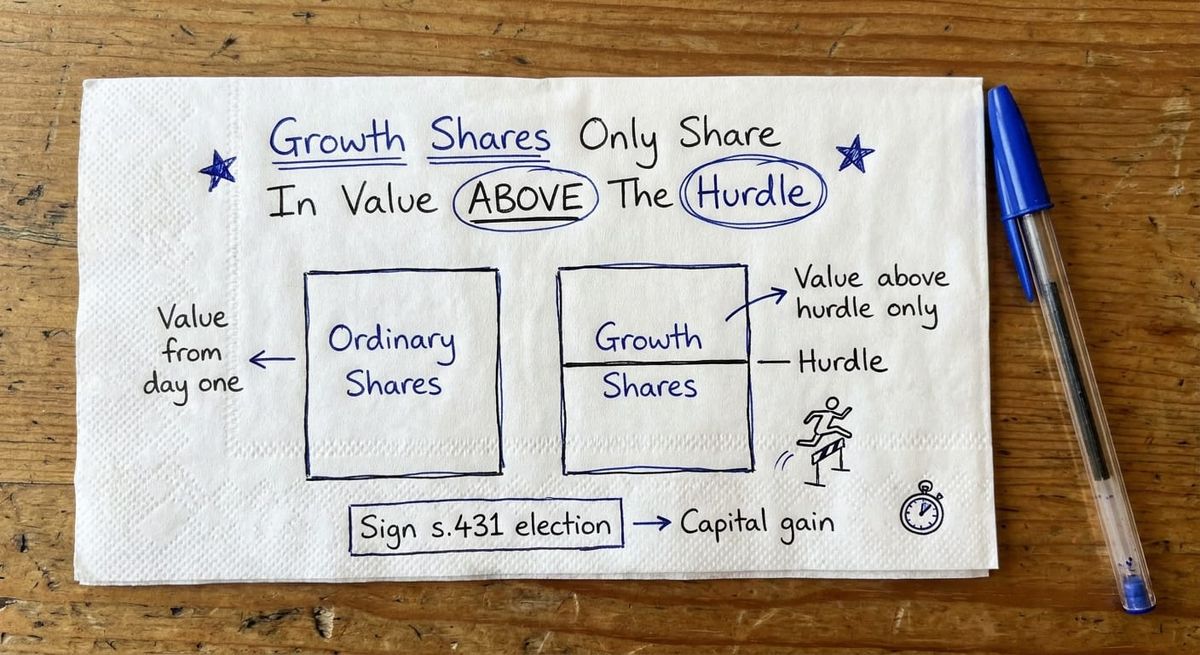
Ordinary shares are the default equity instrument in a UK limited company. Every share typically carries the same rights: identical entitlement to dividends, identical entitlement to assets on a winding up, identical voting weight. There is no threshold to clear before they participate in proceeds. From day one, they carry full economic exposure to the company's value in both directions.
For a founder who incorporates before any external investment and takes ordinary shares at that point, the position is clean. If the company is worth very little at incorporation (which is almost always the case), the shares are acquired at or near nominal value. The unrestricted market value (UMV) and the actual market value (AMV) are effectively the same. Provided a s.431 election is signed within 14 days of acquisition (more on that below), the entire future growth is treated as a capital gain, not employment income.
Ordinary shares normally also interact straightforwardly with SEIS and EIS investment. The investor takes ordinary shares of the same class and there is no multi-class complexity to navigate, so the Advance Assurance application is usually simpler. For pre-revenue founders at the very start of a company's life, ordinary shares are often the right answer precisely because they are simple, tax-efficient when issued early enough, and do not create the drafting risks that bespoke share classes carry.
What Makes Growth Shares Different?
Growth shares are a bespoke class of ordinary shares defined by the company's Articles of Association.
Their distinguishing feature is a 'hurdle': a valuation threshold that must be exceeded before the growth shares participate in any distribution or exit proceeds.
Below the hurdle, growth shares receive nothing. Above the hurdle, they participate in the excess. The hurdle is typically set at or above the current market value of the company at the date of issue, so the growth shares start with £nil or minimal intrinsic value. Their worth lies entirely in the probability of the company clearing the hurdle in the future. HMRC expects that value to be supported by a valuation.
This matters enormously from a tax perspective. Because the value at issue is low, the founder or senior hire acquires the shares at a modest subscription price. When the company later exits above the hurdle, the full gain is a capital gain. The main CGT rate is 24% for a higher-rate taxpayer. Business Asset Disposal Relief (BADR) can reduce the rate on the first £1m of lifetime qualifying gains to 18% for disposals on or after 6 April 2026 (it was 14% for disposals from 6 April 2025 to 5 April 2026), but growth shareholders often do not qualify (see below).
Compare that to an unapproved share option exercise taxed as employment income, where the combined Income Tax and employee National Insurance charge can reach 47%, before any employer National Insurance.
Growth shares acquired by reason of employment or office are Employment-Related Securities under Part 7 of ITEPA 2003, and where the opportunity to acquire them is made available by the employer or a connected person they are treated as acquired by reason of the employment (s.421B(3)). This is not a choice. It means the full ERS regime applies, including the Restricted Securities rules in Chapter 2 of Part 7.
When Growth Shares Make Commercial Sense
Growth shares work best in three scenarios.
- New hires after a funding round. Once an external investor has paid a significant premium for shares, the company has an established value. A new CEO, operations director, or non-executive chair cannot be given ordinary shares at nominal value without triggering an immediate income tax charge on the gap between what they pay and the market value established by the investor round. Growth shares, issued at a hurdle above the current value, sidestep this problem. The subscription price reflects the option value at issuance; the future growth is a capital gain.
- Multi-founder professional services companies. The transition from partnership to limited company often creates complex equity architecture questions. Some founders contribute client books; others build the infrastructure. Growth shares allow active builders to capture upside above a hurdle that reflects the existing book value, without requiring the passive contributors to dilute their position disproportionately. This can be a cleaner route than using alphabet share dividends linked to individual revenue, an approach that tends to attract HMRC challenge.
- Non-executive directors and advisors. EMI options are normally unavailable to non-executive directors because they rarely meet the committed-time requirement of at least 25 hours per week or 75% of working time if that is less, under paragraph 26 of Schedule 5 to ITEPA 2003. Growth shares are the usual alternative for NEDs who want aligned, tax-efficient equity. With a valid s.431 election the future growth is taxed as a capital gain, but a small non-voting holding will usually not qualify for BADR, so the rate is typically the 24% main rate rather than the lower EMI outcome.
The s.431 Election: The Single Most Costly Procedural Omission
The s.431(1) election under ITEPA 2003 is a joint declaration by the employer and the employee (or office holder) that the restricted securities rules are disapplied. In simple terms: the parties agree to treat the shares as if the restrictions (vesting, bad leaver provisions, pre-emption rights) do not exist, and to value them at their unrestricted market value on the day of acquisition.
Without the election, a further income tax charge can arise when the restrictions lift or the shares are sold, calculated by reference to the gap between the unrestricted and actual market values. That part of the value is taxed as employment income rather than as a capital gain, at rates of up to 47%.
The 14-day deadline is absolute. The election must be entered into within 14 days of the share acquisition, it is irrevocable once made, and HMRC has no statutory discretion to extend the period. It is a joint document kept in the company's own records and is not filed with HMRC. The election should ideally be signed on the same day as the share subscription documents.
BADR and the 5% Test: The Growth Shareholder's Biggest Challenge
Business Asset Disposal Relief (BADR) reduces the CGT rate on qualifying disposals to 18% for disposals on or after 6 April 2026 (14% for disposals from 6 April 2025 to 5 April 2026), subject to a £1m lifetime limit. Always fix the rate to the actual disposal date. For growth shareholders, qualifying can be harder than it appears.
BADR for a "personal company" disposal requires under s.169S TCGA 1992 that the individual holds at least 5% of the ordinary share capital, can exercise at least 5% of the voting rights, and either (a) is entitled to at least 5% of distributable profits and 5% of assets on a winding up, or (b) would be entitled to at least 5% of the proceeds on a hypothetical sale of the whole company. These conditions must be met throughout the two years ending with the disposal.
Stand-alone growth shares often fail the 5% tests. They are usually issued in small numbers with low nominal value, they are often non-voting, and HMRC's Capital Gains Manual (CG64051) says that where a share carries no entitlement to profits and assets until a given event occurs, such as some types of growth share, the entitlement is ignored until that event has happened. A holder of 10,000 growth shares out of a 1,000,000 total share count holds 1% by number, and the profits and assets limb is unlikely to be met before the hurdle is cleared. The alternative disposal-proceeds limb is untested for growth shares, so BADR should not be assumed on it.
For this reason, founders who hold growth shares alongside their original ordinary shares are typically in a stronger BADR position than those who hold growth shares only. The ordinary share holding can carry the 5% tests, and the growth shares then add to the gains that may qualify. If you are structuring equity for a new hire or a NED who will hold only growth shares, BADR eligibility needs to be modelled at the point of issue, not assumed. For a sub-5% non-voting holder the realistic plan is CGT at 24%, which is still far better than employment income.
Growth Shares and EIS Investors: The Abingdon Health Problem
If the company is raising or has raised EIS investment, adding a growth share class requires careful drafting. The EIS shares must be ordinary shares with no preferential right to dividends, no preferential right to assets on a winding up, and no right to redemption, per s.173(2) ITA 2007. The prohibition applies throughout Period B, which runs from the issue of the shares to the termination date (s.159 and s.256), broadly three years from issue or, if later, from the start of the trade.
The trap, illustrated by Abingdon Health Ltd v HMRC (First-tier Tribunal, 2016, TC 05525), is this: a waterfall in the Articles that says "pay ordinary shareholders first up to the hurdle, then distribute any excess to all classes" creates a preferential right for the ordinary shares over the growth shares. The existence of the preference, not its exercise, is enough to put the EIS relief at risk retrospectively. Abingdon is a First-tier Tribunal decision, so it is persuasive rather than binding, but it reflects HMRC's settled approach.
The compliant structure uses a participation threshold rather than a waterfall priority. All classes distribute simultaneously. Growth shares simply have a per-share floor below which they receive nothing. The ordinary shareholders are not paid first; rather, the growth shares do not participate unless the per-share amount exceeds the hurdle. The economic outcome can be similar, but the second formulation is the one that reduces s.173 risk. It is a mitigation rather than a guaranteed safe harbour, because HMRC looks at the substance of where priority sits, and the risk to capital condition in s.157A is a separate test that must also be satisfied.
Introducing growth shares after the EIS round, during Period B, creates the same risk. If the new articles give the pre-existing ordinary shares any form of effective priority over the growth shares, HMRC can withdraw EIS relief retrospectively. The sequence matters: issue growth shares before the EIS round, or wait until the three-year clock has run. Where the round has closed, Advance Assurance on the revised articles is a prudent backstop. If you are uncertain whether the articles are compliant, our SEIS and EIS advisory work includes pre-round article review.
Key takeaway: Growth shares convert future equity value from employment income to capital gain. The tax benefit is real and substantial, but it depends entirely on three things being done correctly at the moment of issue: the hurdle is properly valued, the s.431 election is signed within 14 days, and the articles are drafted to avoid creating a preferential right for any other class (especially if S-EIS investors are in the structure). Even then, BADR will often not be available on a small growth holding.
FAQ
What is the difference between growth shares and ordinary shares in a UK company?
Ordinary shares carry full economic rights from day one, entitling the holder to dividends and proceeds from the first pound of value. Growth shares are a bespoke class that participates only in the value of the company above a pre-set threshold (the hurdle). Below the hurdle, growth shareholders receive nothing on a sale or winding up.
When should a UK founder use growth shares rather than ordinary shares?
Growth shares are most useful when a company already has an established value (for example, after an investor round) and you need to incentivise new hires, a non-executive director, or a co-founder without creating an immediate income tax charge. They are also effective in multi-founder professional services firms where some partners contribute more to growth than others. At the very start of a company's life, when market value is genuinely negligible, ordinary shares issued with a s.431 election can deliver the same CGT outcome more simply.
What is the s.431 election and why does it matter for growth shares?
The s.431(1) election under ITEPA 2003 disapplies the restricted securities rules and values the shares at their unrestricted market value at the date of acquisition. Without it, a further income tax charge can arise when the restrictions lift or the shares are sold, taxing part of the value as employment income rather than as a capital gain. The election must be entered into within 14 days of acquiring the shares. Missing the deadline cannot be put right later.
Do growth shares qualify for Business Asset Disposal Relief?
Potentially, but not automatically. BADR requires the individual to hold at least 5% of the ordinary share capital, 5% of voting rights, and either 5% of distributable profits and assets or 5% of disposal proceeds under s.169S TCGA 1992, throughout the two years to disposal. A holder of a small, non-voting parcel of growth shares will usually fail these tests, and HMRC's guidance ignores a growth share's profits and assets entitlement until the hurdle event has occurred. BADR eligibility should be modelled at the time of grant.
Can a company have both growth shares and EIS investors without disqualifying the EIS?
Yes, but only if the articles are drafted correctly. Under s.173(2) ITA 2007, EIS shares must carry no preferential right to assets on a winding up (or the other preferential rights listed there). A standard waterfall that pays ordinary shareholders first (up to the hurdle) and growth shareholders second creates a preferential right for the ordinary shares. This was the issue in Abingdon Health v HMRC (First-tier Tribunal, 2016). The lower-risk approach uses a participation threshold: all classes distribute simultaneously, with growth shares simply not participating unless the per-share amount exceeds the hurdle. This reduces rather than removes the risk, and the risk to capital condition must also be satisfied. Advance Assurance from HMRC on the proposed articles is strongly recommended where growth shares and EIS investment coexist.
How is a growth share valued for tax purposes at the date of issue?
HMRC does not agree a valuation of standalone growth shares before they are issued (unlike the EMI valuation process). The defensible approach is a contemporaneous option-pricing model, typically Black-Scholes, retained on file. A probability-weighted expected returns model is generally appropriate only where an exit is close and its outcome nearly fixed. The inputs are the current ordinary share value, the hurdle, the time to expected exit, volatility and the risk-free rate. The output is the option value attributable to the probability of the company clearing the hurdle. That is the unrestricted market value the subscriber should pay: if the price paid is lower, the shortfall is taxed as employment income, and the same figure is the UMV used in the s.431 election.
Can non-executive directors use growth shares if they do not qualify for EMI?
Yes, and growth shares are the usual tax-efficient alternative to EMI for NEDs. EMI is normally unavailable to non-executive directors because they rarely meet the committed-time requirement of at least 25 hours per week or 75% of their working time if that is less (paragraph 26, Schedule 5 ITEPA 2003). Growth shares, structured correctly with a s.431 election, deliver capital gains treatment, though BADR is often unavailable. The NED holds the shares as an office holder; the ERS regime applies; but future growth is taxed as a capital gain rather than employment income.
The Structure Determines the Tax Outcome
The decision between growth shares vs ordinary shares is not a question of which is generally better. It is a question of which is right for your company at the precise stage it is in, the team you are incentivising, and the investor base you have or plan to bring in.
Ordinary shares at inception typically deliver CGT treatment simply and cleanly. Growth shares, properly structured, do the same job for hires and contributors who join once the company has value. The risk in both cases lies in the procedural requirements: the 14-day election window, the option-pricing model at grant, the Articles drafting for multi-class companies, and the BADR eligibility test at exit.
If you are structuring a cap table for a new round, bringing in a senior hire, or advising a company on founder equity, we are available to review the structure and the documentation. Speak to our team through the contact page on our website.
This is a highly complex technical area so none of the above should be interpreted as professional advice.