How Do You Pass On a Family Limited Company Tax Efficiently in the UK?
How to pass on a family limited company without a tax shock: the £2.5m Business Property Relief cap, CGT holdover planning and employment income traps.

Written 19 October 2026. This reflects the law as it stands before the Autumn Budget 2026.
The Budget is due on 28 October and there are widespread reports that the Chancellor is considering taxing some transfers of a family company to children as income and not as capital gains. The Government has not confirmed it. Owner-managers are asking whether to act now. Our advice is to act on a plan and not on the latest speculative headlines. This guide provides an overview of some of the key tax issues to consider when passing on the shares in a limited company.
In this guide
- What taxes apply when you pass on a family company?
- What changed for inheritance tax on family company shares from April 2026?
- What is the redeemable shares route in the news?
- What conditions must a company buy-back meet today?
- Should you wait for the Budget before deciding?
- What are the main ways to pass on a family company?
- Do you pay capital gains tax when you give shares to your children?
- When does giving shares to a working child create an income tax charge?
- How do growth shares freeze the value of a family company?
- What can stop Business Property Relief applying to your company shares?
- Can you keep working and keep control after giving shares away?
- What is the best order to do things in?
- Frequently asked questions
- Where to go from here
What taxes apply when you pass on a family company?
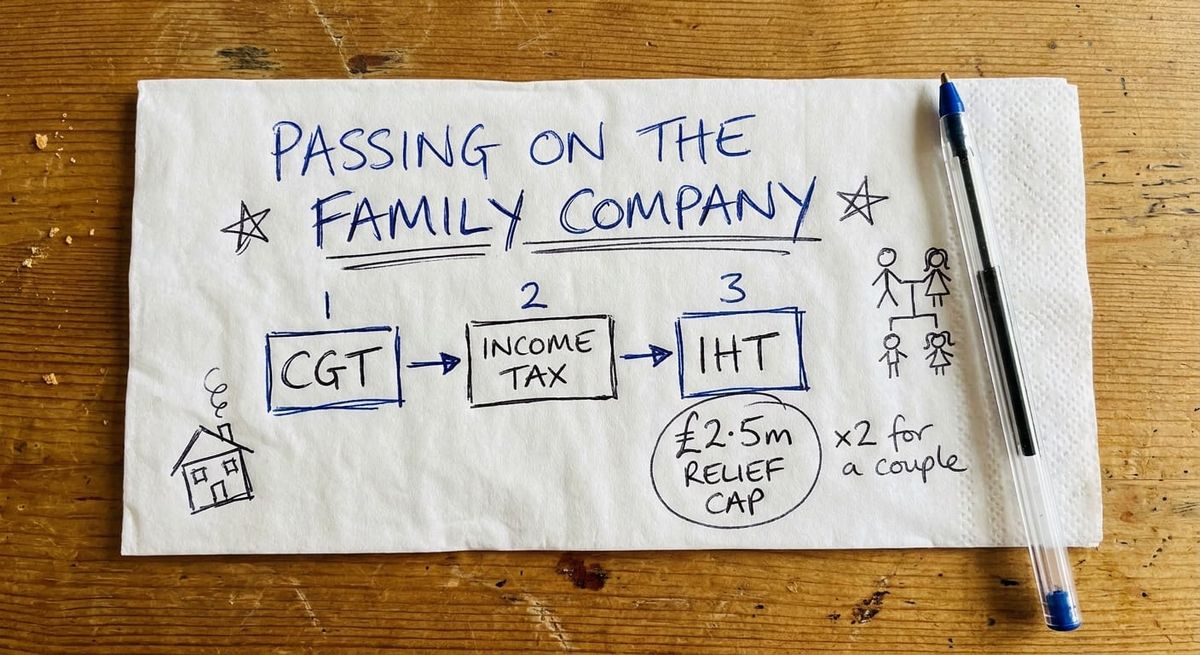
Three taxes potentially impact a transfer of the shares in the business to a family member:
- A gift of shares to a child is treated as a sale at market value, so capital gains tax can apply.
- Income tax (employee taxes: PAYE & NIC) can apply if the child works in the business.
- Inheritance tax applies on death, or on a gift if you die within seven years.
Here is a summary of the key tax triggers and potential remedies:
| Tax | What triggers it | Main relief | Where it goes wrong |
|---|---|---|---|
| Capital gains tax | A gift or sale of shares | Holdover (s.165 TCGA 1992) or Business Asset Disposal Relief | The child's base cost is reduced by the held-over gain, and the election is missed |
| Employment income tax | A working child receives shares | The family relationship exception (ERSM20220) | The company issues new shares, or the child is underpaid |
| Inheritance tax | Death, or a gift followed by death within seven years | Business Property Relief | The £2.5 million cap, cash in the company, and the seven-year clock |
What changed for inheritance tax on family company shares from April 2026?
From 6 April 2026, 100% Business Property Relief applies only to the first £2.5 million of qualifying business and agricultural property per person. Above that, relief is 50%, which provides an effective inheritance tax rate of 20% on the excess (at the current 40% prevailing rate). Any unused allowance passes to a surviving spouse or civil partner.
Two further points are relevant for a family company.
- Tax on qualifying business property can be paid in ten annual interest-free instalments.
- A gift made on or after 30 October 2024 is tested against the new allowance if you die on or after 6 April 2026 within seven years of making it.
Here is the effect on a company worth £6 million, before the £nil rate IHT band and ignoring any other estate assets:
| Position | Relief | Inheritance tax at 40% |
|---|---|---|
| Single or widowed owner, one allowance, £6m | £2.5m at 100%, £3.5m at 50% | £700,000 |
| Married couple, both allowances available, £6m | £5m at 100%, £1m at 50% | £200,000 |
For a married couple the unused allowance passes to the survivor, so a £6 million company left to a spouse can still reach £5 million at 100% on the second death. Splitting ownership still matters where shares may pass to the children at the first death, where the couple are not married or not both UK-domiciled, and where you plan lifetime gifts. The simplest saving is to check, before anything else, that two allowances will actually be available.
What is the redeemable shares route in the news headlines?
It relates to a staged company buy-back which is typically structured to solve a cashflow problem from both the seller (tax) and children's (funding the consideration) perspective. For example, a retiring owner who sells to their children triggers a one-off tax bill on the whole gain, and the children rarely have the cash available to fund it. So the company buys back the parent's shares out of its own retained profits, the owner is paid out over several years, and the children's effective percentage rises (as the parent's reduces) without them personally having to fund the purchase.
The press reports suggest that the change under consideration would tax these buy-backs as income. The figures quoted are 45% vs 24%, which on £1 million is up to £450,000 against £240,000. Those numbers come from the press and not from the Government, and we do not advise that companies restructure in reaction to them.
One more point on the cash. The proceeds sit in the parent's estate once received, and the Business Property Relief that would have covered the shares within the cap does not cover the cash outside of it.
What conditions must a company buy-back meet today?
A buy-back is taxed as a capital disposal only if the conditions in ss.1033 to 1042 CTA 2010 are met. Business Asset Disposal Relief can then apply if its own tests are met. If they are not met, the proceeds are a distribution taxed at dividend rates, up to 39.35% from April 2026.
The company must be an unquoted trading company, and the buy-back must be wholly or mainly for the benefit of its trade. It must not be part of a scheme with a main purpose of avoiding tax or letting you share in profits without a dividend. You must be UK resident and have held the shares for five years, or three if inherited. Your interest, and your entitlement to profits and assets, must fall to no more than 75% of what it was. Afterwards you must hold no more than 30%.
Adult children's shares are not added to yours for these tests, but a spouse living with you, or a child under 18, is (s.1059). Advance clearance is available under and HMRC's guidance says it aims to reply within 30 days. HMRC has questioned contracts where completion is staged, so take advice first. Because a family company is close, also check the transactions in securities rules (s.684 ITA 2007) and request clearance under both.
Should you wait for the Budget before deciding?
No. Do not make an irreversible decision based on a speculative press rumour. We cannot tell you what the Chancellor will announce, and nothing is law until it is legislated. Downing Street has sought to play down tax speculation, and one report says the Chancellor has ruled out raising capital gains tax to income tax rates generally.
The steps that work under any outcome are these:
- Get a defensible valuation, so you know which side of the cap you are on.
- Check that two allowances will be available, given marital status, domicile and your wills.
- Make sure the company is a trading company (and is not hoarding cash and/or investment assets).
- Align your wills with the ownership.
Irreversible steps, such as gifts and share class changes, should wait until you have a plan that works whether the rules stay or tighten.
What are the main ways to pass on a family company?
There are a number of main routes to pass on a family company, and they can be combined. The right mix depends on how much value is in the company, how fast it is growing, whether the next generation works in the business, and how long you expect to remain involved.
Here are some possible scenarios and high level tax considerations:
| Route | Inheritance tax | Capital gains tax | Watch for | Often best when |
|---|---|---|---|---|
| Hold until death, wills aligned | Nil within the allowances | No charge on death, and the heir's base cost resets to market value (s.62 TCGA 1992) | Value above the cap | Value is within £2.5m each, or you want to keep control |
| Gift existing shares, with holdover | A potentially exempt transfer, clear after seven years and tapered between years three and seven only above the nil rate band | Deferred into the child's base cost | Loss of the death uplift, the ERS rules | You want value moved out and no tax bill now |
| Gift and crystallise the gain | As above | Charged now, 18% under Business Asset Disposal Relief up to £1m of gains, if the 5% and two-year officer or employee tests are met | A tax bill with no cash, though ten yearly instalments are available on a gift of unquoted shares (s.281 TCGA 1992) | The gain is modest and the child may sell |
| Growth (freezer) shares | Future growth stays out of your estate, subject to s.98 IHTA 1984 | Depends on structure, with value shifting in point (s.29 TCGA 1992) | Valuation, employment-related securities, the settlements rules | The company will outgrow the cap |
| Move shares between spouses | Exempt, with limits if a spouse is not UK-domiciled | No gain, no loss for spouses living together (s.58 TCGA 1992) | Outright gifts, and the settlements rules on income-heavy shares | One spouse holds nearly everything |
| Staged company buy-back of your shares | The cash proceeds get no Business Property Relief once received | Capital treatment if the s.1033 CTA 2010 conditions are met, otherwise a dividend | The reported Budget target, the 75% and 30% tests, and clearance | You are retiring and the company has the profits to fund it |
| Sale to an Employee Ownership Trust | The sale itself is not an inheritance tax event | Possible relief if the statutory conditions are met | Independence tests, and limits on how many family members can participate | There is no family successor, though the family can keep a minority stake |
For completeness, we should add trusts for families who need control or protection. A gift into most trusts is a chargeable lifetime transfer and not a potentially exempt one, and trusts have their own £2.5 million allowance, so they need specialist advice.
Do you pay capital gains tax when you give shares to your children?
Yes, unless you claim relief. A gift to a child is a disposal at market value, so you can face a tax charge with no cash to pay it. Joint holdover relief under s.165 TCGA 1992 defers the gain for shares in a trading company, but the choice between deferring and paying needs working through.
Holdover is a deferral and not an exemption. The held-over gain is deducted from the child's base cost, so the tax falls due when they eventually sell. The claim is made jointly on form HS295 within four years of the end of the tax year of the gift.
If you gift the shares without holdover and the company is unquoted, you can elect to pay the capital gains tax in ten equal yearly instalments (s.281 TCGA 1992). Interest runs on the unpaid balance, and the whole amount falls due if the shares are later sold for value.
The optimal route depends on the size of the gain and the child's plans.
When does giving shares to a working child create an income tax charge?
Where a child is employed by the company, on first principles, the shares are treated as employment-related securities. Where a company or someone connected with the employer makes shares available to an employee, the law deems it to be by reason of employment (s.421B(3) ITEPA 2003).
The child could then pay income tax on the value of the shares received.
However, there is an important exception for opportunities provided in the normal course of domestic, family or personal relationships (ERSM20220). HMRC's example is a father handing over his family company shares on retirement. It is a question of fact, so we typically check four things:
- The gift is a personal gift of existing shares by you, not a new share issue by the company. A company is not an individual, so a fresh allotment cannot strictly use the exception.
- The child is paid a commercial salary.
- A deed of gift records the family purpose.
- A protective joint election under s.431 ITEPA 2003 is made within 14 days, because it cannot be made late. It only does work where the shares are restricted securities, which private company articles often make them.
Giving a working child a nominal-cost class of new shares from the company is the common failure. For a plain gift, use existing shares. Where a new class is needed, see the next section.
How do growth shares freeze the value of a family company?
Growth shares participate only in value above a set hurdle. If the company is worth £3 million today and the child holds growth shares with a £3 million hurdle, all future growth belongs to the child from day one and never forms part of your estate. That sidesteps the seven-year clock for the future value.
The detail decides whether it works. The hurdle needs a defensible valuation, usually with a premium for hope value. The articles of association must define the rights precisely, with leaver provisions for the child. The structure must also pass the value shifting rules and the settlements legislation where a child is under 18, because dividends on shares given to a minor child can be taxed on the parent (s.629 ITTOIA 2005).
A company that issues growth shares to a working child is not an individual, so the family exception is typically not available. The shares are employment-related securities, the hurdle must reflect their unrestricted market value at issue, and a protective s.431 election is normally made within 14 days. An alteration of share rights in an unquoted company also needs its own inheritance tax review (s.98 IHTA 1984).
For a business expected to grow well past the £2.5 million allowance, this is often the most valuable single step, because it deals with growth not yet earned.
What can stop Business Property Relief (BPR) applying to your company shares?
Relief is not automatic. Relief is not available for a business that consists wholly or mainly of dealing in securities, land or buildings, or of making or holding investments (s.105(3) IHTA 1984) and the shares must generally have been owned for two years (s.106). Assets not used for the business, such as surplus cash, are excepted assets and attract no relief (s.112 IHTA 1984).
The tests are not identical. Business Property Relief asks whether the business is wholly or mainly investments, while holdover and BADR look for a trading company, and HMRC generally expects a higher level of trading for those two. A cash-rich family company is the usual problem. Retained profits left on the balance sheet can reduce relief on that part of the value and can threaten the trading status the whole plan relies on if the build-up becomes sufficiently large. Reviewing the balance sheet each year is a recommended step for BPR protection.
The seven-year rule has a second trap. If you give shares away and die within seven years, accrued relief on that failed gift is not guaranteed. The child must still hold the shares or qualifying replacement property, and the shares must still qualify at your death (s.113A IHTA 1984).
Can you keep working and keep control after giving shares away?
You can, but you must not reserve a benefit from what you have given. If you gift shares and then take value from them in a way a commercial arrangement would not justify, the gift does not start a seven-year clock and the shares remain part of your estate on death (s.102 Finance Act 1986).
Typical risks are an uncommercial salary that looks like a disguised return on the gifted shares, rights to buy the shares back at an undervalue, and informal control over the child's dividends. If you want to stay in charge, a better approach is to keep a majority of the voting ordinary shares while the child holds a separate class, and to put your ongoing role into a written service agreement at a market salary.
What is the optimal order to do things in?
The order of steps matters more than any single relief, because each step changes the answer to the next. This is the sequence we would work through for most owner-managed family companies:
- Value the company now and identify which side of the £2.5 million allowance you sit.
- Check trading status and address surplus cash or non-business assets.
- Check that two allowances will be available, and align ownership and wills if not.
- Decide between holding for death, gifting with holdover, or crystallising the gain.
- If gifting, give existing shares personally, document it by deed, set a commercial salary and file the protective s.431 election in 14 days.
- Add growth shares if the company will outgrow the cap.
- Update wills and diarise the seven-year dates, the HS295 deadline and your next review.
Frequently asked questions
How much can I pass on to my children free of inheritance tax if I own a family company?
If the shares qualify for Business Property Relief, up to £2.5 million of qualifying business and agricultural property per person at 100% relief from 6 April 2026, with the allowance transferable between spouses. Value above that gets 50% relief. A married couple can therefore shelter up to £5 million, before the nil rate band, if the company qualifies.
Is it better to gift my company shares now or leave them in my will?
It depends on the value. Within the allowances, holding until death usually wins, because Business Property Relief covers the inheritance tax and there is no capital gains tax on death. Above the cap, or if the company will grow quickly, lifetime gifts or growth shares move value out of your estate, but they start a seven-year clock.
Do I pay capital gains tax if I give my company shares to my son or daughter?
A gift to a child is treated as a sale at market value, so a gain can arise. You can defer it with joint holdover relief under s.165 TCGA 1992 if the company is a trading company. The deferred gain reduces your child's base cost. Alternatively you can pay tax now, at 18% under Business Asset Disposal Relief on up to £1 million of lifetime gains if you meet the 5% and two-year tests.
Can I spread the capital gains tax on giving my company to my children?
Yes, in one main way. On a gift of unquoted shares where you do not claim holdover, you can elect to pay the tax in ten equal yearly instalments with interest (s.281 TCGA 1992), and the balance falls due if the shares are later sold for value. A staged company buy-back spreads the payments to you, but the gain is normally fixed at the contract date, so it does not by itself spread the tax. HMRC has questioned staged completion, so take advice and seek clearance first.
Can my child be taxed on the shares I give them?
Yes, if the shares are treated as employment-related securities. A personal gift of existing shares from a parent, with a commercial salary and a deed of gift, normally falls within the family relationship exception in ERSM20220. A new issue of shares by the company to a working child does not, and can create an income tax charge on the difference between market value and anything paid, which on a nominal-cost issue is close to the full value.
What happens if I die within seven years of giving shares to my child?
The gift is brought back into your estate for inheritance tax. Business Property Relief can still apply if the child still holds the shares or qualifying replacements and the shares still qualify at your death, but the £2.5 million allowance applies to the gift, including gifts made on or after 30 October 2024 where death follows 5 April 2026.
Does my company qualify for Business Property Relief if it holds a lot of cash or property?
Only in part. The company must be mainly trading and not mainly holding investments or property, and assets that are not used for the business are excepted assets with no relief. Surplus cash and investment property can reduce the relief available, and a large build-up can put trading status itself at risk.
Can I keep control of the company after giving shares to my children?
Yes, if you retain voting control properly. Keeping a majority of the voting ordinary shares while the child holds a separate class works. Taking benefits from the gifted shares, or keeping informal control over their dividends, risks the gift with reservation of benefit rules.
What tax change is reported for passing a family company to children?
Widespread press reported that the Chancellor is considering taxing some buy-backs of a parent's shares as income at up to 45% and not as capital gains at 24%. The Government has not confirmed it, and nothing is law until legislated. The route affected is the staged buy-back of redeemable shares, which is taxed under s.1033 CTA 2010 if its conditions are met.
Will the Budget change the rules on passing on a family company?
No one knows for sure and nothing changes until it is legislated. The April 2026 cap is the current law. Last time, the Government implemented anti-forestalling rules from Budget day. So build a plan that works under the current rules and does not depend on guessing the announcement. We will provide an update on this article if and when the tax position changes.
Where to go from here
The right route for your family depends on the value of the company, who works in it, your age and your appetite for control. If you are an owner-manager thinking about succession, we can help map your position, compare the routes with numbers and give you a written step plan your own solicitor and accountant can implement. You can get in touch to discuss your succession plan or read about how we handle succession and family share transfers. We also work with accountants and solicitors who want tax advisory assistance on a family transfer (see for professionals).
This article is general guidance, not advice for your specific circumstances. Inheritance tax, capital gains tax and employment-related securities rules interact, and the position depends on your facts and the date of any transfer. Take advice before gifting shares.