Does R&D Have to Advance the Science? What Tanglewood Tells Us
HMRC argued every R&D project must advance the underlying science. In Tanglewood [2026] UKFTT 1137 the Tribunal said not always. What that means for claims.

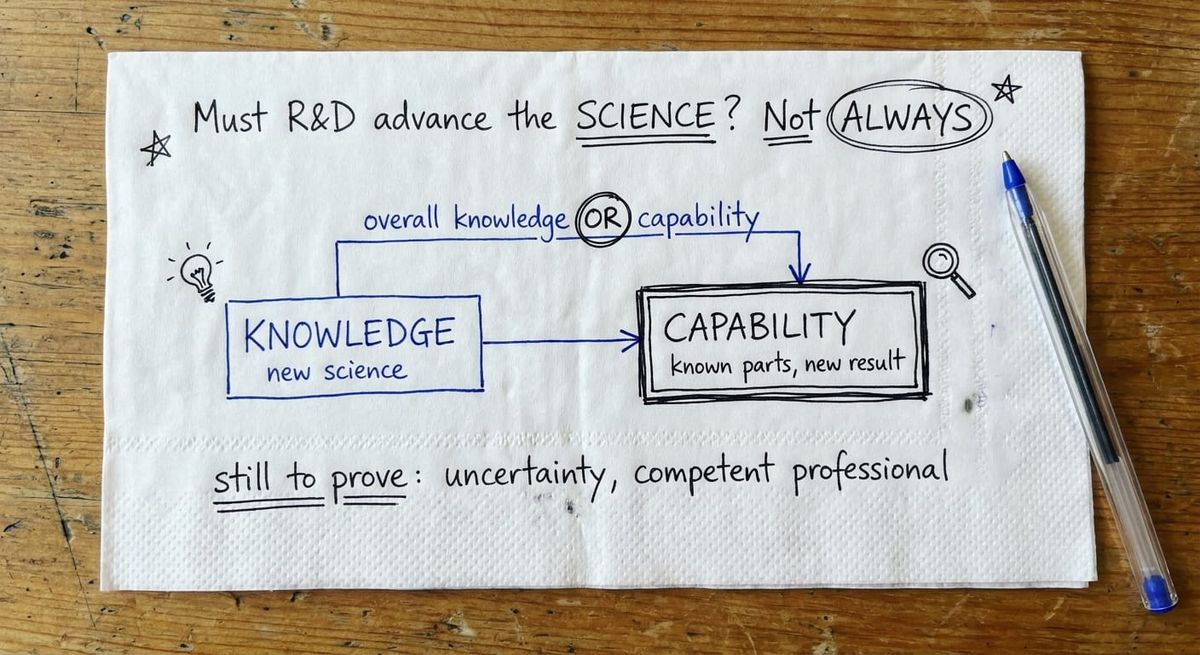
Not always. In Tanglewood Care Services Ltd v HMRC [2026] UKFTT 1137 (TC) the First-tier Tribunal declined to accept HMRC's submission that a claimant must in every case show an advance in underlying scientific or technological knowledge. Paragraph 6 of the Guidelines refers to an advance in overall knowledge or capability, and the Tribunal said that in principle a project may qualify without generating new scientific knowledge. Those comments were obiter (a judge's remarks that were not needed to decide the case, so they persuade but do not bind), because the claim failed on the evidence. The reasons it failed are worth understanding just as carefully.
Contents
- The Case in Short
- HMRC's Argument, Half Accepted
- Why the Capability Route Matters
- A Useful Corroborating Decision: Get Onbord
- System Uncertainty Survives Too
- Where the Claim Actually Died
- The Competent Professional Problem
- Does This Still Apply to Current Claims?
- What This Means If You Are Under Enquiry
- Frequently Asked Questions
- If HMRC Has Challenged Your Advance
The Case in Short
Tanglewood Care Services Limited operates residential nursing homes. It ran seven of them during the accounting period ended 31 January 2021.
It filed its corporation tax return for that period on 28 February 2022 with no R&D claim. On 9 September 2022 it amended the return to claim enhanced R&D expenditure in respect of a single project: managing the outbreak and effects of Covid-19 in a residential care home.
The claimed project was the design, integration and continual refinement of an infection-control system: PPE regimes, testing, visitor restrictions, cohorting of residents, staff segregation, enhanced cleaning, admissions controls, track and trace, daily reporting from each home. The company's case was that the advance lay not in any individual measure but in the way the measures were combined, evaluated and optimised for a care-home setting.
HMRC denied the claim. The Tribunal dismissed the appeal on 6 August 2026.
On the evidence, the result was unsurprising: HMRC's case was that the claim concerned the management of care homes rather than any field of science or technology, and that the supporting report had been prepared after the accounting period without identifying a baseline, the uncertainties or any methodology. None of the company's witnesses claimed expertise in virology, epidemiology, infection science or a comparable discipline. The Tribunal did find that there was a project, was sympathetic to the fact that the period was one of considerable uncertainty and accepted in principle that system uncertainty can qualify. It still dismissed the appeal.
HMRC's Argument, Half Accepted
HMRC advanced a two-part submission on the meaning of an advance in science or technology:
- Paragraph 9 of the Guidelines cannot be read in isolation from paragraph 6. Paragraph 9 lists examples of qualifying projects, including at 9(c) a project seeking to "make an appreciable improvement to an existing process, material, device, product or service through scientific or technological changes". HMRC said an appreciable improvement is not enough on its own unless it reflects an advance in overall knowledge or capability in the field, rather than merely an improvement in the claimant's own operations.
- The second part went further. HMRC submitted that this required advancement of the underlying science or technology.
The Tribunal accepted the first part but did not accept the second, which is important.
On the first:
"Paragraph 9 cannot be read in isolation. The examples given in that paragraph are examples of projects which may satisfy the definition of an advance in science or technology in paragraph 6. It follows that a product, process or service does not qualify merely because it exhibits some improved functionality."
That consistent with Gripple Ltd v HMRC [2010] EWHC 1609 (Ch), where Henderson J described the R&D provisions as a detailed and prescriptive code. Improved functionality is not a shortcut past paragraph 6.
On the second, the Tribunal stated:
"We do not, however, accept that paragraph 6 requires a claimant in every case to demonstrate an advance in underlying scientific or technological knowledge."
Three reasons were given:
- Paragraph 6 refers to an advance in overall knowledge or capability.
- Paragraph 13 expressly contemplates uncertainty arising from turning something already known to be scientifically feasible into a cost-effective, reliable and reproducible process, product or service.
- Paragraphs 29 and 30 recognise that uncertainty can arise from the interaction or integration of processes and components that are individually well understood.
"In principle, a project may satisfy the Guidelines without generating new scientific knowledge if it seeks to achieve an advance in overall capability through the resolution of genuine scientific or technological uncertainty."
Why the Capability Route Matters
Anyone who has handled an R&D compliance check will recognise the shape of the argument HMRC did not persuade the Tribunal to accept.
It appears in enquiry letters in various forms.
- "Your project used existing technology".
- "The components were already known".
- "You have not shown how the science was advanced".
- "You have improved your own processes rather than the state of the art".
Each of those observations may be perfectly sound as a matter of evidence. As a matter of construction, the last step, from "you did not advance the science" to "therefore this is not R&D", is the step the Tribunal declined to endorse.
Note that the Guidelines define "overall knowledge or capability" as a single phrase (paragraph 20), and neither they nor the Tribunal speak of separate limbs. Paragraph 6 does say knowledge or capability, and the Guidelines have never said that capability is a lesser or conditional route.
This matters most for the claims that sit furthest from a laboratory:
- Process engineering.
- Manufacturing scale-up.
- Systems integration.
- Software where the algorithms are published but their combination at the required performance is not.
In each case the honest answer to "what new science did you discover?" is often "none", and that answer need not be fatal. The question is whether overall capability in the field was advanced through the resolution of genuine scientific or technological uncertainty.
In my view three conditions come with that, and the third is the one claimants forget. These are my own commentary, drawn from paragraphs 6, 13, 14 and 20 of the Guidelines. They are not a list the Tribunal set out.
- the capability must be capability in a field of science or technology, not operational, managerial or commercial capability.
- it must be sought through the resolution of genuine scientific or technological uncertainty.
- it is measured against the paragraph 20 baseline, which means what was publicly available, or readily deducible from publicly available knowledge by a competent professional working in the field, at the time. "Our competitors could not do this either" is not the test.
Key takeaway: "We did not advance the underlying science" is not necessarily a concession that ends a claim. It moves the argument onto capability, where the burden is to show a capability in a field of science or technology that was not readily deducible from what was publicly available at the time.
A Useful Corroborating Decision: Get Onbord
If you are going to run this argument, do not rely on Tanglewood alone. It is a case the taxpayer lost, and its comments on paragraph 6 were not necessary to the outcome. There is a taxpayer win that is useful alongside it, though it needs to be described accurately.
In Get Onbord Ltd (in liquidation) v HMRC [2024] UKFTT 617 (TC) the appeal was allowed. The project was an AI-driven KYC verification and risk-profiling system built substantially from open-source components and existing tools. Judge Baldwin's findings sit close to the capability question.
On code written on top of existing sources and tools:
"This code sits on top of the information, gathered using existing sources and software/AI tools, and establishes a capability that was not there before."
On the novelty of components:
"it is not necessary for that to be the case that each component part of the solution must itself be novel or bespoke to the project in question."
The decision goes on to record, in the same paragraph, an observation made by the company's witness Mr Cahill that "if complete novelty were the test, no software project would ever amount to R&D". The Tribunal introduced that with "As Mr Cahill observed" and went on to add that the Guidelines themselves contemplate that an appreciable improvement to an existing process can amount to R&D.
And on the objection that a project cannot exist where objectives evolve:
"Clearly, the project would evolve over time, but this does not mean that there is no method or plan designed to achieve GOL's goal."
However, be wary about what this decision does and does not cover:
- It did not rule on whether an advance in capability alone is enough - HMRC advanced a similar argument - but the Tribunal did not expressly decide the construction point and allowed the appeal on its facts.
- The Tribunal applied the test as a single phrase, requiring an advance in "overall (not just its own) scientific knowledge or capability".
- It cautioned that the test is "not whether a new function has been developed", treating a new function only as an indication. The statement is a finding about that company's code on that evidence. Get Onbord's own formulation is framed around a scientific advance, which is a further reason it is not authority for Tanglewood.
So Get Onbord is useful corroboration and a fact-sensitive win. It shows a Tribunal accepting that building on existing components does not make a development routine, where the claimant had a competent professional who could explain what was and was not readily deducible.
The take-away is that:
- Tanglewood tackles HMRC's construction directly, as obiter comment.
- Get Onbord shows the 'existing-components' point succeeding on strong evidence.
System Uncertainty Survives Too
The Tribunal went further than the advance point. It accepted that the Guidelines are broad enough to encompass system uncertainty arising from the interaction of multiple measures within a system, and that a claimant is not confined to uncertainties about the behaviour of individual components. It rejected any suggestion that a case necessarily fails because it relies on a combination of existing measures rather than new ones.
The Tribunal's words were that "in an appropriate case" uncertainty about how known measures should be combined "may" constitute scientific or technological uncertainty. Read this as a door left open, rather than an explicit endorsement.
Three provisions close it again if the work does not meet them:
- Paragraph 30 is the operative gate. Uncertainty exists if a competent professional working in the field cannot readily deduce how the separate components or sub-systems should be combined to have the intended function. If they can, there is no uncertainty to resolve.
- Paragraph 29 excludes assembly to an established pattern. Combining components to a known pattern, or following routine methods for doing so, involves little or no scientific or technological uncertainty.
- Paragraph 14 is the one most often overlooked, and it is the direct answer to most combination narratives. Improvements, optimisations and fine-tuning which do not materially affect the underlying science or technology do not constitute work to resolve scientific or technological uncertainty. The Tribunal did not treat paragraph 13 in isolation: it found the uncertainties were not of the type contemplated by paragraphs 13 and 14 together.
So the combination route is real and it is demanding. Describing your work as an optimised combination of known measures is as likely to walk you into paragraph 14 as it is to bring you within paragraphs 29 and 30. Which of those it is depends on evidence from someone qualified to say what a competent professional in the field could readily deduce.
The Competent Professional Problem
The appellant's three witnesses were found to be honest, conscientious and experienced individuals with significant expertise in the care sector. None claimed expertise in virology, epidemiology, infection science or any comparable discipline.
The Tribunal was careful about why that mattered. It did not hold that the relevant field had to be virology or epidemiology. The problem was evidential. Without a witness able to speak authoritatively to the field, the Tribunal had no basis on which to assess whether the alleged uncertainties were readily deducible, or whether anything had been advanced beyond the company's own operations.
That reasoning follows AHK Recruitment Ltd v HMRC [2020] UKFTT 232 (TC) and Flame Tree Publishing Ltd v HMRC [2024] UKFTT 349 (TC), and it echoes Beer Express Ltd v HMRC [2026] UKFTT 672 (TC). In Beer Express the Tribunal found that there was no evidence from a competent professional on the nature of the projects or the uncertainties. The author of the applications and Mr Shivam, the only person named against specific projects, were not called. The owner, Mr Narang, did give evidence, and was found truthful and credible, but could not supply what was missing.
In summary, claims are frequently lost, not on the law, but because nobody in the room could tell the Tribunal what the state of the art was.
What This Means If You Are Under Enquiry
Five practical points.
- Read the HMRC letter for the construction, not just the conclusion. If the officer's reasoning depends on the proposition that you must have advanced the underlying science, Tanglewood gives you a reasoned Tribunal comment against it, to be offered with its obiter status disclosed. Where your facts involve building on existing components, Get Onbord shows that approach succeeding on strong evidence, though it did not decide the construction point.
- Do not tell HMRC that this is HMRC's position. It is worth being precise here, because overstating it invites an easy reply. HMRC's own guidance accepts the capability route: CIRD81300 contrasts optimising colour schemes using established knowledge, which is not an advance in capability, with developing new methods to achieve realism under performance constraints, which may be (an illustrative example, not a rule). The better framing is that HMRC's guidance accepts the capability route, a Tribunal has commented that in principle it is available, and an officer who insists that new underlying science is always required is asking for more than the guidance does.
- Decide which route you are running. Knowledge or capability. Many claims are pleaded as though they run on both and are evidenced on neither. If the case is capability, the narrative needs to identify the capability that did not previously exist in the field, not the capability that did not previously exist in your company.
- Pre-test against the paragraph 20 baseline, not against your competitors. In plain terms, the baseline is what was publicly available, or readily deducible from publicly available knowledge by a competent professional, at the start of the period. If the only measure of success is that your business now works better, the claim is exposed. Tanglewood did not turn on the baseline as such. It failed because the objective was the company's own operations, the uncertainties were operational and managerial and there was no competent professional evidence or systematic investigation.
- Secure your competent professional early. Before the technical lead leaves, retires or moves abroad. A witness statement taken while someone is still in post costs very little but could prove crucial. Reconstructing the state of the art three years later, from a report written by an agent costs a great deal more and frequently cannot be done at all.
If you have received a compliance check letter, my page on R&D tax credit defence explains how I approach these cases. If you want to understand why your claim was selected in the first place, see what triggers an HMRC R&D enquiry.
Frequently Asked Questions
Does an R&D project have to advance scientific knowledge to qualify?
Not always, and in principle not. Paragraph 6 of the Guidelines defines an advance in science or technology as an advance in overall knowledge or capability in a field. In Tanglewood Care Services Ltd v HMRC [2026] UKFTT 1137 (TC) at [94] the Tribunal did not accept HMRC's submission that a claimant must in every case demonstrate an advance in underlying scientific or technological knowledge, and said that in principle a project may satisfy the Guidelines without generating new scientific knowledge. Those comments were obiter, because the appeal was dismissed on the evidence. In Get Onbord Ltd v HMRC [2024] UKFTT 617 (TC), where the appeal was allowed, the Tribunal found that the claimant's code "establishes a capability that was not there before", but that was a finding on that company's facts and the Tribunal did not decide the construction point. A project that relies on capability must still show capability in a field of science or technology, achieved through the resolution of genuine scientific or technological uncertainty, and not merely operational capability.
Can a project qualify if all the individual components are already known?
Yes, in principle. Paragraphs 29 and 30 of the Guidelines deal with system uncertainty, which arises from the complexity of a system rather than from uncertainty about how its components behave. Get Onbord at [94] found that not every component part of a solution must itself be novel or bespoke, and the Tanglewood Tribunal accepted that a case does not necessarily fail merely because it relies on a combination of existing measures. There are three limits.
- Paragraph 30 requires that a competent professional could not readily deduce how to combine the parts.
- Paragraph 29 excludes assembly to an established pattern or by routine methods.
- Paragraph 14 excludes improvements, optimisations and fine-tuning that do not materially affect the underlying science or technology.
Is improving your own processes enough for an R&D claim?
No. Paragraph 6 expressly excludes an advance in a company's own state of knowledge or capability alone, and paragraph 22 states that routine analysis, copying or adaptation will not advance overall knowledge or capability even where it is completely new to the company or its trade. This was one of the central failures in Tanglewood: the evidence showed the project was directed at the company's own operations rather than at capability in a field.
Do I need a written project plan for an R&D claim?
Not as a matter of law. In Tanglewood the Tribunal held that paragraph 19 does not require a formally documented plan, and found that a coordinated programme of information gathering, review and implementation constituted a project despite the absence of one. Get Onbord made the related point that a project does not cease to be one because its objectives evolve. But the absence of a plan is not a free pass: Tanglewood cleared paragraph 19 and then lost where the evidence did not establish a systematic process of investigation or experimentation directed at resolving scientific or technological uncertainty. Contemporaneous records of the uncertainties and the work done on them remain essential in practice.
Who counts as a competent professional for an R&D claim?
Someone with appropriate qualifications, experience and up-to-date knowledge of the relevant scientific or technological principles. In Flame Tree Publishing HMRC's counsel argued in a skeleton argument that the expression is self-explanatory and requires more than an intelligent interest in the field, and the Tribunal said it had no hesitation in agreeing. In Tanglewood the witnesses were experienced care-home operators, and the Tribunal held that this left it without sufficient evidence as to whether the alleged uncertainties were scientific or technological, whether they were readily deducible by a competent professional, or whether the activities sought an advance in overall knowledge or capability beyond the company's own operations, which was significant to the outcome. Whether a claimant must always produce competent-professional evidence is not settled: in Get Onbord the Tribunal found its witness was a competent professional, declined to decide the wider question, and said it was "not sure" it would have agreed with Flame Tree "with the same degree of alacrity".
Does the Tanglewood decision bind HMRC?
No. First-tier Tribunal decisions are not binding precedent, either on other Tribunals or on HMRC. And because the appeal was dismissed on the evidence, the paragraph 6 comments were obiter. They are reasoned comments: the Tribunal treated the construction point as something it was "necessary to address" and said that it would proceed on the basis of the wider question. But they are persuasive only. Get Onbord [2024] UKFTT 617 (TC), a taxpayer win, is useful corroboration on the existing-components point, though it did not decide whether capability alone suffices and was decided on its own facts.
If HMRC Has Challenged Your Advance
The advance test is where most R&D enquiries are won and lost, and the argument is frequently conducted at cross purposes. HMRC officers ask what science was advanced. Claimants answer with what their business can now do. Both can be right and the claim still fails, because nobody has addressed the question the Guidelines actually pose.
Steve Livingston FCA is the founder of IP Tax Solutions, a specialist innovation tax advisory firm. He handles R&D tax credit defence, HMRC enquiry response, SEIS/EIS structuring, Patent Box computation, and EMI scheme issues.