R&D Tax Relief and AI: Using AI Versus Advancing AI
Using off-the-shelf AI rarely qualifies for R&D tax relief. Resolving real technological uncertainty in building AI can. Where the line sits and what to keep.

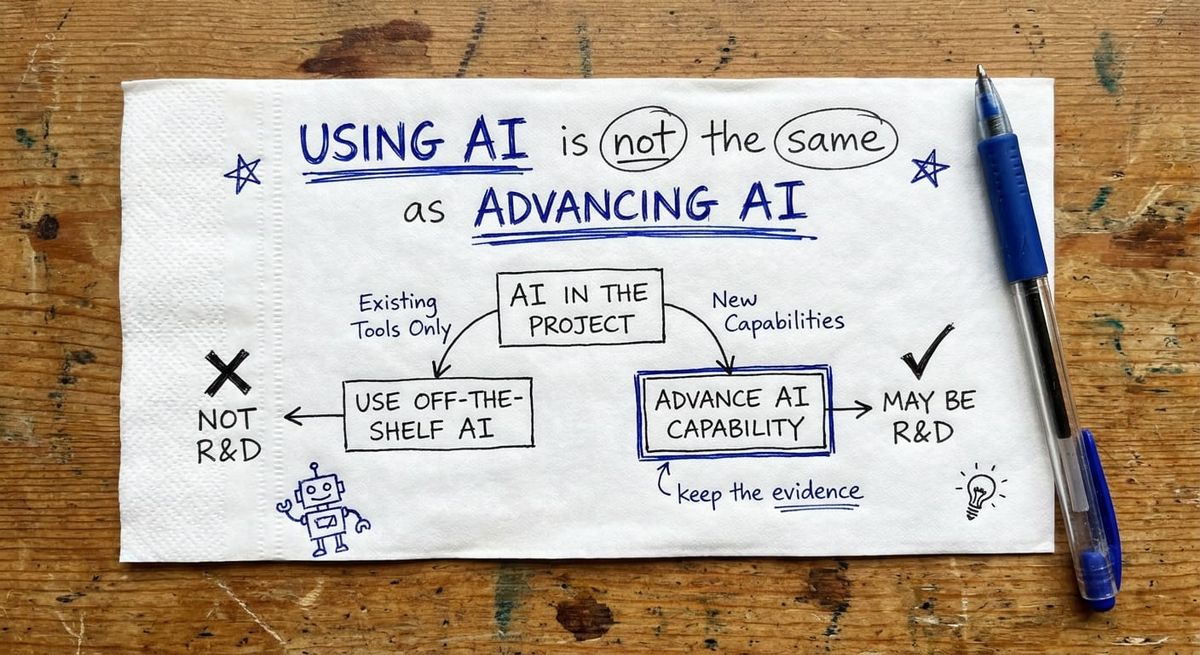
Using off-the-shelf AI tools to run or improve your business is generally not qualifying R&D. Building or materially changing AI capability can be, but only where you were trying to resolve a scientific or technological uncertainty that a competent professional could not readily resolve, and only for the work that did that. The test turns on the project, not on the label "AI".
Founders and their accountants ask me the same question in different forms.
We use AI everywhere, so can we claim? We built an AI product, so does that qualify automatically? The honest answer to both is that it depends on what you were trying to achieve and what you had to figure out to get there.
This article explains where the line sits under the statute, the DSIT Guidelines and HMRC's manual, what recent First-tier Tribunal decisions add, what evidence to keep, and how the merged scheme treats AI costs. It is written for a founder or finance lead deciding whether to claim, and for the accountant advising them.
Table of Contents
- What is the difference between using AI and advancing AI?
- What does the law say counts as R&D?
- Why does applying an off-the-shelf AI tool usually fall short?
- When can building with AI qualify as R&D?
- How do advance in capability and the Tanglewood decision bear on the line?
- Has AI moved the baseline for what is readily deducible?
- What evidence should you keep for an AI project?
- How do the merged scheme rules work for an AI company?
- What do you need to file before you claim?
- Which AI costs can qualify?
- Frequently asked questions
- Getting the line right before you claim
What is the difference between using AI and advancing AI?
Using AI means you buy or license a model, tool or platform and apply it to your own work. Examples are drafting, support triage, document review, forecasting, coding assistance and workflow automation.
Advancing AI means you set out to make AI do something that a competent professional could not readily make it do from what is publicly available, and you had to resolve genuine technological uncertainty to get there.
The statute does not ask whether your product contains AI. It asks whether a project sought an advance in science or technology. A business can use AI heavily and do no R&D at all, and a small team can assemble existing parts and still do qualifying R&D if the combination was not readily deducible.
Key takeaway: The question is never "do we use AI". It is "what were we trying to achieve, what did a competent professional not know how to do, and what did we do to find out".
What does the law say counts as R&D for tax purposes?
Four paragraphs do most of the work:
- Paragraph 3: R&D takes place when a project seeks to achieve an advance in science or technology.
- Paragraph 6: an advance means an advance in overall knowledge or capability in a field of science or technology, not a company's own state of knowledge or capability alone.
- Paragraph 13: uncertainty exists when knowledge of whether something is technologically feasible, or how to achieve it in practice, is not readily available or deducible by a competent professional working in the field.
- Paragraph 14: uncertainties that can readily be resolved by a competent professional are not uncertainties, and optimisation and fine-tuning that do not materially affect the underlying technology do not count (fine-tuning here means adjusting a working system, not the machine learning technique of further training a model).
Paragraph 20 fixes the baseline. Overall knowledge or capability is what is publicly available or readily deducible from it by a competent professional.
Why does applying an off-the-shelf AI tool usually fall short?
Because the Guidelines say so in terms. Under paragraph 8, a product or service does not become an advance simply because technology is used in its creation.
Under paragraphs 12 and 22, routine copying or adaptation of an existing product does not advance overall knowledge, even if it is completely new to your company. Paragraph 24 adds that deploying existing technology in a new context with only minor or routine changes is not an appreciable improvement.
HMRC's software page makes the same point about configuration. It says that customising software by configuring it to a company's own requirements is unlikely to be qualifying R&D, because that is generally already within the capability of the existing software (CIRD81960). The Guidelines' own example D2 reaches the same result for software built to analyse market research data and then adapted to analyse customer spending patterns.
On that reasoning, connecting a commercial model to your CRM, writing prompts and workflows for your team, or switching on a vendor's AI features sits on the wrong side of the line. The work may be valuable and difficult for you. Difficult for you is not the test.
When can building with AI qualify as R&D?
The clearest authority is Get Onbord Ltd v HMRC [2024] UKFTT 617 (TC), where the taxpayer won. The company built an AI system for know-your-client verification and risk profiling. It used existing components with a large amount of new code written around it.
The Tribunal accepted that using existing code, open-source material or other technologies does not of itself make a development routine, and that not every component must be novel. It was satisfied that the technology was not publicly available or readily deducible, was more than routine adaptation, and required resolution of technological uncertainty that a competent professional could not readily resolve. The Tribunal gave real weight to a witness who understood the field, and it did not treat the use of AI as the point.
HMRC's software guidance gives further examples of qualifying uncertainty. They include extending a framework beyond its design where the method was not readily deducible, and solving a problem that computer scientists document as a subject of research (CIRD81960). Paragraphs 29 and 30 of the Guidelines add that combining standard technologies can qualify where a competent professional cannot readily deduce how to combine them.
Has AI moved the baseline for what is readily deducible?
Projects which sought an advance in earlier years may not qualify now, because technological capability has increased and solutions to earlier uncertainties have become available or readily deducible (CIRD81960). If a capable engineer with current AI tools can solve your problem in an afternoon, it is hard not to conclude that the answer was readily deducible.
Using AI to help with the work does not disqualify the project, but it sharpens the question of what was left unresolved after the tools had done what they could.
What evidence should you keep for an AI project?
Keep records made at the time, because the burden of proof is on the claimant. The Tribunal in Get Onbord said so, and in Tanglewood the absence of expert evidence and of a systematic process counted against the company. These are the records I would want to see on file:
- A baseline note at the start: what existing models, tools and published methods you looked at, and what they could not do.
- An uncertainty log: the specific technical questions you could not answer in advance, in plain language.
- Experiment records: what you tried, the evaluation results, the failures and what you changed. Version history helps, and in Get Onbord the company pointed to the code held in its repository.
- Evidence of alternatives tried first, such as an off-the-shelf model or a standard architecture, with results showing why it was not enough.
- The named competent professional, with their experience, who can speak to the field and be questioned. Flame Tree Publishing Ltd v HMRC [2024] UKFTT 349 (TC) failed partly because neither key witness was a competent professional in software.
- Time records tied to project work. Flame Tree also failed on estimated time allocations that nobody could explain.
- Payroll records for staff costs and invoices for compute, data and model access tagged to the project.
The Tribunal in Get Onbord wisely suggested that a claimant ideally produces one document marshalling the technical evidence, including competent professional evidence.
Which AI costs can qualify?
The categories are staffing costs, software, data licences, cloud computing services, consumable items and externally provided workers.
In practice, training and evaluation compute, data licences used to build or test the model, and an AI coding tool used by engineers on the qualifying project can be considered. Inference costs for your live product generally cannot qualify. Tools used across the business may not either, although HMRC says software used by the HR department for routine work related to the R&D staff is included (CIRD134000), so look at what each tool is actually used for.
Payments to external developers or AI contractors are restricted. For unconnected contractors and externally provided workers, the qualifying element is 65% of the payment and work done overseas is restricted unless an exception applies.
Frequently asked questions
Is using ChatGPT or Copilot in my business R&D?
Generally no. Applying an existing tool to your own work is deploying existing technology in a new context, which paragraphs 8, 22 and 24 of the DSIT Guidelines exclude. The tool's cost can only qualify as software if it is employed directly in a project that is itself R&D.
Does using AI coding tools stop my software work qualifying?
No. The Guidelines apply equally to all fields of technology, and the tools you use do not decide whether the project is R&D. They do affect the baseline, because a competent professional is likely to be treated as working with current tools. Your records should show what remained uncertain after those tools had done what they could.
Can fine-tuning or training a model qualify?
It can, if the work sought an advance and resolved uncertainty that was not readily deducible. It will not qualify merely because it is technically demanding. Optimisation and fine-tuning that do not materially affect the underlying technology are excluded by paragraph 14, so the evidence needs to show a real technical gap. Paragraph 14 uses fine-tuning in the engineering sense of adjusting a working system. It does not rule out machine learning fine-tuning as such, which is judged on the same test as any other work.
Do I need a PhD to be the competent professional?
No formal qualification is required. In Get Onbord the Tribunal accepted a witness without formal software qualifications because he had experience, current knowledge and could explain the field fluently. In Flame Tree Publishing the witnesses did not have the necessary software expertise and the claim failed.
Can I claim compute and API costs?
Cloud computing services and data licences can qualify where they are employed directly in qualifying R&D, with apportionment where use is mixed. Costs of running your live product and indirect activities do not qualify.
Do I need to tell HMRC before I claim?
A claim notification may be needed within six months after the end of the period of account (if you haven't filed a valid claim in the past three years) and an additional information form is needed with each claim. Check both before filing, as an invalid claim cannot be rescued by a good narrative.
Getting the line right before you claim
The dividing line is not AI versus no AI. It is whether the project sought to advance capability in a field of technology by resolving uncertainty that a competent professional could not readily resolve, and whether you can prove it.
If you are weighing a claim for an AI project, test it before you file. Write the baseline, name the uncertainties and identify your competent professional. If you cannot do those three things, the claim is unlikely to survive an enquiry.
I have defended software R&D claims against HMRC, including a claim of more than £200,000 where fraud was alleged. Another for £1m+.
I work directly with founders and behind accountants who want a second opinion on where an AI project sits. You can get in touch to discuss an AI R&D claim and I will tell you plainly which side of the line it falls on. If HMRC has already opened an enquiry, start with my page on R&D enquiry defence.
This article is general guidance, not advice for your specific circumstances. Whether a project qualifies depends on the facts and the evidence. Take advice before acting.