How to Choose a SEIS or EIS Adviser in the UK (and Why Specialism Actually Matters)
Choosing a UK SEIS or EIS adviser? Here are the tests a true specialist runs, the questions to ask, and the traps generalist firms still miss in 2026.

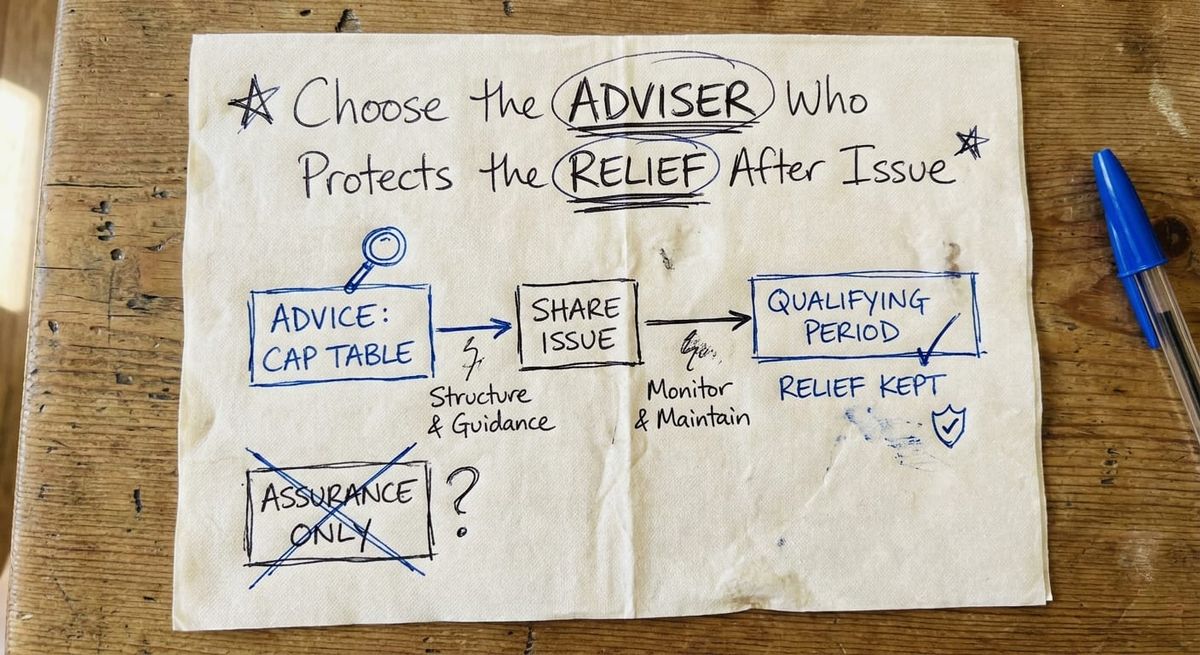
Many companies raising under SEIS or EIS start looking for an adviser only when investors ask for advance assurance, and then screen on price and turnaround rather than on whether the relief will survive an HMRC check after the shares are issued. By then the structure is fixed, the cap table is set, and the shares may already have been issued.
The difference between a strong SEIS or EIS adviser and a weak one is often not visible at the advance assurance stage. It shows later, if HMRC withdraws or reduces relief (for example for value received under s.213 ITA 2007), and someone has to defend a position that was set up at the start.
What a SEIS or EIS adviser is actually doing for you
The headline service most firms describe is "SEIS and EIS advance assurance applications". That is one document among many. The actual work spans four workstreams.
- Structural diagnosis comes first: testing the issuing company conditions, including the gross asset and employee limits, the qualifying business activity, and the risk-to-capital condition.
- Sequencing comes second: SEIS issue is barred if any EIS or VCT investment has been made in the company on or before the day the SEIS shares are issued, so a premature EIS issue can close off SEIS for that company.
- Documentation comes third: advance assurance applications to HMRC's Venture Capital Reliefs (VCR) Team are non-statutory and discretionary, are not valid if relevant facts are not disclosed, and carry no right of appeal against the VCR Team's decision.
- Defence comes fourth: relief can be withdrawn or reduced after issue, including where the investor receives value from the company, or where a qualifying condition ceases to be met during the qualifying period.
The five tests a competent SEIS or EIS adviser will run before they even quote
If a firm offers you a fixed fee for "SEIS and EIS advance assurance" in the first call, before they have looked at your cap table, it is worth asking what the price assumes.
A careful adviser will run a short diagnostic across five inputs:
- the cap table at the planned point of share issue, including all founders, employees, options, ASAs, convertibles, and any group structure. The control and independence test and the connected persons rules are common pressure points.
- the trade history. SEIS requires a "new qualifying trade" under s.257HF: the trade must not have begun, whether with the issuing company or any other person, before the three years ending on the day the shares are issued, and no other trade can have been carried on earlier by the issuing company or its 51% subsidiaries. EIS uses a different age test in s.175A ITA 2007: shares issued after the initial investing period (seven years from the first commercial sale, or ten for a knowledge-intensive company) must meet one of conditions A, B or C. Where a trade has been spun out or restarted, check the predecessor's history, because both tests look beyond the issuing company's own record.
- the source and use of funds. The money raised must be used by the issuing company (or a 90% subsidiary in SEIS, a qualifying subsidiary in EIS) for a qualifying business activity. Where investors are foreign, where founders are also investors, or where the company is part of a group, the use-of-funds test can interact with the connected persons rules.
- the genuine commercial proposition. Risk to capital is not a documentation exercise. HMRC says it will look "in the round" at the company, the prospective investment and any associated arrangements.
- what has already happened: shares already issued, advance assurance previously refused, prior R&D claims, prior EMI grants, prior receipts of value by investors. Several of these cannot be unwound.
If a firm does not ask for these five inputs at the diagnostic stage, ask how it intends to test eligibility.
Why "we've got advance assurance" is not the answer to "is the relief safe?"
A common assumption is that advance assurance settles the question. It does not. Advance assurance is a discretionary opinion from HMRC's VCR Team based on the facts disclosed at the date of the application.
Per VCM60110:
An advance assurance becomes invalid if the company "has not disclosed all the relevant facts, or circumstances change between the time of the advance assurance and the share issue".
HMRC's own guidance is clear that an advance assurance is given for a particular share issue, is not an assurance of relief for any particular investor, and is not valid if circumstances change before the share issue.
It does not protect against a later receipt of value under s.213 ITA 2007 (EIS) or s.257FE (SEIS), a failure of the independence requirement during the qualifying period, or a change in the trade. The withdrawal provisions operate independently of any earlier assurance. An adviser whose service ends when the assurance arrives has dealt with the application, not with the qualifying period that follows.
Where relief is most exposed after issue
Three areas deserve particular attention when you test any adviser's approach.
- Sequencing on mixed SEIS and EIS rounds. An EIS investment (shares issued, with a compliance statement provided) or VCT investment made on or before the day the SEIS shares are issued bars that SEIS issue, and same-day issues do not help. Once an EIS issue has been made, the SEIS position cannot be repaired afterwards.
- Value received. The rules reduce or withdraw relief where the investor receives value from the company during the relevant period, and VCM15060 lists the circumstances, including payments or assets received on a winding up or dissolution. The rules continue to apply throughout the qualifying period, so post-issue events need monitoring.
- Risk to capital. The condition turns on all the circumstances at the time of issue, with no bright lines (VCM8500). A company that looks qualifying on paper, even with assurance granted, can still fail where the commercial reality at share issue does not match what was disclosed.
The questions to ask before you instruct a SEIS or EIS adviser
The right diligence question is not "have you done SEIS and EIS work before?". Many accountancy firms will have filed an assurance. Ask sharper questions.
- How many advance assurance applications did you submit in the last twelve months, and how many were refused at first instance? A record with no refusals is worth probing, because it may reflect the cases the adviser chose to take on.
- How do you handle sequencing on a mixed SEIS and EIS round, and what conditions do you write into the term sheet to control completion order?
- Can you point to written advice you have given in the last six months on the risk-to-capital condition?
- What happens if HMRC opens an enquiry into one of your assurances after issue: do you handle the defence in-house or refer it on? If defence is referred out, you need to know to whom and on what terms.
- Have you represented a client through a compliance check or advance assurance refusal on an EIS or SEIS matter?
What good looks like, and when you do not need a specialist
The engagements that run cleanly share four characteristics:
- a written eligibility memo before any application is drafted, anchoring each condition to statute and VCM reference;
- sequencing built into the term sheet, with SEIS completion as a condition precedent to any EIS receipt;
- an application that discloses the points of doubt rather than concealing them, as VCM60110 requires (it asks the company to "highlight any areas of doubt"); and
- documentation filed against the holding period, with annual reviews of any post-issue events that might constitute receipt of value.
An adviser who works to that standard is not the cheapest, and not usually the fastest. But the relief is durable.
Not every round needs a specialist. A first-time founder raising a small SEIS round of £100,000 to £150,000 with friends and family investors, no group structure, no foreign investors, and a clean cap table can often be served well by a competent generalist. The EIS changes for shares issued on or after 6 April 2026 (higher gross assets, annual and lifetime limits) widen the regime but do not change the diagnostic.
You do need a specialist where any of the following are true:
- mixed SEIS and EIS in the same round,
- group structures or 51% subsidiaries,
- founders investing alongside external investors,
- prior advance assurance refusal,
- non-UK parent companies,
- sector-specific commercial models touching on excluded activities (VCM3000),
- restart or successor ('phoenix') entities following a winding up, or any meaningful risk-to-capital exposure.
The relief has to be kept through the qualifying period after the share issue. An advance assurance is an opinion on the application, not a guarantee of the outcome.
Frequently asked questions
How do I choose the best SEIS or EIS adviser in the UK?
Screen on diagnostic depth, not on price. A competent SEIS EIS adviser will ask for the cap table, trade history, source and use of funds, commercial proposition, and prior history before quoting. They should be able to handle defence work as well as advance assurance, and to point to written advice on the risk-to-capital condition (s.157A and s.257AAA ITA 2007) and to direct experience of HMRC enquiries into venture capital reliefs.
What is the difference between a SEIS and EIS specialist and a generalist accountant?
A specialist works in the regime regularly and anchors advice to the statute and the HMRC guidance. A generalist may be fully capable on a straightforward round, but should be asked how they handle the value received rules, the independence requirement and the disqualifying arrangements provisions during the qualifying period, because that is where relief can be withdrawn after the application stage has finished.
Is advance assurance enough to protect SEIS or EIS relief?
No. Advance assurance is a discretionary opinion from HMRC's VCR Team based on disclosed facts at the date of application. Per VCM60110, an advance assurance will not be valid if relevant facts were not disclosed or circumstances change before the share issue. Withdrawal of relief under VCM15000 or VCM36000 can occur for events during the holding period that no advance assurance can pre-empt, including receipt of value under s.213 or s.257FE ITA 2007.
How much should a UK SEIS or EIS adviser cost?
Fees vary with the complexity of the round, so ask for a written scope and price (plus VAT) before the work starts, and check what it covers: the application only, or also the compliance statement and post-issue monitoring. Mixed rounds, group structures, founder participation and cross-border elements will usually need more work. The cost of getting it wrong falls mainly on investors, because withdrawal of relief is assessed on the investor's tax relief with interest (VCM15010).
What questions should I ask before instructing a SEIS or EIS adviser?
Ask how many advance assurance applications they submitted in the last twelve months and how many were refused. Ask how they handle sequencing on a mixed SEIS and EIS round. Ask whether they have given written advice on the risk-to-capital condition in the last six months. Ask whether they handle HMRC enquiries themselves or refer them on. Ask whether they have represented a client through HMRC challenge or compliance check on a venture capital reliefs matter.
Closing
If you are choosing between SEIS or EIS advisers in the UK in 2026, the question is not who can deliver an advance assurance fastest. It is whose engagement is structured to protect the relief through the qualifying period. Reach out for specialist assistance.
Steve Livingston FCA is the principal at IP Tax Solutions Ltd, a UK tax advisory firm specialising in venture capital reliefs (SEIS, EIS, VCT), R&D tax credits, EMI, and Patent Box.