Wine in a Can: What RDM Wines v HMRC Tells Us About R&D Evidence
RDM Wines lost its R&D claim for canned wine on the evidence. The missing paper trail, the late letter and the advance test, and what it means for your claim.

RDM Wines Limited lost its R&D appeal at the First-tier Tribunal because it could not prove what it did, when it did it, or that its activities were aimed at an advance in the field's overall knowledge or capability. The decision, RDM Wines Ltd v HMRC [2026] UKFTT 1348 (TC), was released on 24 September 2026.
Contents
- The Case in Short
- The Burden Sits With the Claimant
- The Timeline That Did Not Hold
- The Letter Produced Days Before the Hearing
- Staff Costs With No Staff Evidence
- No Project, No Method or Plan
- No Advance: The Industry Guide Was Already There
- A Commercial Choice, Not a Research Question
- What I Would Keep, and When
- Does This Decision Bind HMRC?
- Frequently Asked Questions
- If HMRC Has Challenged Your Claim
The Case in Short
RDM Wines Limited, trading as Fine Wines Direct UK, imports and distributes fine wine. It amended its corporation tax return for the accounting period ended 31 October 2021 to claim R&D relief. HMRC opened an enquiry into the amendment on 26 April 2023, issued a closure notice on 18 December 2023 and upheld it on review on 31 October 2024. RDM appealed on 20 November 2024. The amount in dispute was £43,387.01: additional corporation tax of £14,972.95 and repayment of a tax credit of £28,414.06.
The project, as RDM put it, was to create a high quality single varietal organic wine in a can for events where drinks cannot be sold in glass. Most of the technical work was said to have been carried out by a South African winery, Riebeek Valley Wine Co, through an iterative programme of trials in 2021 and 2022. RDM said the programme tested can linings, gases and can sizes, and that it was ultimately unsuccessful.
The Tribunal decided in HMRC's favour as RDM's appeal was dismissed.
The Burden Sits With the Claimant
The Tribunal started where every R&D appeal starts. The burden is on the appellant to prove the facts it relies on, on the balance of probabilities.
The challenge was to the reliability of the evidence, particularly given the passage of time and the fallibility of memory, and the Tribunal said that a finding that the standard of proof has not been met "is not the same thing as concluding that there was dishonesty in the evidence".
Evidence is required to prove that the projects sought to achieve an advance in science or technology and that, as part of that project, the claimant carried out activities which sought to resolve a scientific or technological uncertainty as defined by the Guidelines.
It cited Beer Express Ltd v HMRC [2026] UKFTT 672 (TC) at [94] and AHK Recruitment Ltd v HMRC [2020] UKFTT 232 (TC) at [68] for that formulation.
The Timeline That Did Not Hold
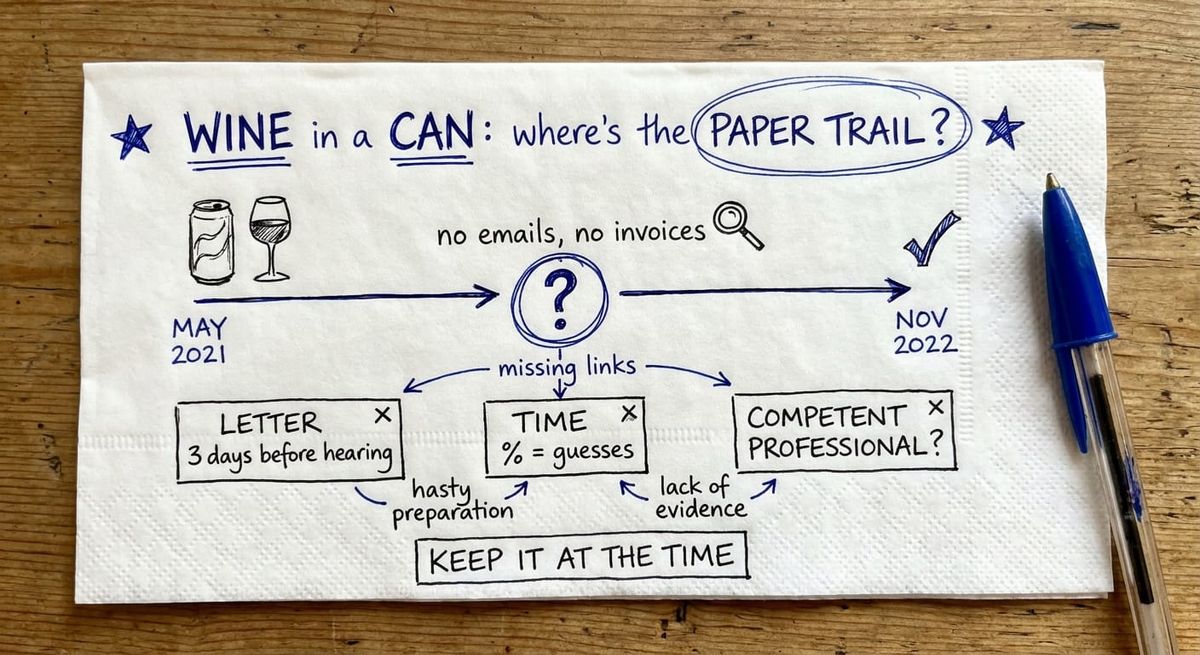
RDM's case was that work with Riebeek began in May 2021 and ran as an iterative process until November 2022. The Tribunal found, on the balance of probabilities, that the relationship began in or shortly before November 2022.
Its reasoning is a useful study in how a tribunal reads documents:
- It first asked what paper it would expect to exist if the relationship had begun in May 2021. It listed the absence of any emails or correspondence with Riebeek between May 2021 and October 2022, any logs or notes of calls, any Riebeek invoices for services in that period and any contract or terms of engagement.
- It then looked at what documents did exist and what they showed. The email chain about RDM's wine order began on 2 November 2022 and made no reference to any earlier workstream. Riebeek's own internal email described RDM as a "new client". The only Riebeek invoice was for the large order of wine, with the same reference as the purchase order. And RDM's own manager had written in November 2024 that the first material stage in the relationship was the order placed on 4 November 2022.
- The Tribunal also found it unlikely that RDM would place a substantial order for wine in 200ml cans if it had already tested that approach and failed in May 2021. It said that was "a surprising commercial decision". It found the canning run using 200ml cans happened in or after November 2022, and made no finding on the exact date because RDM had no contemporaneous record of it.
Staff Costs With No Staff Evidence
The claim included £139,188 of salaries and wages for RDM staff. The director's own oral evidence was that the technical work was carried out by Riebeek, and that his staff's time was spent on project management and taste testing.
The Tribunal went through the percentages in the claim report one person at a time. The director was said to have spent 35% of his time on the project. Two other directors were put at 15% each, a project manager at 25%, the general manager at 15% and an unnamed operational member of staff at 100%. For the directors, the project manager, the quality control director and the unnamed staff member, the Tribunal found no contemporaneous record of involvement: no emails, no meeting notes and no testing records, and no timesheets were put before it. Only the general manager appears in the documents at all, and then only in connection with buying the wine.
For anyone preparing or reviewing a claim, the lesson is direct. Time percentages are assertions until something shows them to be true. If the time is estimated, record who estimated it, on what basis and when.
No Project, No Method or Plan
The Guidelines define a project as "a number of activities conducted to a method or plan in order to achieve an advance in science or technology" (paragraph 19). The director described an iterative testing process, which could be a method or plan. But the Tribunal had found that RDM had not proved that process happened.
It then looked for other evidence of a plan, and found notable absences: no correspondence on project planning, no records of the unsuccessful tests and no documents setting out alternative approaches in light of the results. Without at least some supporting contemporaneous evidence, RDM had not shown a systematic approach that would amount to a method or plan.
No Advance: The Industry Guide Was Already There
Even apart from the evidence problem, the Tribunal found against RDM on the advance. Four points.
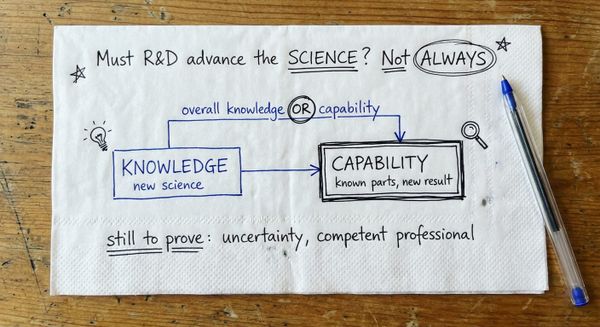
- The guide defined the baseline. The parties agreed that a published article, "The Winemaker's Guide to Wine in a Can", reflected the state of knowledge in the industry, and the Tribunal accepted it as an accurate reflection of the field's overall knowledge and capability at the relevant times. It followed that any activity within the boundaries of the article was not an advance. The guide discussed using nitrogen to fill a can's headspace and prevent oxidation. The director did not give a clear explanation of how RDM's approach differed.
- Novelty is not the test. The director said that sealing 187ml of wine in a 200ml can with inert gas was something no one else was doing. The Tribunal cited B.E. Studios Ltd v Smith & Williamson Ltd and held that uniqueness or novelty is not the relevant test. The claimant has to demonstrate resolution of uncertainty that led to an advance in overall knowledge and capability, not readily deducible to a competent professional.
- No evidence from a competent professional. RDM named its director responsible for quality control, and Riebeek, as competent professionals. Neither gave evidence. The Tribunal could not assess the director's status or whether the work would have increased his knowledge. The winery's letters attested to what it had done, but did not explain the industry's level of understanding or how the tests were meant to resolve uncertainty, and nobody from the winery attended to be asked. The Tribunal adopted the Flame Tree Publishing meaning of competent professional: someone able to demonstrate appropriate qualifications, experience and up-to-date knowledge of the relevant scientific and technological principles. Where the claimant's only witness has said he has no scientific expertise, the competent professional has to come from somewhere else.
Subcontracted R&D: Guidance from the case
The decision lists much of the paper the Tribunal expected and did not find. Turned into a working list, it is a reasonable retention schedule for any claim where the core work is done by a subcontractor or in a niche field.
- A contract, engagement letter or at least email correspondence setting up the work, dated before it started.
- Instructions to the subcontractor, and their feedback on tests as they happen.
- Test results, including the failures, with dates.
- Internal notes or messages recording what was decided after each result.
- Invoices that describe the work, not only the product.
- Timesheets or a documented method for estimating time, written when the work was done.
- The identity and credentials of the competent professional, and a short statement from them of what was uncertain and why it was not readily deducible, ideally written close to the time.
- A note of the industry baseline: what the standard guides, standards and publications said when the project began.
The test is simple: if a tribunal asks where in the paper trail a particular statement in the claim can be found, there should be something evidential to point to.
Frequently Asked Questions
Why did RDM Wines lose its R&D appeal?
Because it did not discharge the burden of proof. The Tribunal found that RDM had not proved an iterative testing process occurred, had not shown a method or plan, and had not shown an advance in science or technology or that its activities were in order to achieve one. HMRC did not allege dishonesty, and the Tribunal said that not meeting the standard of proof is not the same as dishonesty.
Is a letter from a subcontractor enough evidence of R&D activity?
Not on its own, and not when it is produced shortly before the hearing. In RDM Wines the Tribunal gave very little weight to a letter written from memory three years after the events, by an author who did not give evidence, following a meeting with the claimant's representatives, with no contemporaneous records behind it.
Does it matter if the technique is new to the company?
It does not help by itself. The Guidelines test is an advance in overall knowledge or capability in the field, not in the company's own knowledge (paragraph 6). The Tribunal held that novelty is not the relevant test and relied on B.E. Studios.
Who is a competent professional for an R&D claim?
Someone with appropriate qualifications, experience and up-to-date knowledge of the relevant scientific and technological principles, following Flame Tree Publishing. In RDM Wines the person named as the competent professional gave no evidence and the Tribunal could not assess his status.
Can I claim staff time when a subcontractor did the technical work?
The decision does not decide that as a point of law. It does show how a Tribunal tests it. The director's evidence was that the technical work was done by the subcontractor, and the Tribunal looked for evidence that each claimed individual had actually done R&D themselves, and found none.
Can I rely on the R&D report prepared by my claim adviser?
The report in RDM Wines was the basis of the claim, but it did not prove what the staff did. The Tribunal noted that parts appeared generic and that no timesheets were put before it.