Can a New Company Qualify for SEIS or EIS When the Founders Already Run a Similar Business?
Can a new company raise SEIS or EIS when its founders already run a similar business? How the predecessor trade, phoenix and advance assurance tests work.

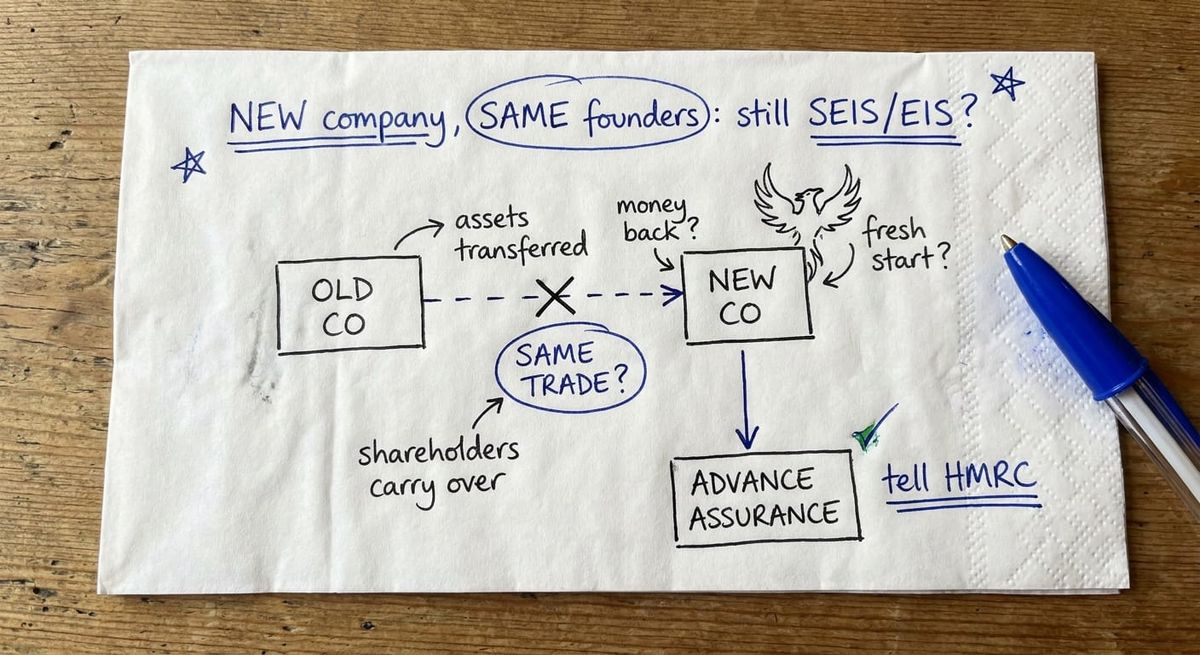
Yes, but only if the new company is a genuinely separate venture and not the old trade moved into a new wrapper. SEIS asks whether the trade is "new" (s.257HF ITA 2007). EIS asks how old the business is (s.175A) and what the money buys (s.175). Both ask whether the structure is a set of "disqualifying arrangements" (s.257CF and s.178A). Tell HMRC about the old company at the advance assurance stage.
Founders with a trading company often want to put a new venture into a new company so that outside investors can back it with tax relief. That is not forbidden. The rules do not ask whether the founders are the same. They ask whether the activity is really new, whether the money ends up back in the old business, and whether HMRC has been told the full story.
This article sets out how each test works, where a similar existing business creates risk, and what HMRC's advance assurance team will want to see.
Table of Contents
- Can founders who already run a similar business use a new company for SEIS or EIS?
- Does SEIS care what the old company does?
- Does EIS care how old the existing business is?
- What are disqualifying arrangements and why do they matter for a phoenix structure?
- Can the new company pay the old company without losing relief?
- Does the risk-to-capital condition matter for a new company carved out of a profitable business?
- What makes a new company look genuinely separate?
- What will HMRC look at in an advance assurance application?
- Frequently asked questions
- Getting the structure right before you incorporate
Can founders who already run a similar business use a new company for SEIS or EIS?
Yes. Nothing in the legislation bars a new company because its founders run, or have run, another business. What matters is whether the new company's own position meets the scheme conditions and whether the arrangements as a whole are acceptable.
Three questions do most of the work:
- Is the trade actually new, or has it been carried on before by the old company or anyone else? (EIS has no new trade test, but looks at when anyone first sold in a trade the new company later carried on.)
- Would the activity naturally have sat inside the old business, and does the investment money flow back to it?
- Has the structure been disclosed in full?
I use "phoenix" below as shorthand for a new company that carries on substantially what a predecessor did. It is not a term used in the legislation, so there is no rule against a "phoenix" as such. There are rules that catch the things a phoenix structure tends to do.
Does SEIS care what the old company does?
Yes, even where the old company is a separate legal entity. SEIS requires the issuing company to carry on a "new qualifying trade" (s.257HF ITA 2007). A trade is new only if both of these are true:
- The trade did not begin before the three year pre-investment period. That is the three years ending immediately before the day the shares are issued, and the test covers a trade begun "by the relevant company or any other person". The period was two years for shares issued before 6 April 2023. HMRC puts it the same way (VCM34020, last updated 14 July 2023).
- No other trade was being carried on by the issuing company or its 51% subsidiaries before this trade began. This looks only at the issuing company and companies that were its own 51% subsidiaries at the time. A sister company owned by the founders is not caught by this limb. It can still matter under the first limb if it began the same trade more than three years before the issue, and if it carries on that trade after the new company starts.
In practical terms, this makes the first limb the live one for founders. If the old company has carried on the same trade for more than three years, a new company starting that same trade is not carrying on a new qualifying trade, however new the company is.
A further rule applies after the issue: the new qualifying trade must not be carried on by anyone other than the issuing company or its qualifying 90% subsidiary at any time in period B, which runs from the share issue to the day before the third anniversary. If the old company carries on that same trade after the shares are issued, that is a problem. There are two exceptions:
- Where the issuing company or its 90% subsidiary is doing preparation work, carrying on of the trade by another company in period B before the issuing company (or that subsidiary) begins the trade is ignored. It covers only carrying on by a company and only the period before the new company starts.
- Separately, if the trade ceases to be carried on by the issuing company or its 90% subsidiary merely because of administration, receivership, winding up or dissolution, and is then carried on by a person who was not connected with the issuing company at any time in period A, the rule is not treated as failed. That exception applies only if the event is for genuine commercial reasons and is not part of a scheme with tax avoidance as a main purpose. Neither exception helps a founder-owned sister company that simply carries on the trade alongside the new company.
SEIS also has a control and independence requirement. The issuing company must not be under the control of another company, or of another company together with a person connected with that other company, at any time in period A (ignoring any period when it was an unused shelf company), and no arrangements may exist by which it could be. It matters here if the old company would hold control of the new one. Founders holding the shares personally, rather than through the old company, avoid that point on its face.
Does EIS care how old the existing business is?
Yes, through the age rule and the use-of-money rule. EIS has no "new trade" test like SEIS. It has these two instead.
- Age: Shares issued after the "initial investing period" need one of conditions A, B or C to be met. The period is seven years from the relevant first commercial sale, or ten years for a knowledge-intensive company. The "relevant first commercial sale" is the earliest of several dates. One of them is the first commercial sale made by any person who previously carried on a trade that the issuing company (or a company that is or has been its 51% subsidiary) later carried on. So if the new company takes over the old company's trade, its age clock can start when the old company first sold. HMRC says the purpose is to stop businesses being moved into a newer company wrapper (VCM8152).
- Use of money: Employing the money raised, on its own or together with other money, on the acquisition, directly or indirectly, of any of five things does not count as employing it for a qualifying business activity. They are an interest in another company such that it becomes a 51% subsidiary of the issuing company, a further interest in a company that is already a 51% subsidiary, a trade, intangible assets employed for the purposes of a trade, and goodwill employed for the purposes of a trade. The "together with other money" wording means mixing investor money with a bank loan does not cure it. HMRC's example is a company that funds the brand name with a bank loan and uses relevant investment money for the plant and machinery of the same business, which still fails (VCM8140, Example 11). HMRC's examples also include that a company may not buy intangible assets that have already been used in a trade, but may buy assets created and not yet used, or commission new ones (VCM8140). Moving the old company's software, brand or customer list into the new company with investor money is the pattern this catches, as is buying the old company's trade or shares in it.
What are disqualifying arrangements and why do they matter for a phoenix structure?
This is the provision that deals most directly with a founder-led new company set up next to an old one. It is s.257CF for SEIS and s.178A for EIS. The wording is materially the same in both. Arrangements are "disqualifying" only if the main purpose, or one of the main purposes, is to secure that a qualifying business activity is carried on by the issuing company and that someone may obtain relevant tax relief on the shares. Then one of two conditions must also be met:
- Condition A: the whole or the majority of the money raised is, in the course of the arrangements, paid to or for the benefit of a "relevant person" (which I use here as shorthand for the statutory phrase "a person who is a party to the arrangements or a person connected with such a party" found in s.257CF(3) and s.178A(3)).
- Condition B: in the absence of the arrangements, it would have been reasonable to expect the whole or greater part of the component activities to have been carried on as part of another business by a relevant person (s.257CF(4) and s.178A(4)).
It does not matter whether the issuing company is itself a party (s.257CF(5) and s.178A(5)). A person is a party only if they have sufficient involvement in the arrangements that it is appropriate to treat them as participating in their purpose, which may be wider than having devised them (Coconut Upper Tribunal, followed in Hoopla Upper Tribunal). In Coconut the Upper Tribunal noted that one company is connected with another where the two are under common control, so a company under the same control as a party can be a relevant person.
For a founder-led structure the practical point is that the founders who devise the new company, and any company they control, are the most likely parties and relevant persons. Money paid to them or their companies out of the funds raised can therefore count towards Condition A. "Arrangements" includes any scheme, agreement, understanding, transaction or series of transactions, whether or not legally enforceable (VCM12100 and VCM33080).
HMRC describes the target as delivering tax-advantaged finance to another entity or project that would not itself qualify, or whose owners do not want to give up equity. It gives as an example a business fragmented in a commercially unusual way (VCM12100 and VCM33080). Condition B is where an existing business is most exposed. If the activity is the natural next line of the old company, HMRC may ask why it needs a separate company at all. The Upper Tribunal in Coconut observed that the purpose conditions in the first part of the test will be met in most share issues designed to qualify, so Conditions A and B are where the argument is usually won or lost.
Can the new company pay the old company without losing relief?
Sometimes, but payments to the old company are where I would look first. Condition A asks whether the majority of the money raised is paid to or for the benefit of a relevant person. If the old company is a relevant person, a services agreement, an IP licence fee, a management charge or a subcontract with it can all be payments to it. The same goes for payments to the founders themselves or to other companies they control, drawn from the money raised.
The Upper Tribunal has taken a broad view of this. In Coconut Animated Island Ltd v HMRC [2024] UKUT 75 (TCC), a SEIS case under s.257CF, it held that "paid to or for the benefit of" can extend to a payment made under a contract whether or not it is on commercial arm's length terms. In Hoopla Animation Ltd v HMRC [2025] UKUT 28 (TCC), an EIS case under s.178A, it followed Coconut and upheld HMRC's refusal. Both involved a production services agreement with a related group company. In Hoopla the Upper Tribunal added that nothing in Condition A stands in the way of ordinary subcontracting as such, and that it bites only where the counterparty to a contract that forms part of the arrangements is a relevant person as defined. In Coconut it expressly left open whether a supplier unaware of the purpose of the arrangements and only peripherally involved would be a party, and it did not decide Condition B.
That last point cuts both ways. The First-tier Tribunal found Condition B not met in both Coconut and Hoopla, which is some comfort for a structure where the new activity would not naturally have sat in the old business. Neither Upper Tribunal decided Condition B, though, because Condition A disposed of each appeal. In Hoopla it expressly declined to rule on it, and HMRC's argument is recorded there as concerning "Condition B in s178A(4A)" (subsection numbering as in the current vault text, which has only s.178A(4)). Condition B is therefore not settled, and I would not treat the First-tier findings as a safe harbour.
HMRC's advance assurance guidance lists indicators of disqualifying arrangements. They include most of the work for customers being done by people other than the company's own employees, and all or most of the money raised being paid to a party the work is subcontracted to before the work is done, while the customer pays only on completion (VCM60160 for EIS and VCM60260 for SEIS, both last updated 8 October 2019). Those indicators matter only where there is some reason to think disqualifying arrangements exist. Subcontracting as part of normal trading is not itself a problem.
Does the risk-to-capital condition matter for a new company carved out of a profitable business?
It can. Both SEIS and EIS rules ask whether, on the circumstances at the time of issue, it is reasonable to conclude that the issuing company has objectives to grow and develop its trade in the long term and that there is a significant risk of a loss of capital greater than the net investment return. Among the circumstances that may be considered are the extent to which others participate in or devise the company's ownership or management structure, and the extent to which activities are subcontracted to unconnected persons.
A new company carved out of a profitable similar business can struggle with the "objectives to grow and develop" limb if it looks like an extension of the old company and not a venture with its own ambitions. In Hoopla the Upper Tribunal recorded HMRC pressing the risk-to-capital condition but declined to decide it, so there is no Upper Tribunal ruling to lean on either way. The First-tier Tribunal in Hoopla concluded the objective to grow and develop was reasonably made out on its facts, which shows the point is fact-specific. The business plan should say plainly how the new company grows in its own right.
There is no statutory checklist, and what follows is my own approach, not HMRC's. I would test whether each of these can be stated plainly and evidenced:
- A different trade in substance. Different customers, product or technology, not just a different brand name.
- IP with a clean history. Owned or licensed from a source other than the old company, or created new. If it comes from the old company, I would want a clear answer to s.175(1ZA) for EIS.
- No transfer of the old business. No customers, contracts, staff or operating assets moving across.
- Most of the money stays in the new company. Spent on its own people and activity, with any payments to the old company priced, limited and not the majority.
- The old company does not carry on the same trade. If it carries on the very trade the new company runs, s.257DC for SEIS is in play, and for SEIS the new trade test comes first.
- A commercial reason for a separate company. Written down, and not tax relief.
None of these is a safe harbour. The facts decide, and one weak point can undo several strong ones.
What will HMRC look at in an advance assurance application?
Advance assurance is a non-statutory, discretionary service run by HMRC's Venture Capital Reliefs team (VCM60010). You do not need it before issuing shares, but it cannot be sought once shares have been issued. The company must already exist and have a UTR (VCM60110 for EIS and VCM60210 for SEIS).
HMRC expects full disclosure of the company's structure and activities, and of any area of doubt. An assurance based on limited disclosure is not valid. HMRC may decline to give an opinion if the information is not enough, or where the disqualifying arrangements requirement is not met. There is no right of appeal against its decision.
For a founder with an existing business that means the old company, its trade, any shared IP, staff, premises and payments between the companies, and the reason for the new company should be set out up front. HMRC is also not bound by an assurance where the substance of the activities turns out to be different from what the application set out. A company that has never raised under these schemes must also give details of the investors it expects.
Frequently asked questions
Can a new company raise SEIS if its founders already run a company in the same industry?
Yes. Shared founders and the same industry are not disqualifying on their own. The tests look at the trade itself. For SEIS the trade must be new, which means it must not have begun more than three years before the share issue, whether the old company or anyone else carried it on (s.257HF).
Is a "phoenix" company allowed under SEIS or EIS?
The legislation does not use the word. A new company can qualify even where it follows a predecessor. The risk is in what the structure does. The relevant tests are the new trade or age rules, the use-of-money rule for EIS and the disqualifying arrangements provisions (s.257CF and s.178A).
Can the old company licence IP or services to the new company?
It can be done, but it needs care. Payments to the old company can fall within Condition A if they are the majority of the money raised, and the Upper Tribunal has said an arm's length commercial contract can still be caught (Coconut and Hoopla). For EIS the investor money also cannot be spent on intangible assets employed in a trade (s.175(1ZA)).
Does it matter if the old company has already raised SEIS or EIS?
The SEIS rule on previous investments (s.257DK) covers prior EIS, VCT, and other state aid risk capital investments (such as the now-closed Social Investment Tax Relief). It asks whether any such investment has been made in the issuing company, or in a company that is a qualifying subsidiary of the issuing company at the time the shares are issued (s.257DK(1)(a) and (b)). A separate old company's EIS, VCT, or other state aid history is therefore not caught by that rule as such. The old company's own SEIS history is not an s.257DK point at all. The history should still be disclosed. The age rule for EIS and the disqualifying arrangements provisions can still apply. The position of the old company's own investors is a separate question that I do not cover here.
Can I apply for advance assurance before the new company exists?
No. The company must have been formed and have a UTR before it can use the service.
Getting the structure right before you incorporate
The expensive mistakes with a new company beside an old one are made before the company exists, when the IP, the staff and the money flows are decided. Those are cheap to fix on paper and hard to unwind afterwards.
If you are an accountant or adviser with a founder client in this position, or a founder weighing up a new company, I work both directly with founders and behind accountants and solicitors. You can get in touch to talk through the structure and I will tell you plainly where the risk sits on your facts. For the wider service see SEIS and EIS advisory, and if you are a professional adviser see how referring a complex structuring matter works.
This article is general guidance, not advice for your specific circumstances. The SEIS and EIS conditions turn on the detailed facts, the share issue date and the documents. Take advice before acting.