SEIS Advance Assurance Refused: How to Turn It Around and Get Approval
HMRC refused your SEIS advance assurance? Here is the specialist process to identify the real issue, fix it, and get the SEIS1 approved on resubmission.

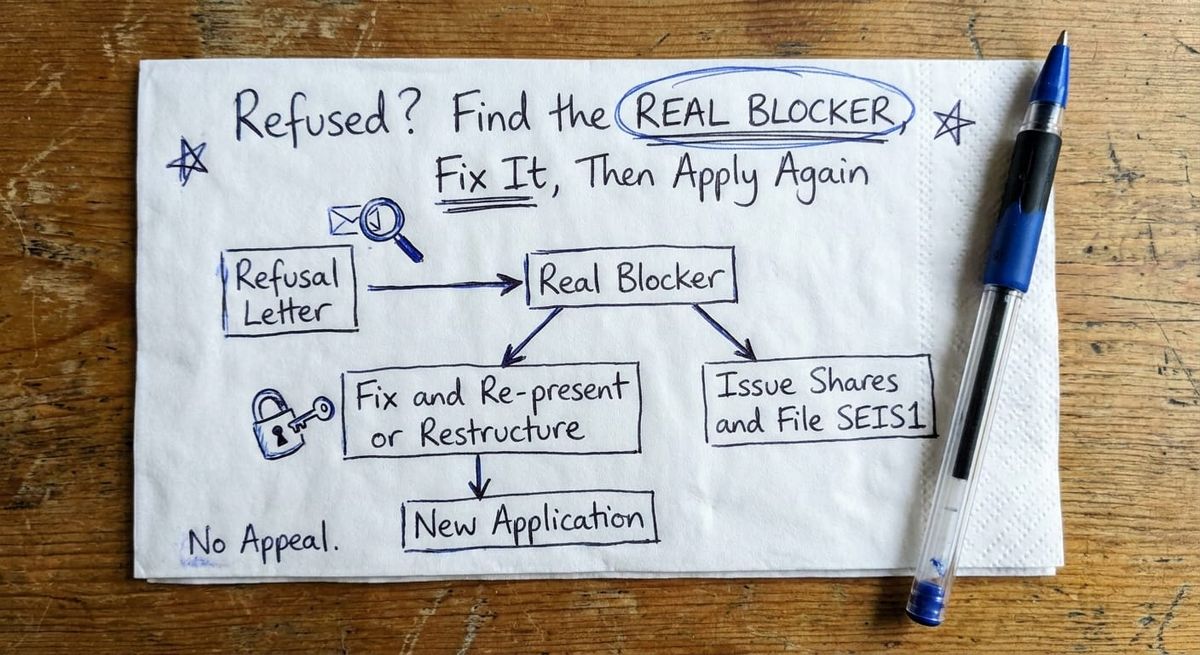
If HMRC has declined to give SEIS advance assurance on your share issue, "what do you do next?" This article sets out the practical work involved when the company, or its adviser, wants to put the issue right and resolve it with HMRC. It assumes you understand the basics of the SEIS regime and that you have already received an unfavourable response from HMRC's Venture Capital Reliefs (VCR) Team.
Read the Refusal Letter Properly Before You Do Anything Else
HMRC's guidance says that where the VCR Team cannot give an advance assurance, a brief explanation of the reason will be given, and that it is then entirely the company's responsibility to decide what amendment, if any, to make to its proposals (VCM60270). A short explanation is therefore all you should expect, and the work of finding the real blocker (or breakthrough) falls to you.
Before drafting a response, work through the letter and identify the following three key points:
- What specific condition or guidance reference is HMRC citing for the objection?
- What facts in the application has HMRC drawn on to reach that view?
- What evidence or change would, on its own, remove the obstacle?
If HMRC says the proposed investment does not meet the risk-to-capital condition in s.257AAA ITA 2007, for example, the cited condition is risk to capital. The facts HMRC has drawn on are likely to include the term sheet, the use-of-funds narrative, and any investor-protection language in the Articles or shareholders' agreement. The change required is rarely one document. It is the consistency of the package as a whole.
HMRC Limits How Much Correspondence It Will Enter Into
HMRC's published guidance (VCM60270) says that once it has provided an opinion it will engage in no more than two rounds of correspondence about the circumstances of the investment. A related page (VCM60050) adds that the VCR Team will not enter into protracted correspondence where it considers an investment would not be eligible or it is unable to reach a decision, will look at new information supplied, and may decline to correspond further once a decision is given. Each round spent asking general questions or sending partial information is one less round available to move the file forward.
In practice the next letter to HMRC needs to do three things at once:
- acknowledge the specific concern raised,
- provide the evidence or restructuring that addresses it, and
- close out any secondary issues that could come up if HMRC re-examines the application.
Where the details of the proposed investment change, HMRC's guidance (VCM60270) says the company must submit a new application. Whether to correspond further or to apply afresh is a judgement call that depends on how far the facts have moved, and the guidance does not say how a fresh application is counted against the earlier one.
Tactical Fixes by Refusal Type
The work required depends on which condition HMRC has identified as the problem. HMRC's guidance (VCM60250) lists the main situations in which it will decline to give an assurance: the information or the nature of the activity does not let it reach a conclusion, tax avoidance concerns, aggressive tax planning, an investment outside the principles of the scheme, a loophole, or a failure of the risk-to-capital condition or the disqualifying arrangements requirement. The categories below follow that list and the statutory conditions.
Risk to Capital
Under s.257AAA ITA 2007 it must be reasonable to conclude, having regard to all the circumstances at the time the shares are issued, that the company has objectives to grow and develop its trade in the long term, and that there is a significant risk of a loss of capital of an amount greater than the net investor return, taking into account the value of SEIS relief. HMRC's guidance (VCM8540) says an investment protected by assured future income streams or capital repayment is unlikely to meet the condition, and that marketing which presents an investment as low risk is likely to indicate capital preservation (VCM8542). It also says a company set up solely to deliver a project or a limited series of projects would not be considered to have objectives for long-term expansion.
The fix is rarely a redrafted business plan. It usually means looking at the share rights, any shareholders' agreement or side arrangements, and the investor-facing materials together, and removing anything that protects investors from loss or describes the investment as low risk. Where the business model itself looks like a capital-preservation arrangement, the question may be whether the company can meet the condition at all. HMRC says it will not provide an advance assurance where, on the facts available, the investment appears likely to fail this condition (VCM8550).
Trade Timing
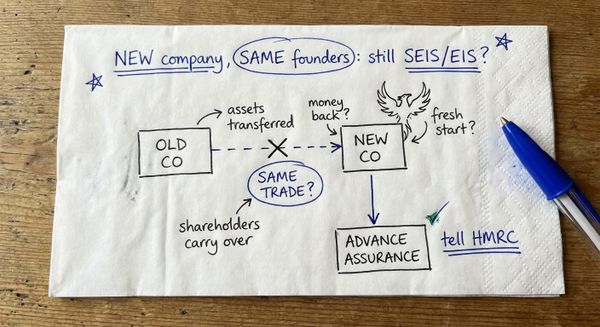
For shares issued on or after 6 April 2023, a qualifying trade is a "new qualifying trade" only if it did not begin to be carried on, by the company or any other person, before the three-year period ending immediately before the share issue, and no other trade was being carried on by the issuing company (or a company that was then its 51% subsidiary) before the relevant company began the trade (s.257HF ITA 2007). A predecessor business, or earlier activity that amounts to the same trade, can therefore start the clock earlier than the founder expects. Whether earlier work such as consultancy or paid testing counts as the same trade is a question of fact that needs to be looked at carefully on the particular history. If it was the same trade and falls outside the three-year window, SEIS will not be available for that trade.
Issuing Company Conditions
The issuing company conditions in s.257DA to s.257DM ITA 2007 include the following:
- The company's gross assets must not exceed £350,000 immediately before the shares are issued (s.257DI).
- The full-time equivalent employee number must be less than 25 when the shares are issued (s.257DJ).
- No EIS investment or VCT investment can have been made in the company on or before the issue day (s.257DK).
- The amount raised through SEIS, taking in SEIS investment made in the previous three years and any de minimis aid, must not exceed £250,000 (s.257DL).
- The trading requirement in s.257DA must also be met.
Refusals on these grounds usually reflect a real eligibility issue. The fix, where one exists, is structural: bringing the company within the conditions before the share issue, or adjusting the timing of the round.
Insufficient Information
HMRC may decline to give an opinion where the information provided, or the nature of the proposed activity, does not enable it to reach a conclusion (VCM60250). Its guidance asks for full and open information, including any areas of doubt, and a business plan of the kind that would be given to a commercial investor (VCM60220). Where a company has never raised money under one of the venture capital schemes, HMRC also expects information about named prospective investors or the intermediary involved (VCM60230). The fix is to provide what was missing without restating what was already there. The resubmission should add new evidence, clarification or documents addressing the specific gap.
Disqualifying Arrangements
Section 257CF ITA 2007 applies where the shares are issued, or the money spent, in connection with arrangements whose main purpose, or one of whose main purposes, is to secure that a qualifying business activity is carried on and that persons obtain relevant tax relief, and either most of the money raised is paid to or for the benefit of relevant persons (Condition A) or the activity would otherwise reasonably have been expected to be carried on as part of another business by relevant persons (Condition B). HMRC's guidance (VCM60260) lists indicators it considers, such as most of the money raised being paid to a subcontractor in advance of the work, or offer documents suggesting the investment is not high risk. The same page says normal commercial subcontracting does not by itself prevent an assurance where it is not part of disqualifying arrangements. The turnaround work is to remove or rewrite any arrangement that fits the statutory test and to evidence the commercial substance of the company's own activity.
Restructuring or Re-Presenting: Which You Need
Most turnarounds come down to a choice.
Is the existing structure capable of qualifying for SEIS (in which case the work is evidence and presentation), or is the structure itself non-qualifying (in which case it needs to be changed before any further application)?
Re-presenting is appropriate when the facts support eligibility but HMRC has not been given the right material to see that: a tighter use-of-funds narrative, a corrected employee count, a clearer growth statement, or Articles that no longer carry rights they should not have. Restructuring is required when something in the proposition does not satisfy a SEIS condition: shares that carry preferential rights to dividends or assets or a right to be redeemed (s.257CA ITA 2007), a trade that started too early, or a holding structure that does not meet the issuing company conditions.
Investor-side conditions are a separate matter. An advance assurance is not an assurance that relief is available to any particular investor, and each investor must be certain they meet the investor conditions, including the no substantial interest requirement in s.257BB ITA 2007 (VCM60210). A cleaner pitch deck does not fix a non-qualifying share class.
Building the Resubmission Package
Treat the resubmission as a complete, self-contained file. Do not assume HMRC will look back at the previous application. HMRC requires the completed advance assurance application form, and its guidance says the company must disclose all relevant facts, because an advance assurance based on limited disclosure will not be valid (VCM60220).
A sensible package contains the following:
- A covering letter setting out what has changed and why, with cross-references to the section that was at issue
- A revised business plan addressing the points HMRC raised.
- The current Articles, confirming the shares meet s.257CA and carry no rights that protect investors from loss.
- The current shareholders' agreement or term sheet, aligned with the Articles.
- A use-of-funds schedule showing the money will be spent for the purposes of the qualifying business activity (s.257CB and s.257CC).
- Evidence of named investors or the intermediary where HMRC expects it (VCM60230).
- Finally a short technical note tying the structure back to the legislation.
The aim is a single document set that deals with every concern in the refusal letter in language anchored to the statutory tests. HMRC states that it generally accepts what is said in an application unless a company flags a particular area of doubt (VCM60220), so what you say needs to be accurate and consistent across documents.
When to Proceed Without Advance Assurance Instead
There is no requirement to obtain advance assurance before issuing SEIS shares (VCM60010). Where the underlying eligibility position is strong and the investors are willing to accept the risk, the company can issue the shares and submit the SEIS1 compliance statement through the statutory route.
Two points to note:
- Once the shares have been issued HMRC will not give an advance assurance, so this is a one-way decision (VCM60250).
- A compliance statement cannot be filed until at least 70% of the money raised has been spent for the purposes of the qualifying business activity, or the new qualifying trade has been carried on for at least four months (s.257ED(3) ITA 2007).
HMRC's guidance says a refusal does not indicate that it has already reached a view on how the legislation will apply, and that it may examine the facts when the company provides its compliance statement (VCM60250). It also says that if the VCR Team declines to issue an advance assurance, an investor may go ahead and the law may be tested through the statutory procedures (VCM60050). That is not the same as saying the compliance statement will be accepted.
This is rarely the right move where the refusal rested on risk to capital, disqualifying arrangements or a tricky issuing company condition. Issuing shares without resolving the underlying issue leaves the same question to be decided later, with the investors' relief depending on the outcome and the company's compliance statement open to examination. An advance assurance based on limited disclosure is not valid (VCM60220), and relief can be withdrawn where the information supplied at the time of investment was misleading or incomplete (VCM8550).
A SEIS advance assurance refusal is not a determination on the merits of eligibility. It is the outcome of a non-statutory, discretionary service. There is no right of appeal against it (VCM60050). The practical response is to identify the real blocker, deal with it, and either apply again with a complete package or decide to proceed through the statutory route.
How to Engage HMRC's VCR Team in Correspondence
Three principles are worth following.
- Write to the legislation and the published guidance: show that you are engaging with the tests HMRC applies.
- Do not relitigate the original refusal: acknowledge it, address it and move on.
- Be precise about what has changed: name the revised documents, identify the version and explain the change.
Frequently Asked Questions
Can a SEIS advance assurance refusal be reversed?
There is no appeal against it (VCM60050), but a refusal is not a view on the merits of eligibility. HMRC's guidance says refusal does not indicate that it has already reached a view on how the legislation will apply (VCM60250), and that the VCR Team will look at new information supplied. Where the underlying problem can be fixed, a further application or a response addressing the concern may produce a different outcome, but that is a matter for HMRC's discretion and is not guaranteed. Risk-to-capital and disqualifying arrangements refusals are likely to need structural change.
How many times can I resubmit a SEIS advance assurance application?
HMRC's guidance does not set a limit on separate applications. HMRC says it will engage in no more than two rounds of correspondence once it has given an opinion (VCM60270), and that a new application is required where the details of the prospective investment change. It may decline to correspond further once a decision is given (VCM60050).
Should I appeal a SEIS advance assurance refusal?
There is no right of appeal. The advance assurance service is non-statutory and discretionary, and HMRC's guidance (VCM60050 and VCM60210) states there is no right of appeal against the VCR Team's decision. The practical options are to revise and apply again, to restructure and apply afresh, or to issue shares and proceed through the statutory SEIS1 compliance route (VCM60050).
How long does HMRC take to respond to an advance assurance application?
HMRC's published aim is to respond to most applications within 15 working days, and within 40 working days for complex cases (VCM60270). These are aims and not guarantees, and a response may be an advance assurance, a rejection or a request for more information. The guidance does not say how a further application after a refusal is classified, so allow for the longer period when planning the timetable for the round.
What if HMRC refused on risk-to-capital grounds?
HMRC's guidance says it will not provide an advance assurance where the investment appears likely to fail the risk-to-capital condition (VCM8550). The condition looks at the company's long-term growth objectives and whether investor capital is significantly at risk, taking into account everything around the investment, including investor-facing materials (VCM8542). A further application is unlikely to change HMRC's view until the documents tell a consistent story that meets both parts of the test.
Can I issue SEIS shares while a turnaround is in progress?
Technically yes, since advance assurance is not required (VCM60010). But once the shares are issued HMRC will not give an advance assurance (VCM60250), so the compliance statement route becomes the only path, and the unresolved issue is left to be tested then. Where round timing allows it, holding the share issue until the position is resolved is usually the safer course.
What documents does a further application need?
The completed advance assurance application form, a covering letter addressing HMRC's concerns by reference to the legislation and guidance, a business plan, the current Articles, the current shareholders' agreement or term sheet, a use-of-funds schedule, investor or intermediary information where HMRC expects it (VCM60230), and a short technical note tying the structure back to s.257AAA, s.257CA and s.257DA to s.257DM ITA 2007 where relevant. The package should be self-contained.
What to Do If You Are Facing a SEIS Advance Assurance Refusal
The most costly mistake at this stage is acting too quickly. A reply sent within days that addresses the wrong issue risks using up the limited correspondence HMRC will offer. The right starting point is to read the refusal letter carefully, identify the real blocker, decide whether the work is restructuring or re-presenting, and prepare a complete package that addresses the issue head-on.
We advise founders, accountants and corporate finance advisers on SEIS advance assurance refusals and the work that follows. The approach is to anchor everything in the legislation, deal with the specific concern HMRC has raised, and present a clean, consistent package. Our specialist HMRC enquiry defence work is built on the same discipline. If you would like a second view on a SEIS advance assurance refusal, please get in touch.
The above article is for information purposes only and does not constitute professional advice.