SEIS advance assurance refusal: acquired software IP case
A software spin-out case illustrates the SEIS royalties exclusion, the value-created exception and why nominal purchase price is not a general solution.


Reviewed and updated: 21 September 2026.
A software university spin-out approached us after HMRC refused its SEIS advance assurance application. The difficulty concerned acquired intellectual property and the excluded-activities rules.
The published case illustrates why a company's actual business model and IP history deserve attention before an application is submitted. It does not establish a general solution for every university spin-out or software company.
Why licence income can raise a question
Receiving royalties or licence fees is an excluded activity for these purposes, subject to important exceptions. This means a software company cannot simply assume that its description as a technology business settles the trading condition.
The relevant question is whether the activities fall within the exclusion or an exception. Where there are excluded activities, assess whether they form a substantial part of the trade. HMRC normally accepts no more than 20% under a reasonable measure as not substantial. That is practice, not a statutory definition or a rule that every case turns solely on revenue. VCM3010.
The exception for value created by the company
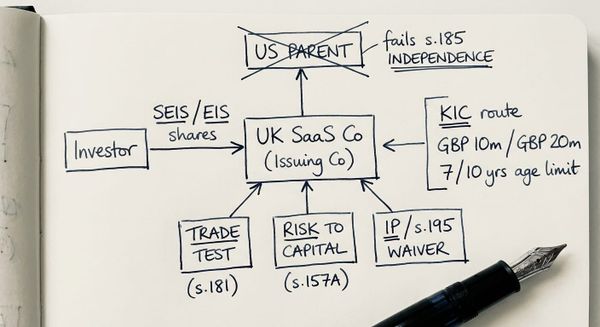
The royalties/licence-fees exclusion is waived for receipts attributable to a relevant intangible asset. Broadly, the asset, or the greater part of it by value, must have been created by the issuing company or a company that was its subsidiary while carrying out the relevant creation. The detailed relationships and facts matter. ITA 2007 s.195 and VCM3060.
HMRC's guidance recognises that a company can acquire an asset at an early stage and subsequently develop it so that it has created the greater part of the value. Purchasing an asset does not itself establish that condition. Nor is development expenditure necessarily the same thing as value created.
What happened in this case?
The software had been acquired from the university. The company therefore needed to consider the value-created limb rather than rely on having originated the IP entirely itself.
As reported in our original case account, the founders revised the transaction, including acquiring the IP for a nominal sum, and HMRC accepted the revised arrangements for advance assurance.
A nominal purchase price is not, by itself, proof that the company created the greater part of the asset's value. The outcome depended on the particular facts and arrangements disclosed. A negotiated price and the economic value of existing IP are not necessarily the same. Another company should not copy the price change and assume the tax result follows.
Evidence worth assembling
For an acquired-IP business, useful evidence can include the development history, what existed on acquisition, the rights obtained, who undertook subsequent work and evidence of the value created. The commercial agreements and the explanation to HMRC must describe the same transaction.
The question also extends beyond royalties. A purchase of a trade, historic company activities, group relationships and the use of investment funds can introduce separate eligibility issues. An answer to one question does not clear the whole structure.
The practical lesson
This case supports a specific proposition: investigate difficult facts before relying on a standard application or an informal assurance that the company will qualify. Make full disclosure and identify the issue on which HMRC's view is sought.
Read our SEIS advance assurance guide for the process and our SEIS1 guide for the subsequent compliance stage. HMRC's assurance concerns the disclosed proposal; it does not determine each investor's entitlement or remove continuing obligations.
For help with a proposed investment, discuss your SEIS or EIS position with IP Tax Solutions. We can agree the scope of a review around the facts and the point causing concern.
This article provides general information. Company, share and investor conditions require separate consideration.