EIS Financial Health Requirement: Losses, Funding and HMRC Review
Check EIS financial health at the share issue: accumulated losses, capital, evidence, SEIS rules and the consequences of an HMRC challenge.

By Steve Livingston FCA, founder of IP Tax Solutions. Technical sources reviewed: 21 September 2026.
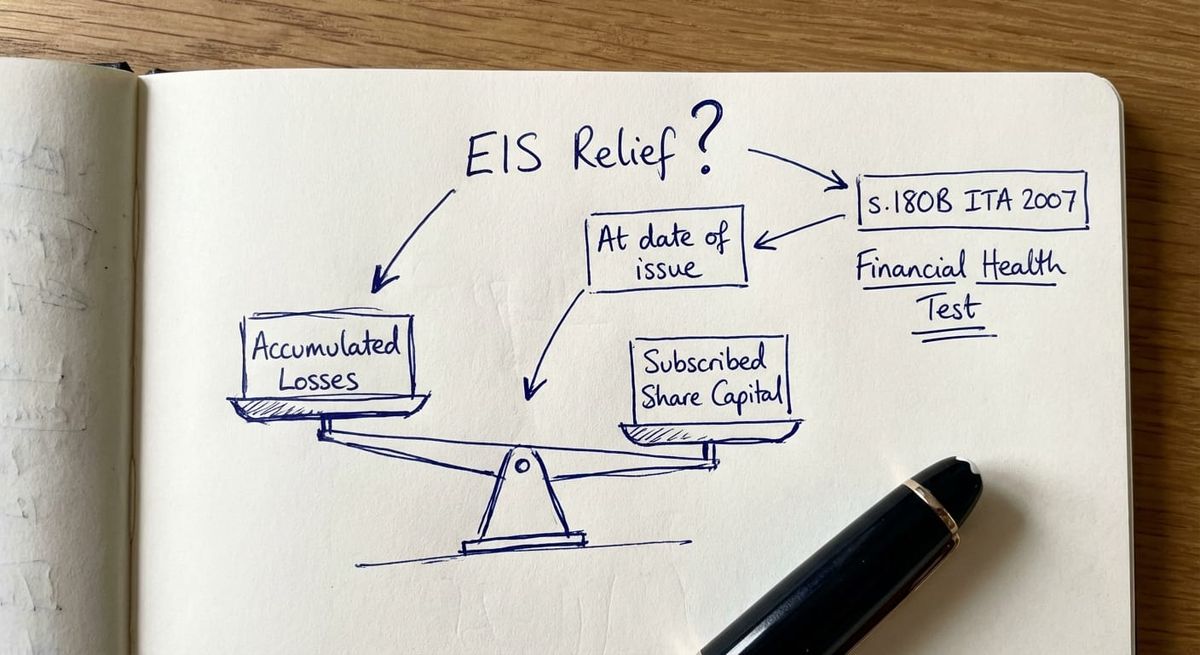
The EIS financial-health requirement asks whether the issuing company is in difficulty at the date the shares are issued. A company can be loss-making and still qualify, but a healthy cash balance alone does not establish that the test is met. The relevant balance sheet, funding commitments and wider financial circumstances need to be examined together.
SEIS has a financial-health requirement too. The EIS provision is ITA 2007 s.180B; the SEIS provision is s.257DE.
When is the test applied?
For EIS, the company must meet the requirement at the beginning of Period B, the date of the share issue. It is not itself a continuing financial-health test throughout the subsequent holding period. Later events may reveal the position that existed at issue, and other scheme requirements continue separately.
A round with several issue dates therefore needs more than one snapshot. An assessment based on accounts prepared months earlier should be reconciled to the actual position on each relevant date. An earlier qualifying issue is not automatically invalidated simply because a later issue fails this particular condition.
Do not assume that proposed EIS subscription cash automatically cures financial difficulty. The analysis must address the actual arrangements, available resources and statutory test at the relevant time. HMRC's guidance identifies irrevocable future non-tax-incentivised investments as one possible adjustment, rather than endorsing a general rescue-by-EIS rule. VCM13040.
What does “in difficulty” mean?
The statutory definition refers to the specified Community Guidelines. HMRC explains that it applies the 2014 definition, subject to the relevant risk-finance modifications, although s.180B refers to the earlier guidelines. The analysis is therefore more specific than simply asking whether directors believe the company is viable.
HMRC generally regards a company as in difficulty where it meets the insolvency criteria, such as inability to pay debts as they fall due or liabilities exceeding assets when contingent and prospective liabilities are included. Beyond the relevant initial investing period, the subscribed-capital erosion test also becomes relevant. The company's ability to continue its activity in the short or medium term forms part of the assessment. HMRC's financial-health guidance.
That does not mean every early-stage company with accumulated development losses is excluded. Establish which part of the framework applies and the company's actual financial circumstances.
Accumulated losses and subscribed capital
The capital test concerns more than half of subscribed share capital having disappeared as a result of accumulated losses. Share premium is included where relevant. The guideline calculation takes account of reserves and other own funds; it is not always the simple comparison of one accumulated-loss figure with half of nominal share capital or total cash raised.
For a simple illustration, assume a company has £2 million subscribed capital including premium, no other relevant reserves or adjustments and £1.1 million accumulated losses. More than half the subscribed capital has been lost on those assumptions. Before applying that result, establish whether the capital test applies to the company and whether the accounting figures and assumptions are correct.
The underlying guidance describes the reserves/own-funds calculation. Official government guidance reproducing the undertaking-in-difficulty definition. For EIS, apply it with HMRC's risk-finance and company-specific qualifications, not the grant scheme's eligibility rules.
How the initial investing period matters
HMRC's published approach applies the additional capital-erosion test to companies raising funds outside their initial investing period. Broadly, that period is seven years for standard EIS companies and ten years for qualifying knowledge-intensive companies, with detailed rules for the start date and relevant business history.
Do not use incorporation age as a substitute. The relevant first commercial sale, group history and transferred trades can matter. Knowledge-intensive companies have a statutory alternative involving the £200,000 annual-turnover threshold. Eligibility for a later investment under another EIS age route does not make the initial-period question disappear. ITA 2007 s.175A and HMRC KIC guidance.
Our multi-round funding guide explains the separate routes for follow-on investment.
Reconstruct the issue-date position
The latest accounts are a starting point. Prepare a reconciliation to the share issue covering cash, debtors, creditors, loans, contingent liabilities and material transactions since the accounts date. Assess whether obligations are legally binding and whether proposed funding is genuinely committed.
HMRC's guidance allows consideration of reasonable adjustments reflecting the particular circumstances. It expressly gives examples involving irrevocable future non-tax-incentivised investment and R&D expenditure that could have been capitalised under UK GAAP. An accounting adjustment must be supportable; the fact that expenditure relates to R&D does not make it automatically capitalisable.
Retain the accounting basis and evidence for every proposed adjustment. Do not treat an informal expectation of loan forgiveness, an unsigned funding proposal or an optimistic sales pipeline as interchangeable with an enforceable commitment. The question is what the evidence establishes at the relevant date.
What advance assurance can and cannot establish
Advance assurance concerns the disclosed proposed investment. A financial-health explanation should use the available facts and explain relevant assumptions about the position at issue. If the company or proposed arrangements change, review whether the assurance can still be relied upon and whether a new application is needed.
An old assurance letter is neither an automatic defence nor automatically worthless. Its scope, disclosures, factual assumptions and relevant changes need to be examined. Our advance assurance guide explains those limitations.
Before filing EIS1, check the actual position at issue against the application. For SEIS, complete the equivalent review alongside the SEIS1 compliance statement. Company certificates do not replace the underlying conditions.
What happens if the condition was not met?
Income tax relief on the affected issue may be unavailable or recoverable. The financial-health defect relates to the relevant issue; other issues need their own analysis. Recovery from investors, company compliance obligations and any penalty question must be considered separately.
Do not use a generic four-year enquiry window to decide whether HMRC is out of time. ITA 2007 s.237 contains a specific six-year rule for relevant EIS withdrawal assessments, measured from the later statutory reference year, and preserves the deliberate-conduct extension. The reference year can involve the use-of-money deadline or the event causing withdrawal. The procedure and facts therefore matter.
Interest is also not universally measured from the day the original claim was submitted. The applicable assessment and interest provisions need to be identified. HMRC DMBM407040 explains relevant EIS recovery mechanics.
Capital gains consequences require a separate analysis. If shares were never eligible for deferral relief, that differs from a later event ending an otherwise valid deferral. The gain does not automatically become taxable in the year HMRC happens to revoke the claim. Apply TCGA 1992 Schedule 5B to the original gain, eligibility and any chargeable event.
Responding to an HMRC challenge
Begin with the exact condition and date HMRC disputes. Assemble the issue-date reconciliation, relevant accounts, funding and liability documents, statutory age analysis and support for any accounting adjustment. Distinguish a factual disagreement from a legal interpretation or a procedural point.
A reasoned response may show that the company was not in difficulty or that HMRC has applied the wrong test. It should not assume that tax relief can simply be negotiated down as a commercial compromise where the statutory conditions were not met. Address the merits and applicable procedure directly.
Review the company's and investors' positions together, including notification duties and any related claims. Do not infer deliberate or careless conduct merely from the existence of an incorrect compliance statement; behaviour and reasonable care require their own evidence.
Frequently asked questions
Does financial health apply to SEIS?
Yes. SEIS has an express condition in s.257DE. Apply its requirements and the relevant guidance rather than assuming the issue is covered only by risk to capital.
Do losses automatically prevent EIS?
No. Establish the applicable initial investing period, the financial circumstances and any relevant capital or insolvency test. A loss figure alone is insufficient.
Can later profitability cure an issue-date failure?
No. The question is whether the requirement was met at issue. Later evidence may help establish the earlier facts, but later improvement does not rewrite them.
Can HMRC examine an issue after three years?
Yes. The investor holding period is not the same as the statutory assessment period. Check s.237 and the applicable procedures before drawing a time-limit conclusion.
Review the position before the next issue
Contact IP Tax Solutions if the company has significant losses, uncertain liabilities or a financial-health challenge. For wider HMRC disputes, see our enquiry defence service.
This article provides general information. It does not determine the financial health of a particular company or the tax consequences for an individual investor.