Making SEIS and EIS funding work harder: company cash and investor relief
Separate investor tax relief from company cash when planning a startup funding round, employee incentives and possible R&D relief.


Reviewed and updated: 21 September 2026.
Suppose a startup needs £500,000 to develop its product and reach its next commercial milestone. SEIS and EIS may help attract eligible investors, while employee incentives and any qualifying R&D relief may support the wider plan.
The essential budgeting point is to keep each benefit in the right place. Tax relief received by an investor is not additional cash in the company's bank account.
A simplified £500,000 funding example
Assume the company has £250,000 of available SEIS headroom and can raise the remaining £250,000 under EIS. Assume all company, share and investor conditions are met, the subscriptions are spread within the investors' individual limits and the investors have enough income tax liability to use the relief.
At 50%, the SEIS subscriptions could give the investors £125,000 of income tax relief. At 30%, the EIS subscriptions could give them £75,000. That is £200,000 of potential investor income tax relief on the £500,000 subscribed. It is not £200,000 of extra company funding. HMRC investor guidance.
The company receives the £500,000 investment, before transaction costs. Its cash forecast should begin with that amount, not £700,000. The relief may influence the investors' willingness to subscribe, but any tax refund belongs to them.
Get the investment structure right first
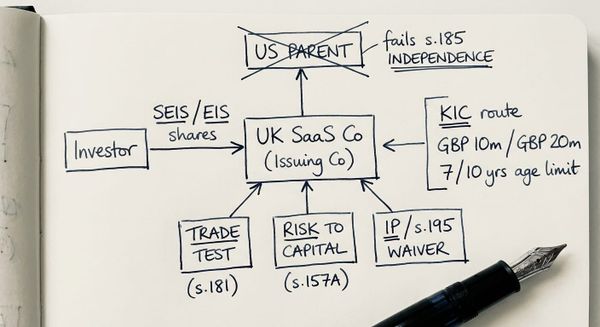
The example is not permission to divide any £500,000 raise mechanically between the schemes. Check available SEIS headroom, prior aid and investment, assets, trade age and the separate EIS conditions.
Timing is particularly important. Relevant EIS or VCT investment on or before the SEIS issue day can prevent SEIS qualification. Separate-day issues address that particular restriction, but early cash receipts and the asset test also need review. See our sequencing guide and s.257DK.
Use the advance assurance process to disclose the proposal and difficult points. Assurance is optional and does not approve individual investors. After issue, complete the relevant compliance process, including SEIS1 where applicable.
Employee incentives: model dilution as well as cash
Share options can give employees a stake in future growth. They do not eliminate the need for an appropriate salary, and they should not be presented as a guaranteed substitute for market pay.
An EMI or other option arrangement needs its own review of eligibility, valuation, terms, reporting and employee tax consequences. Compare the expected retention benefit and cash cost with dilution and the effect on the cap table. The correct choice depends on the company and the people involved. Do not assume that a low agreed valuation or a particular future CGT rate is available in every case.
Discuss options with the fundraising advisers early so the investment documents, pool size and employee arrangements fit together.
R&D relief: build the claim from the work and accounting period
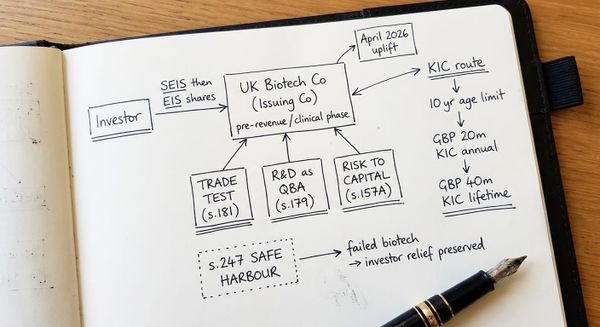
A technology business does not qualify automatically for R&D relief simply because it develops software or AI. The technical work and expenditure need to meet the applicable conditions, and the regime depends on the accounting period and company circumstances.
The earlier version of this article used a 33.3% cash-rebate illustration. That is not a current universal rate and should not be used to forecast a new claim. Assess the relevant regime, qualifying costs, restrictions, tax position, procedural requirements and expected payment timing separately.
A prudent cash forecast distinguishes expenditure already funded, a claim that has been technically assessed and a repayment that has actually been received. Do not treat an unreviewed estimate as cash available to meet payroll.
Keep three calculations separate
First, show company funding and expenditure: subscriptions, transaction costs, payroll, development costs and runway. Second, show investor tax outcomes, including income tax relief and any applicable capital gains or loss relief. Third, show company tax relief, if the underlying conditions are met.
Our guides to SEIS capital gains relief and SEIS loss relief explain investor considerations separately. None of those amounts should be added to the company's cash balance merely because they arise from the same funding round.
The practical result
These arrangements can form part of a coherent funding plan, but their benefits arise for different people at different times. A useful plan identifies the assumptions, the evidence needed and who receives each benefit. That gives founders a more reliable view of the runway the investment actually buys.
For help with a proposed investment, discuss your SEIS or EIS position with IP Tax Solutions. We can agree the scope of a review around the facts and the point causing concern.
This article provides general information. Company, share and investor conditions require separate consideration.