Novation of a Director's Loan to a Holding Company: Powell v HMRC Upheld by the Upper Tribunal
A director's loan novated to a new holding company was a taxable release, and the Upper Tribunal has agreed. What Powell v HMRC decided, approx £195,000 of tax and what to check.

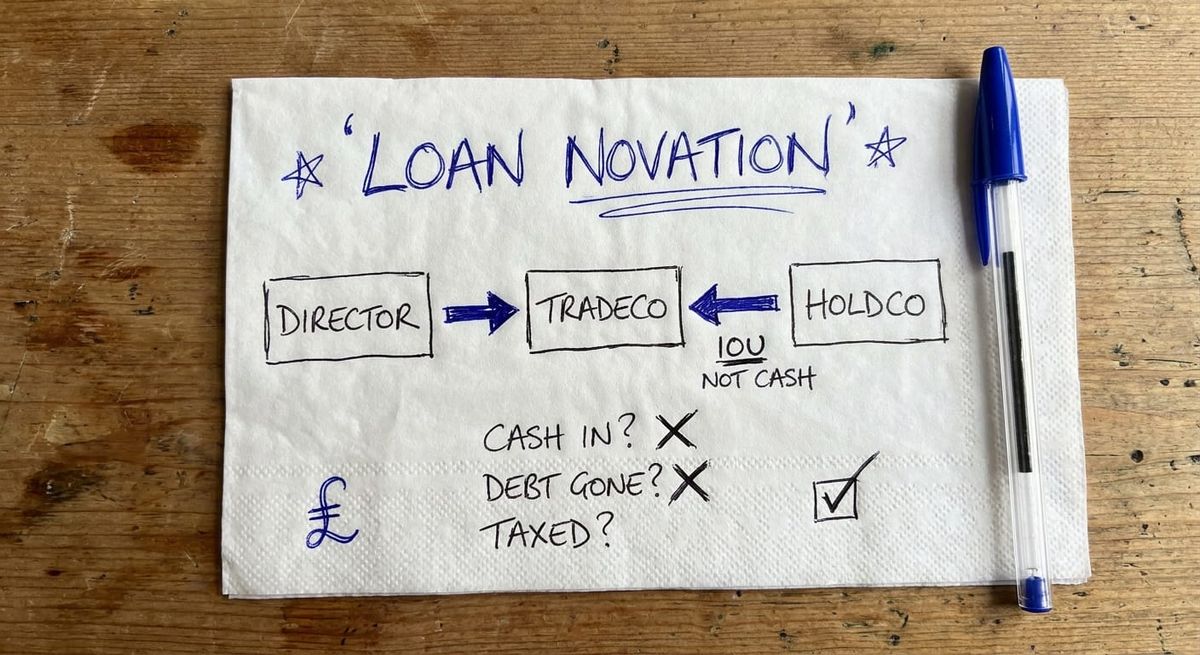
Owner-managed companies often have a director's loan account that needs to be tidied up in a reorganisation. One common idea is to move the loan to a new holding company via a deed of novation.
Powell v HMRC shows why that can create an income tax charge on the director even though the debt carries on and the director still owes the money.
In this guide
- What did Powell v HMRC decide?
- What were the facts?
- Why did a novation to a holding company still count as a release?
- What did the Upper Tribunal add?
- What would have counted as repayment?
- Why was the company relieved while the director was taxed?
- What does this mean when a loan is moved in a reorganisation?
- What should you check on existing loan accounts?
- What does the decision not decide?
- Frequently asked questions
- Getting a director's loan restructure right
What did Powell v HMRC decide?
The First-tier Tribunal decided that a deed of novation, under which a trading company released its director from a loan and a new holding company took over as lender, was a release of the debt for the purposes of section 415 of the Income Tax (Trading and Other Income) Act 2005 (ITTOIA 2005).
The director was therefore charged on dividend income equal to the amount released.
The appeal was refused. The First-tier Tribunal decision is Nicholas Powell v The Commissioners for HMRC [2025] UKFTT 528 (TC), released on 9 May 2025 after a hearing on 29 and 30 April 2025. Mr Powell appealed, and the Upper Tribunal dismissed that appeal in [2026] UKUT 418 (TCC) on 28 October 2026, holding that on the binding authority of Collins v Addies the First-tier Tribunal reached the right decision.
What were the facts?
Mr Powell was a director of Thermoline Limited, a close company, and its sole shareholder until 2 July 2020, when a share for share exchange made Property Holding SW Limited (PHSW) its holding company. He was a director of both.
Thermoline had paid out money to him or on his behalf, and his director's loan account stood at £309,338 on 31 March 2020. By 31 December 2020 it was £512,713.89.
On 16 March 2021 Mr Powell, Thermoline and PHSW signed a deed of novation, stated to take effect from 31 December 2020. Under it:
- Thermoline released Mr Powell from the loan.
- PHSW became the lender and Mr Powell agreed to repay PHSW.
- PHSW recorded £512,713.89 as owing to Thermoline on an intra-group loan account, which was the consideration for taking over the loan.
Mr Powell's 2020/21 return showed no dividend. HMRC issued a closure notice on 9 March 2023 and amended the return by £194,580.60. The parties agreed the calculation and the tribunal dealt only with whether section 415 applied.
Why did a novation to a holding company still count as a release?
Section 415 ITTOIA 2005 applies where a company that was chargeable to tax under section 455 of the Corporation Tax Act 2010 on a loan to a participator releases or writes off the debt. The First-tier Tribunal applied the Court of Appeal decision in Collins v Addies [1992] STC 746, where the debts of two shareholders were taken over by a third person and the release was held taxable.
The key passage from that case is that a release is not taxable where it amounts to a repayment of the loan or the company accepts something equivalent to it, because the company has then recovered its money. A novation does not do that.
Mr Powell argued that his case differed. In Collins a new debtor stepped in. Here a new creditor stepped in, and PHSW had agreed to pay full value for the loan. The tribunal accepted that, as a matter of contract, PHSW's promise to pay was valuable consideration. In substance, the reasoning was:
- A promise to pay is not payment, following Millett J in Collins. Thermoline held a claim against PHSW for exactly the amount it had released, so it had not recovered its money.
- The tribunal saw no relevant difference between substituting a debtor and substituting a creditor, where the substitute does not enable the original lender to recover its money.
- Only where no debt is owed by any party in respect of the sum can it be said that no distribution has been made.
What did the Upper Tribunal add?
The appeal was heard on 28 July 2026 by Judge Thomas Scott and Judge Guy Brannan. Mr Powell's five grounds were, in substance, a single point: that the First-tier Tribunal erred in law in applying section 415 to the facts it found.
The Upper Tribunal drew six principles from Collins v Addies. Three of them decided the case: repayment of a loan is not a release, replacing one debt with another is not repayment, and the repayment limitation does not exclude a novation. It then dealt with the main arguments:
- Substitution of creditor. It accepted that the facts differed from Collins, but said the new lender made no material difference. The debt of the participator was released, by novation, and not repaid.
- Valuable consideration. Collins rejects any limit of the charge to releases for no or insufficient consideration, so consideration for the release does not mean the debt was repaid.
- No benefit to the director. Mr Powell argued the charge is aimed at extracting value, and he extracted none. The Upper Tribunal said this caused it some concern but rejected it. In Collins the focus is on whether the participator's legal obligation has been released and whether the company is enabled to recover its money, not on whether the participator gained.
- HMRC guidance. It did not help with a question of statutory interpretation.
The Upper Tribunal added that without Collins it would have had some residual concern, because it is possible to see the approach in that case as "relatively legalistic or linguistic", focusing on Thermoline and Mr Powell and not on the arrangements as a whole, which left Mr Powell owing the same sum to PHSW. It was bound by the Court of Appeal, so it applied it. It also said the Esprit decision added nothing to Mr Powell's case.
What would have counted as repayment?
The First-tier Tribunal said repayment or satisfaction needs the close company to receive the full value of the debt in cash or in kind, from the debtor or a third party. A right to call on someone else in connection with the debt does not do that. The Upper Tribunal did not test that formulation.
Two points in the judgment show where the line sits:
- HMRC's representative appeared to accept that if PHSW had paid the £512,713.89 in cash, HMRC would not have imposed a section 415 charge. The tribunal also asked what the position would be if PHSW had been given a short period of credit. HMRC did not answer.
- In Esprit Logistics Management Ltd v HMRC [2018] UKFTT 287 (TC) the tribunal accepted that setting off equal and mutual obligations between the company and the participator was payment, not a release.
The First-tier Tribunal spoke of the full value of the debt. Neither tribunal says what follows from part payment or deferred payment, or how quickly funds must arrive.
Why was the company relieved while the director was taxed?
Two separate codes were running side by side.
- Section 455 CTA 2010 charges the company when a loan to a participator is outstanding nine months after the period end. Section 458 gives the company relief when the loan is repaid, released or written off. Section 415 ITTOIA 2005 then taxes the participator, but only where the debt is released or written off, not where it is repaid.
- Thermoline claimed and was granted section 458 relief on the balance to 31 March 2020, and the tax was repaid to it on 9 November 2022. HMRC also accepted that no section 455 tax arose on the advances between 31 March 2020 and 31 December 2020, because the release took effect on 31 December 2020 (the judgment describes this as within nine months of the year end). On HMRC's acceptance the company side was relieved, and the income tax charge fell on Mr Powell.
The relief claim letter also described the arrangement as a release. The tribunal did not rely on that wording, but said it was at least indicative that the parties had been advised the deed was a release and not a repayment.
What does this mean when a loan is moved in a reorganisation?
The risk arises wherever a director's loan account is moved, assigned or swapped as part of a restructure. Typical examples are inserting a holding company after a share for share exchange, preparing for a sale or tidying up before an exit.
The main points from the decision:
- An intra-group loan account entry is not repayment, even where the contract treats it as full consideration.
- The director does not need to have gained anything. The charge turns on the release, not on value extracted.
- The tax follows the substance of what the lending company receives, not the contractual label.
- A deed signed in March 2021 with effect from December 2020 was explained by Mr Powell's counsel as designed to fall within the nine month window for section 455. The tribunal noted its concern at the gap but did not decide the case on it.
- Because the release is taxed as a dividend on the director, the amount released is taxed in the year of the release even though the director may still owe the same sum to a new lender.
What should you check on existing loan accounts?
Where a director's loan has been moved or restructured, these are the points to review:
- Whether any loan account was novated, assigned or exchanged for an intra-group balance since a holding company was inserted.
- Whether the lending company actually received cash or something of equal value, or only a new balance owed to it.
- Which tax year the release fell in and whether that year's return reported it.
- How any section 458 claim described the event. A claim that says "released" may be read against a later argument that the loan was repaid.
- Whether the loan was in fact repaid from funds the director had already been taxed on. Repayment and redrawing arrangements need separate checking.
HMRC's time limits for assessing income tax can reach back several years, longer where there has been a careless or deliberate error. A reorganisation that looked tidy at the time may still be open.
What does the decision not decide?
The Upper Tribunal decision binds the First-tier Tribunal, and both apply Court of Appeal authority in Collins v Addies. Other cases will still turn on their own deeds and facts. The Upper Tribunal itself expressed some concern about the Collins approach, which only the Court of Appeal or above could revisit. Whether a further appeal has been sought is not known at the date of writing.
The First-tier Tribunal also had no evidence of why the novation was entered into, the terms of the original loan, or whether it bore interest. Neither tribunal needed to decide whether cash funding, a credit period or a set-off would have changed the outcome, although the First-tier Tribunal commented on cash and set-off (paragraphs 34 and 37). Those routes are left open by the decisions and not endorsed by them.
Frequently asked questions
What is the section 415 ITTOIA charge on a director's loan?
Income tax is charged on a participator where a close company that was chargeable to tax under section 455 CTA 2010 on a loan or advance releases or writes off the whole or part of the debt. The amount released is treated as income and charged as dividend income.
Is a novated director's loan treated as repaid?
Not where the lending company receives only a new promise to pay. In Powell v HMRC the new holding company recorded an intra-group balance owed to Thermoline, and the tribunal held that Thermoline had not recovered its money, so the loan had been released and not repaid.
Would the outcome have been different if the holding company had paid cash?
HMRC's representative appeared to accept before the First-tier Tribunal that a cash payment of the full amount would not have led to a section 415 charge. Neither tribunal decided the point, and HMRC did not answer the question of a short period of credit.
Was the company charged as well as the director?
On HMRC's acceptance the company side was relieved. Thermoline obtained section 458 relief on the balance to 31 March 2020, and HMRC accepted that no section 455 tax arose on the advances to 31 December 2020 because the release took effect within nine months of the year end.
How much was the tax bill in Powell v HMRC?
HMRC amended Mr Powell's 2020/21 return by £194,580.60 on a release of £512,713.89, reported as a tax bill of approx £195,000. The parties did not dispute the calculation.
Does the decision bind the First-tier Tribunal?
Yes. The Upper Tribunal decision binds the First-tier Tribunal, and other Upper Tribunal judges would normally follow it. Both tribunals apply the Court of Appeal decision in Collins v Addies, which binds both.
Does a release of a director's loan always trigger income tax?
It does where section 455 applied to the loan and the release is not itself a repayment. A release that follows full repayment or the receipt of equivalent value by the company is outside section 415.
Can an old novation still be challenged by HMRC?
Potentially. The time limit depends on whether any error was careless or deliberate, and HMRC can reach back several years. An existing novation of a director's loan is worth reviewing against the Powell reasoning.
Getting a director's loan restructure right
Before moving a director's loan account in a reorganisation, the question to answer first is what the lending company will actually receive and when. The tax charge follows from that, not from the wording of the deed.
IP Tax Solutions advises owner-managed companies on share reorganisations and director's loan accounts. Scope and fee are agreed in writing before work starts. You can get in touch to discuss a case or see the page for accountants and lawyers.
This article is general guidance, not advice for your specific circumstances. The outcome depends on the terms of the loan, the deed and the company's own facts, and the law changes. Take advice before novating, assigning or releasing a director's loan.