EIS Tax Relief Withdrawn or Clawed Back by HMRC - What Now?
HMRC can withdraw or claw back EIS tax relief years after shares are issued. Here is what triggers it, how the assessment works, and how to challenge it.

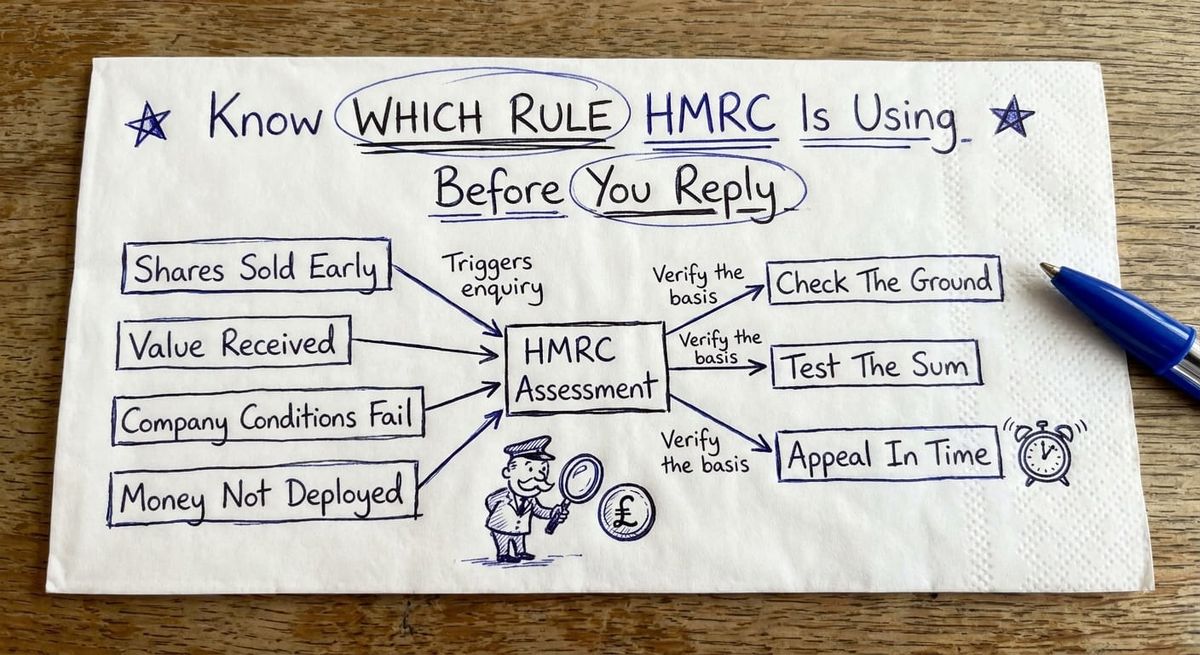
EIS tax relief can be withdrawn or reduced by HMRC after it has been given. For event-based withdrawals the assessment must be made within six years after the end of the relevant tax year (ITA 2007 s.237). The most common triggers are a share disposal inside the three-year holding period, value received from the company (ss.213 to 222), the issuing company ceasing to meet its conditions, and money not being employed for the qualifying business activity within two years (s.175). Relief is recovered by an income tax assessment on the investor (s.235), and the investor can appeal. The right first step is to establish exactly which provision HMRC is relying on, because the defences depend entirely on the ground relied upon.
Table of Contents
- What it means when HMRC withdraws EIS relief
- The five grounds HMRC uses to withdraw EIS relief
- Withdrawal versus reduction: the statutory distinction that matters
- How HMRC must actually do it: the procedural rules
- The investor's right of appeal
- Interest, penalties, and the real cash exposure
- How a specialist defends an EIS withdrawal case
- Frequently asked questions about EIS tax relief withdrawn by HMRC
What it means when HMRC withdraws EIS relief
EIS tax relief withdrawn by HMRC is not the same thing as relief disallowed at source. Withdrawal applies to relief that has already been claimed and granted, and is then unwound when an event means the conditions are no longer met, or when HMRC concludes the relief was never due. The statutory architecture sits at ITA 2007 Part 5, Chapters 6 and 7 (ss.208 to 244), with HMRC's own guidance at VCM15000 in the Venture Capital Schemes Manual.
The practical effect is an income tax assessment on the investor for the tax year in which the relief was obtained (s.235). The amount recovered is worked out at the EIS rate that applied when the shares were issued: 30% for shares issued after 5 April 2011 and 20% for earlier issues (VCM15015, VCM15040). Interest runs from 31 January following the tax year for which the assessment is made (s.239, VCM15160). Penalties can follow where an investor or company fails to give a required notice (TMA 1970 s.98).
Investors often hear about a problem only after HMRC has opened correspondence with the company. HMRC's guidance explains why: for company-side grounds it deals with the company first, because the company holds most of the evidence and because it simplifies the process where there are many investors (VCM15120). Early specialist involvement, ideally when the company has to give notice under s.241 or receives a notice under s.234(3)(b), shapes the defence from the start. IP Tax Solutions works with founders and professionals to help defend in HMRC enquiries and disputes.
The five grounds HMRC typically uses to withdraw EIS relief
HMRC does not withdraw EIS relief on general concern. It must identify a specific statutory ground. Five groups of ground account for most cases.
- Ground one: share disposal inside Period A (ITA 2007 s.209). Period A runs from incorporation (or two years before the issue, if the company is older) to the termination date, which is the third anniversary of the share issue (or the third anniversary of the date the trade begins, where the money was raised for a trade not yet begun) (ss.159 and 256). A disposal before Period A ends triggers withdrawal or reduction. If the disposal is not an arm's length bargain, all the relief attributable to the shares is withdrawn (s.209(2)). If it is at arm's length, the reduction is the smaller of the relief attributable to the shares and tax at the original EIS rate on the consideration received (s.209(3), VCM15015). Transfers between spouses or civil partners living together are outside the section (s.209(4)), as is a disposal on the investor's death (s.209(6)). Granting a call option over the shares counts as a disposal (s.211), and a put option granted to the investor in Period A withdraws the relief (s.212).
- Ground two: value received by the investor (ITA 2007 ss.213 to 222). If the investor receives value from the issuing company at any time in Period C (from 12 months before the issue to the termination date), the relief is reduced or withdrawn (s.213). Section 216(2) lists what counts as receiving value, including: a repurchase or redemption of the investor's shares, repayment of certain debts, release or waiver of a liability of the investor, a loan or advance to the investor that has not been repaid before the shares are issued, a benefit or facility, an asset transferred at an undervalue, and any other payment other than the excepted payments in s.168(2) and ordinary trade debts. The reduction is tax at the original EIS rate on the value received, capped at the relief attributable to the shares (VCM15040). Receipts of £1,000 or less, or amounts that are insignificant against the sum subscribed, are ignored, but receipts are aggregated, and the let-out does not apply where repayment arrangements existed in the 12 months before the issue (ss.214 and 215).
- Ground three: the issuing company stops (or never did) meet its conditions (Chapter 4). The conditions are tested at different times, which matters in practice. The UK permanent establishment requirement (s.180A), the trading requirement (s.181), the requirement that the qualifying activity is carried on by the company or a qualifying 90% subsidiary (s.183) and the control and independence requirement (s.185) apply throughout Period B, which runs from the issue to the termination date. The financial health requirement (s.180B) and the unquoted status requirement (s.184) are tested at the beginning of Period B. The gross assets requirement (s.186) is tested immediately before and immediately after the share issue, and so is the employee number requirement (s.186A, when the shares are issued). The gross assets limits depend on the issue date. For shares issued on or after 6 April 2026 the limits are £30 million before and £35 million after the issue, except for a specified Northern Ireland company (s.256B), where they remain £15 million before and £16 million after. For earlier issues the limits are £15 million before and £16 million after. The employee limit is fewer than 250 full-time equivalents, or fewer than 500 for a knowledge-intensive company (s.186A). The annual and lifetime risk finance limits (ss.173A and 173AA) are also tested at the date of issue, so the figures that apply are those in force for that issue date. Where a company ground is relied on, HMRC's route is the s.234 procedure described below, and the relief is withdrawn in full rather than reduced (VCM15010).
- Ground four: money not employed for the qualifying business activity in time (s.175). All the money raised must be employed wholly for the qualifying business activity for which it was raised within two years of the share issue (or within two years of the date the trade begins, where it was raised for a trade not yet begun) (s.175(1) and (3)). An amount that is not significant used for another purpose does not break the requirement (s.175(2)). Using the money to acquire a trade, goodwill or certain intangible assets, or a 51% subsidiary, does not count as employing it for the activity (s.175(1ZA)). Expect HMRC to ask for evidence of deployment, particularly where the funds still sit on the balance sheet as cash. Failure here is treated as relief not due and withdrawn in full (VCM15010).
- Ground five: value moving through associates and connected persons (ss.216(6) and 221), and related company events. The value received rules reach beyond the investor personally. A payment or transfer to an associate of the investor, or made indirectly or for the investor's benefit, is treated as value received by the investor, and value coming from a person connected with the company at any time in Period A counts as coming from the company (s.221). "Associate" is defined in s.253 and covers a spouse or civil partner, ancestors and lineal descendants, partners, and trustees of certain settlements. Separately, if a person connected with the company purchases the investor's shares or pays for the investor giving up rights over them, the investor is treated as receiving value (s.216(6)). Two further company-side events withdraw the relief of an investor within the control tests: the company acquiring a trade or trading assets previously carried on by a person or group who control it (s.232), and the company acquiring all the share capital of another company under common control (s.233). Where advance assurance was refused and the company issued shares anyway, the reasons for the refusal should be revisited early, because relief claimed on those shares is exposed to a finding that it was not due (s.234(1)).
A separate rule affects investors who did nothing themselves. If the issuing company (or a subsidiary) repurchases or redeems shares belonging to another member during Period C, the relief of the relieved investors can be reduced (s.224). Section 224 is a distinct head from the value received rules. It does not apply where the other member's own relief is withdrawn or reduced by the same repayment (s.224(4)), and insignificant repayments are ignored unless repayment arrangements existed in the 12 months before the issue (s.225).
Withdrawal versus reduction: the statutory distinction that matters
HMRC correspondence often uses the words "withdrawal" and "clawback" interchangeably, but the statute treats them differently and the defence is different in each case.
Complete withdrawal applies where relief was never due or the conditions have failed in a way the statute treats as fatal. HMRC's guidance gives the examples:
- the shares are not eligible shares,
- the individual is not a qualifying investor,
- the company is not a qualifying company, or
- the money raised was not employed within the time allowed (VCM15010).
Section 234(1) requires any relief found not to have been due to be withdrawn. Non-arm's length disposals, put options and the acquisition events in ss.232 and 233 also withdraw the relief.
Reduction applies where an event cuts back, but does not remove, the relief. Arm's length disposals (s.209), value received (s.213) and repayments to other members (s.224) work through a formula, so the amount recovered can be materially smaller than the full relief. The calculation uses the EIS rate at the time the shares were issued, and where the investor did not obtain the maximum relief the figure is apportioned (ss.210 and 220, VCM15040). HMRC's opening figure can therefore be tested against the statutory computation rather than accepted.
The distinction matters at the first response. A letter that concedes the ground before the computation is tested leaves the investor exposed to HMRC's opening number.
The investor's right of appeal
An investor assessed to withdraw or reduce relief has the ordinary right to appeal an income tax assessment under the Taxes Management Act 1970. The notice of assessment states the time limit for appealing, which is short, so it should be diarised the day the assessment arrives and the appeal notice checked against the assessment itself. The routes are an internal HMRC review, alternative dispute resolution, or an appeal to the First-tier Tribunal (Tax Chamber). The Tribunal is the substantive fact-finding forum.
Which route is right depends on the dispute. A review by an HMRC officer independent of the original decision-maker suits cases with procedural defects or a marginal technical position. Alternative dispute resolution can suit a narrow technical gap. The Tribunal suits genuinely contested facts or a point of principle.
Interest, penalties, and the real cash exposure
Interest on withdrawn EIS relief runs from 31 January following the tax year for which the assessment is made, rather than from the date of the event (s.239, VCM15160). Where HMRC instead proceeds by a discovery under TMA 1970 s.29, the normal TMA 1970 s.86 interest rules apply (VCM15160). Because the relevant date is tied to the year the relief was given, a withdrawal several years later can carry a long interest period on top of the tax. Check the current HMRC late payment interest rate on gov.uk when quantifying the exposure.
Penalties are a separate question. Where an incorrect return is involved, other penalty regimes can apply, and the answer depends on the facts. Prompt notification and full cooperation put the investor in the best position.
Key takeaway: The EIS withdrawal rules are technical, and the outcome often turns on which provision HMRC is actually relying on and how the computation is done. The first letter back to HMRC should not concede a ground that has not been made out, or accept a computation that has not been tested against the statutory formulas.
How a specialist defends an EIS withdrawal case
The defence discipline is different from routine compliance work. A specialist engagement on an EIS withdrawal matter typically follows four steps.
Step one: identify the exact statutory ground. Read the HMRC letter carefully. The ground relied on determines everything that follows. A s.213 value received case is defended differently from a s.180B financial health case. A case framed as a s.29 discovery has a different time-limit profile from an event-based assessment under s.235. If the ground is unclear, the right first response is a written request for particulars, not an admission.
Step two: rebuild the facts against the statute. Reconstruct the subscription and share issue documentation, the compliance statement, the board minutes, the evidence of fund deployment, and any value flows between the investor, associates and the company. Map each to the specific provision HMRC relies on. Weaknesses identified here define the negotiation space.
Step three: test the computation. Where reduction is in play, run the statutory formula and the apportionment on correct inputs. Where withdrawal or reduction is in play, check whether any protective provisions apply: the spouse transfer rule in s.209(4), replacement value under ss.222 and 223, or the insignificance rules in ss.214, 215 and 225.
Step four: choose the appeal route on merit. An internal review is the right starting point where procedural defects exist or where HMRC's technical position is marginal. Alternative dispute resolution is the right route where the dispute is narrow and technical. The Tribunal is the right route where the facts are genuinely contested or where a principled legal issue is at stake. Each route has different evidential requirements and different timetables.
Frequently asked questions about EIS tax relief withdrawn by HMRC
How long does HMRC have to withdraw EIS tax relief?
For an assessment based on a triggering event, HMRC has until six years after the end of the relevant tax year, which is the later of the tax year in which the two-year use of money deadline under s.175(3) falls and the tax year in which the event occurs (ITA 2007 s.237). Where HMRC instead relies on a discovery under TMA 1970 s.29 that relief was excessive, HMRC's guidance says the s.34 four-year limit applies, extended under s.36 where the loss of tax was brought about carelessly or deliberately (VCM15150). Time limits are often a strong first line of defence.
What is the difference between withdrawal and reduction of EIS relief?
Withdrawal removes the relief entirely and applies where relief was not due or a fatal condition failed (for example the company was not a qualifying company, or the money was not employed in time). Reduction partially unwinds relief following an arm's length disposal, value received or a repayment to other members. Reduction is computed by formula under ss.209, 213 and 224 and is frequently smaller than HMRC's opening figure.
Can HMRC withdraw EIS relief if I sell my shares?
Yes, if the disposal occurs inside Period A, which ends on the third anniversary of the share issue (or the third anniversary of the date the trade begins, where the money was raised for a trade not yet started). If the sale is not at arm's length, all the relief attributable to the shares is withdrawn. If it is at arm's length, the reduction is the smaller of the relief attributable to the shares sold and tax at the original EIS rate (30% for shares issued after 5 April 2011, 20% before) on the consideration received. Transfers between spouses or civil partners living together are outside the section.
Does HMRC have to write to the company first before withdrawing my EIS relief?
Only for certain grounds. Where the ground is that the purpose of the issue or use of money requirements are not met, or that the issuing company is not a qualifying company, HMRC cannot withdraw relief unless the company has given a notice under ITA 2007 s.241 or an officer has given the company a notice under s.234(3)(b) (s.234(2) and (3)). HMRC's guidance says the notice should specify the date of the share issue, the grounds and the company's right of appeal (VCM15120). Investor assessments can be made without waiting for the company's appeal, and investors keep their own right of appeal.
What is a Special Assessment for EIS clawback?
Section 235 requires relief to be withdrawn or reduced by an assessment to income tax for the tax year for which it was obtained. HMRC's internal guidance says EIS relief cannot be withdrawn through the self-assessment return and should be recovered by a manual Special Assessment, although an in-time amendment by the investor to their own return can be accepted (VCM15140, VCM15010). The assessment carries the usual appeal rights, and the time limit is stated on the notice.
How do I appeal an HMRC decision to withdraw EIS tax relief?
Check the time limit stated on the assessment and appeal within it. The routes are an internal HMRC review, alternative dispute resolution, or an appeal to the First-tier Tribunal (Tax Chamber). Which is right depends on whether the dispute is procedural, technical or factual.
Are there penalties on top of clawed-back EIS tax relief?
Potentially. Failure to give a required notice under ITA 2007 s.240 or s.241 within 60 days, or to comply with an information notice under s.242 or s.243, can attract penalties under TMA 1970 s.98 (VCM14190, VCM15170). Other penalties can arise where an incorrect return was filed. Prompt notification and cooperation put the investor in the best position.
What to do if HMRC has opened an EIS withdrawal enquiry
The decision points are compressed. The time limit for appealing an assessment is stated on the notice and is short. The two-year use of money window, the six-year event-based assessment window and the four-year discovery window all run independently and need to be tested before any substantive response is given.
If you are an investor, a company finance director, or an adviser to one, and HMRC has raised an EIS withdrawal concern, the first step is a review of the position against the specific ITA 2007 section HMRC is relying on. From that point the defence is tractable. IP Tax Solutions handles EIS and SEIS withdrawal defence alongside R&D tax credit enquiry defence.
The above article is for educational and general guidance purposes only and does not constitute professional advice. No reliance should be placed on this article and you should seek professional advice specific to your circumstances.