When Can a Company File SEIS1 or EIS1, and What Is the Deadline?
When a company can file SEIS1 or EIS1: the 70% spend test, the four-month rule, the two-year EIS longstop, and who gets the certificate when investors use a nominee or fund.

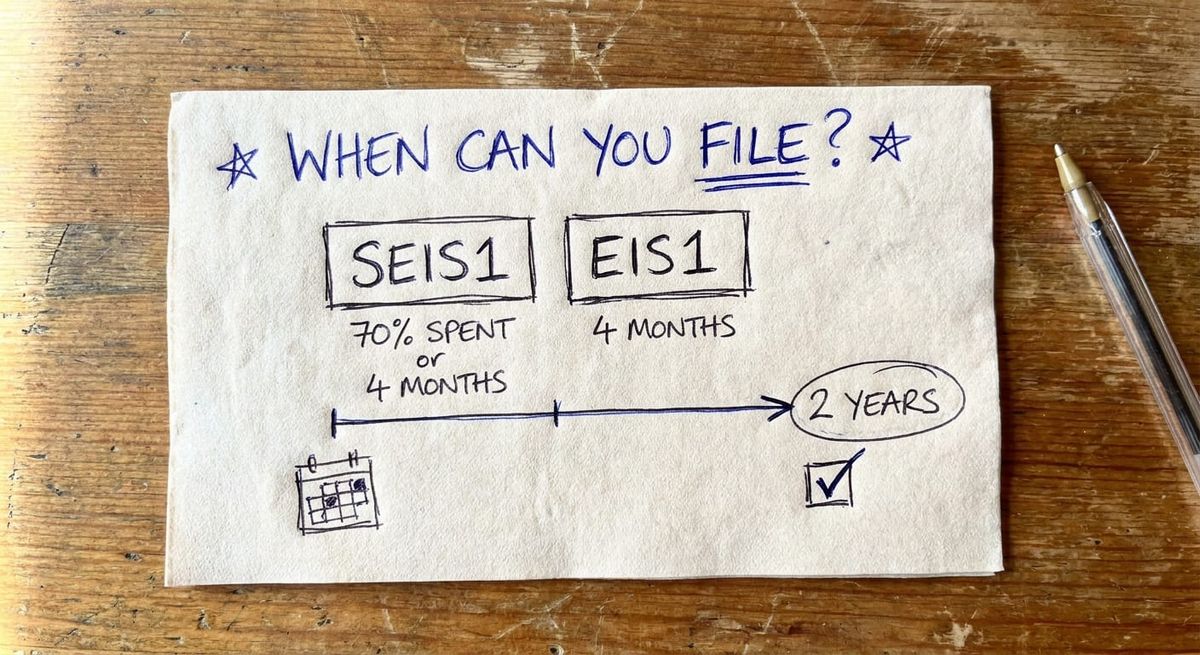
The short answer: A company can file an EIS1 once its qualifying trade, or its qualifying research and development, has been carried on for four months. It can file a SEIS1 once 70% of the money raised has been spent on the qualifying activity or the new trade has run for four months, whichever happens first. EIS1 has a two-year statutory longstop. Investors cannot claim relief until they hold the certificate.
Written 6 November 2026. This reflects the legislation and the HMRC manual as held at that date.
Founders usually ask about the filing date after the money has landed and the investors want their certificates. The rule is not the same for the two schemes, and the EIS and SEIS statutes handle the deadline differently. This guide sets out each gate, the dates that matter and who receives the certificate when an investor holds through a nominee or a fund.
In this guide
- What do SEIS1 and EIS1 do, and why does the filing date matter?
- When can a company file SEIS1?
- When can a company file EIS1?
- What is the statutory deadline for filing?
- What if the practical date has passed but the longstop has not?
- Who gets the certificate when investors use a nominee or a fund?
- Frequently asked questions
- Getting the filing date right
What do SEIS1 and EIS1 do, and why does the filing date matter?
SEIS1 and EIS1 are the compliance statements. They are the company's own declaration to HMRC that the conditions for relief, other than those that relate to the investor, are met now and have been met since the shares were issued (s.205(1) and s.257ED(1) ITA 2007).
Nothing else unlocks the investor's claim. The company sends the statement. If HMRC is satisfied it returns a SEIS2 or EIS2 authority with a Unique Investment Reference, and the company then issues a SEIS3 or EIS3 certificate to each investor (VCM35020 and VCM14020). The investor is entitled to claim relief only once they hold that certificate (s.203 and s.257EB).
Advance assurance does not replace this step. The company must still file the compliance statement, and HMRC is bound by an assurance only if the statement matches the information given at the assurance stage (VCM14020 and VCM35020). For the assurance stage see why advance assurance applications get rejected.
| Step | SEIS | EIS |
|---|---|---|
| Company files the compliance statement | SEIS1 | EIS1 |
| HMRC authorises and gives a reference | SEIS2 | EIS2 |
| Company issues the certificate | SEIS3 | EIS3 |
| Investor claims | On the certificate (s.257EB) | On the certificate (s.203) |
When can a company file SEIS1?
A company must not file a SEIS1 until at least one of two conditions is met (s.257ED(3) ITA 2007). Either is enough.
- At least 70% of the money raised by the issue has been spent for the purposes of the qualifying business activity for which it was raised.
- The new qualifying trade has been carried on by the company, or a qualifying 90% subsidiary, for at least four months.
The statement must say which condition is met at the time it is made (s.257ED(4)(a)). HMRC's manual puts the same point plainly: the company cannot submit until it has been trading for at least four months or has spent at least 70% of the money raised by the relevant issue (VCM35040).
The 70% limb is the one that helps a pre-trading company. Take a company that raised £100,000 under SEIS in October and has spent £70,000 on the qualifying activity by mid-December. It can file then, even though it is not four months into trading. The test is applied to the money raised by that issue and not the company's cash generally.
When can a company file EIS1?
The gate for EIS is time only. There is no 70% spend alternative. A company cannot provide the statement until the following requirement is met.
- For a company raising money for a trade, that means the trade has been carried on for at least four months, throughout by the issuing company or a qualifying 90% subsidiary and by nobody else (s.176(2)). The four-month period must end at or after the time of the issue. So a company that has already been trading for several months when it issues the shares does not have to wait a fresh four months.
- For a company raising money wholly or partly for research and development from which it intends to derive a qualifying trade, the gate is four months of that research and development (s.176(3)). HMRC's manual describes the gate as the trade or the R&D having been carried on for at least four months (VCM14040).
The company does not need to have spent all the money first. A statement can go in before the funds are fully employed (VCM14040).
The four months run from when the activity started, not from each investor's subscription date. A later investor in the same round does not start their own clock.
| SEIS1 | EIS1 | |
|---|---|---|
| Statutory gate | 70% of the issue spent, or four months of the new trade | Four months of the trade, or of qualifying R&D |
| Spend shortcut | Yes, 70% | No |
| Source | s.257ED(3) | s.205(4)(a) and s.176 |
| Must the statement say which gate applies | Yes | No such requirement |
What is the statutory deadline for filing?
For EIS there is an express long-stop. A company may not provide the statement later than two years after the end of the tax year in which the shares were issued.
Where the four-month requirement is first met after that tax year has ended, the limit is two years after it is first met (s.205(4)(b) ITA 2007). HMRC's manual describes it as the later of the two dates (VCM14040).
A company cannot submit a compliance statement after the later of the following dates:
two years after the end of the year of assessment in which the shares were issued
two years after the end of the period of four months.
| Example | Four months met | EIS1 can go in from | Statutory longstop |
|---|---|---|---|
| Shares issued 14 January 2027, trade already running for six months | Already met at issue | Straight after the issue | 5 April 2029 |
| Shares issued 14 January 2027, trade starts 1 March 2027 | Around 1 July 2027, after the tax year end | Around 1 July 2027 | Approx 1 July 2029 |
In the first example the issue falls in 2026/27, which ends on 5 April 2027, so the long-stop is 5 April 2029. In the second the four months finish after the tax year has ended, so the later date applies.
For SEIS the position is different. The SEIS manual pages on company conditions and the statement do not state a deadline. Do not read it as open-ended. The investor's own claim must be made by the fifth anniversary of the normal self-assessment filing date for the tax year of the issue (s.257EA), and the statement still has to say the conditions have been met at all times since the shares were issued.
Each separate issue needs its own statement. All shares of the same class issued on the same day count as one issue (VCM35040).
What if the practical date has passed but the long-stop has not?
The long-stop is a limit on the company. Until the certificate is in the investor(s)' hands they cannot make a claim, change their PAYE code or reduce a payment on account.
If you are past the date you meant to file but inside the long-stop, file as soon as possible. The statutory position is unchanged. An investor's claim for EIS relief can be made until the fifth anniversary of the normal self-assessment filing date for the tax year of the issue (s.202(1)(b)), and if it is too late to amend their return the manual provides a stand-alone claim using the claim section of the certificate (VCM14140).
Accuracy matters as much as timing. HMRC's manual cites Ashley v HMRC (SpC 633), where the investor could not claim because the EIS1 and the EIS3 carried the wrong share issue date, and says the onus is on the investor to check the certificate and ask the company to correct it (VCM14020). A company that provides a negligent or fraudulent statement faces a penalty of up to £3,000 (s.207 and s.257EF). A refusal by HMRC to authorise certificates can be appealed (s.206 and s.257EE).
Who gets the certificate when investors use a nominee or a fund?
Relief follows the individual, not the nominee. Shares subscribed for, issued to or held by a nominee for an individual are treated for the purposes of the scheme as subscribed for and held by that individual (s.250(1) for EIS and s.257HE(1) for SEIS).
Frequently asked questions
Can we file EIS1 before the trade has started?
Only if the money was raised wholly or partly for research and development from which a qualifying trade is intended to be derived, and that research and development has been carried on for four months (s.176(3) and s.205(4)(a) ITA 2007). A company with no trade and no qualifying R&D cannot file.
Do we need to have spent all the money before filing?
No for EIS. A statement can be submitted before the money is fully employed (VCM14040). For SEIS the 70% spend test is one of two ways in, so a company relying on four months of trading does not need to have spent 70%.
If we have advance assurance, can we skip SEIS1 or EIS1?
No. HMRC requires the compliance statement even where advance assurance has been given (VCM14020 and VCM35020).
Is there a deadline for SEIS1?
Section 257ED does not contain an express two-year long-stop of the kind found in s.205(4)(b) for EIS. The investor's claim deadline in s.257EA still applies, and the statement must confirm the conditions have been met since the shares were issued. File as soon as the gate is open.
Can an investor claim before receiving the certificate?
No. The right to claim the tax reliefs depends on holding the compliance certificate (s.203 and s.257EB). HMRC's EIS guidance says in no circumstances can a claim or a coding adjustment be made, or a payment on account reduced, before the investor has received the EIS3 or EIS5 (VCM14140).
What if the certificate shows the wrong date or amount?
The investor should ask the company to correct it, and inform HMRC if the company refuses (VCM14020). HMRC's manual cites the Ashley decision, where an uncorrected date meant the investor could not claim.
Who signs the compliance statement?
For EIS1, a company secretary, a director or an authorised agent. A signed letter of authority from the company must go with a statement completed by an agent, and a statement completed by anyone else is returned unread (VCM14030).
Getting the filing date right
The common mistakes are quoting the 70% test for EIS, treating the long-stop as the date to aim for, and sending the certificate to the nominee. Each is avoidable if the gate, the share issue date and the beneficial owner schedule are checked before the statement goes in.
We work directly with founders and behind accountants who want a second pair of hands on compliance statements. You can get in touch to discuss your filing.
This article is general guidance, not advice for your specific circumstances. The filing gate and deadline turn on the share issue date, the company's own facts and the scheme concerned. Take advice before submitting a compliance statement.