EIS Advance Assurance: How to Apply, What HMRC Checks and How Long It Takes
How to apply for EIS advance assurance, what HMRC checks, whether you must name investors, how long it takes and when an assurance stops protecting you.

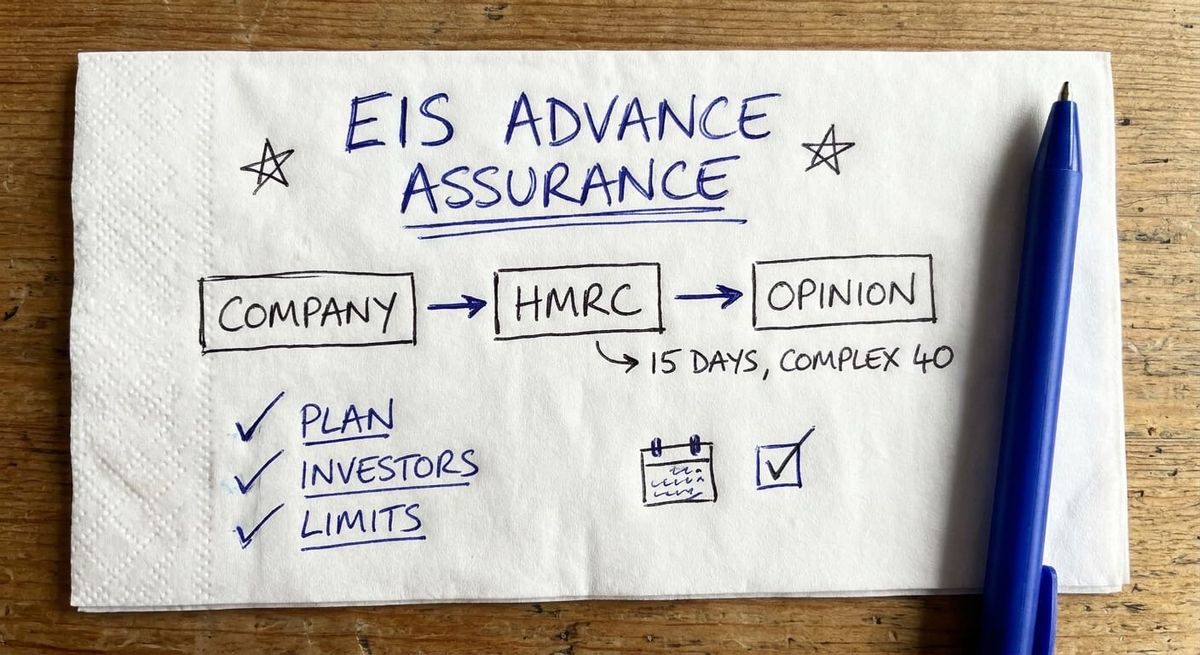
The short answer: EIS advance assurance is HMRC's discretionary opinion, given before shares are issued, that an investment is likely to qualify. It is not mandatory, but it is highly recommended and most investors will insist on it. A director, company secretary or authorised agent applies online through GOV.UK, and HMRC aims to respond within 15 working days, or 40 for complex cases.
Written 16 November 2026. This reflects the legislation and the HMRC manual as held at that date.
Founders raising under the Enterprise Investment Scheme usually meet advance assurance through an investor who asks for it. This guide explains what it is, who applies and how, whether the company must name its investors, what HMRC checks, how long it takes and when the assurance stops protecting the company.
In this guide
- What is EIS advance assurance, and do you need it?
- How do you apply for EIS advance assurance?
- Do you have to name your investors?
- What does HMRC check in an EIS advance assurance application?
- Which EIS limits apply, and why does the share issue date matter?
- How long does EIS advance assurance take?
- When does an EIS advance assurance stop protecting the company?
- What does advance assurance not do?
- Why do applications get refused, and what then?
- How does EIS advance assurance work alongside SEIS?
- Frequently asked questions
- Getting an EIS advance assurance application right
What is EIS advance assurance, and do you need it?
Advance assurance is a service run by HMRC's Venture Capital Reliefs (VCR) Team. HMRC describes it as non-statutory and discretionary: the team may give an opinion on whether a prospective investment would be a qualifying investment, and sometimes cannot give one (VCM60010).
A company does not need advance assurance. HMRC states that there is no requirement to obtain it before shares are issued under any of the venture capital schemes, and a company may issue shares without it (VCM60010). In practice many investors ask for it, because it tells them HMRC has looked at the company and the proposed round and considers the conditions likely to be met.
Two limiting factors to take into account:
- The service is only available before the shares are issued: if the shares have already been issued, the company cannot apply and should file its compliance statement instead (VCM60010 and VCM60150).
- The service also gives no right of appeal. If the VCR Team declines to give an assurance, an investor may still go ahead and the position is tested through the statutory procedures later (VCM60050).
How do you apply for EIS advance assurance?
The route is the online form on GOV.UK. The HMRC guidance page, last updated on 18 December 2024, says companies can apply using the new online form for all schemes, and that a separate application is needed for each proposed investment (GOV.UK: apply for advance assurance).
The application can only come from the company secretary, a director or an agent authorised to act for the company. HMRC returns unread any application from anyone else (VCM60030). An agent must include a signed authority from the company, and the GOV.UK page says it must be dated within the last three months.
Before applying, the company needs to have been formed and registered with HMRC for a Unique Taxpayer Reference (VCM60020 and VCM60110). HMRC expects a business plan and supporting documents with the application (VCM60120). The business plan should be the document already prepared for investors, with the same level of detail a lender would expect, explaining how the money will be spent and how the investment leads to growth (VCM60120).
The company must disclose all facts that affect eligibility. If it leaves any out, the assurance will not be valid (VCM60110).
Do you have to name your investors?
Yes, if it's the first application. A company that has never raised money under SEIS, EIS, VCT or SITR must show that it has serious prospects of raising the money. HMRC does not accept speculative applications from such companies (VCM60130 and VCM60110).
For a company raising directly from individuals, that means giving the names and addresses of the prospective investors and the amounts they intend to invest. Naming one or two people expected to invest a small share of the round is not sufficient (VCM60130). Where the money comes through a fund manager, business promoter or crowdfunding platform, the company must show evidence that the intermediary has agreed the company may be a viable investment and that further engagement is under way. Failing to disclose an intermediary invalidates any assurance given. Details of any fund expected to invest must always be provided (VCM60130).
A company that has already raised under one of the schemes is not rejected automatically for leaving investor details out, although HMRC says supplying them can help (VCM60130). A separate guide covers the requirement to list potential investors in more detail.
What does HMRC check in an EIS advance assurance application?
HMRC looks for a genuine growth company that will be a qualifying company, issuing eligible shares for a qualifying business activity (VCM60020). The main tests are in ITA 2007 Part 5:
- Risk to capital. The company must have objectives to grow and develop its trade in the long term, and there must be a significant risk of loss of capital greater than the net investment return (s.157A). HMRC will not give an assurance where the investment appears likely to fail this condition (VCM8550).
- Age. Shares issued more than seven years after the first commercial sale must meet one of the conditions in s.175A (ten years for a knowledge-intensive company).
- Gross assets. The figures in s.186, covered in the next section.
- Employees. The full-time equivalent employee number must be below 250, or 500 for a knowledge-intensive company (s.186A).
- Use of the money. All of the money raised must be employed wholly for the qualifying business activity. Using it to buy a trade, a 51% subsidiary, intangible assets or goodwill does not count (s.175).
- Financial health, UK presence and excluded activities. The company must not be in difficulty (s.180B), must have a UK permanent establishment (s.180A) and must not carry on excluded activities as a substantial part of its trade (ss.189 and 192).
HMRC will not routinely opine on knowledge-intensive status, only where the round would otherwise breach the funding limits, the age limit or the employee limit (VCM60110). A separate guide to the risk to capital condition covers the first test.
Which EIS limits apply, and why does the share issue date matter?
The limits that apply depend on the date the shares are issued, not the date of the application or the assurance. Finance Act 2026 raised the EIS gross assets test for shares issued on or after 6 April 2026. For a company that is not a specified Northern Ireland company, gross assets must not exceed £30 million immediately before the issue and £35 million immediately afterwards (s.186 ITA 2007).
An advance assurance does not lock in the figures that applied when it was given. HMRC says it is not bound where the law relevant to the qualifying conditions changes before the shares are issued, for example through a new Finance Act. If the new statute is enacted before the issue and applies from a later date, a previously given assurance is not binding either, and it remains the company's responsibility to take account of changes in the law (VCM60140).
For a round that sits on an assurance obtained before 6 April 2026, the practical step is to check each limit again against the actual issue date before the shares are allotted.
How long does EIS advance assurance take?
HMRC aims to respond to most applications within 15 working days. Complex cases take longer, and HMRC aims to respond within 40 working days. A response may be an advance assurance, a rejection or a request for more information (VCM60170). These are targets and not guarantees, so plan accordingly.
Once HMRC has given an opinion it will engage in no more than two rounds of correspondence about the circumstances of the investment (VCM60170). The team does not enter protracted correspondence where it considers an investment would not be eligible, and it may decline to go on once a decision is given (VCM60050).
HMRC says companies should follow the information guidance in VCM60120 to minimise the time taken (VCM60170). That means a complete application, a business plan that already answers the risk to capital and use of funds questions, and a clear statement of any area of doubt, since the officer may ask further questions or decline to give an opinion if the information is not sufficient (VCM60120).
If the round has a hard date, build in the 40 working day case and do not plan around the 15 day target.
When does an EIS advance assurance stop protecting the company?
An assurance is given only on the basis of the information supplied, for a particular issue of shares. HMRC says one given for one share issue should not be regarded as covering a different issue (VCM60110).
HMRC also says an assurance is not valid if circumstances change between the assurance and the share issue (VCM60110), and the GOV.UK page says changes since the application must be reported with the compliance statement.
The manual lists circumstances in which HMRC is no longer bound (VCM60140). They include: a material change in the nature or terms of the transaction, information that has been superseded since the assurance was given and a failure to disclose the full facts. They also include later transactions that show the substance of the company's activities was different from the application, a court or Upper Tribunal decision that changes the prevailing interpretation of the law, and a change in the law itself. The company must submit a new application if the details of the prospective investment, or any information about the assurance, change (VCM60170).
The manual pages and the GOV.UK page reviewed state no fixed expiry date for an assurance. The practical question is whether anything has moved since it was given: the amount raised, the investors or fund, the use of the money, the share terms or the date of issue. Each of these should be compared with what the application said.
What does advance assurance not do?
It does not guarantee relief for any investor. Investors must meet their own conditions, such as the connection rules, and the VCR Team does not deal with investors' claims (VCM60010). HMRC says the company should make investors aware that holding an assurance does not guarantee that the investors are eligible or that relief will not later be reduced or withdrawn (VCM60170).
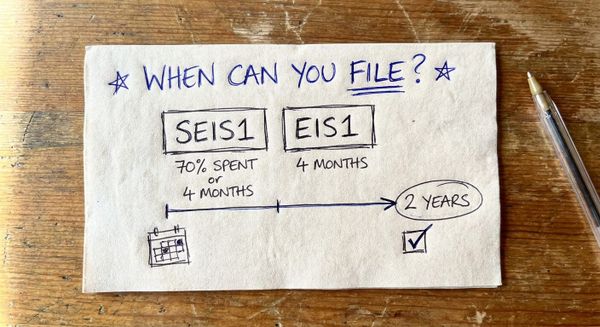
It does not replace the compliance statement. After the shares are issued, the company must still submit form EIS1 and receive HMRC's authority before issuing certificates to investors. The assurance indicates only that HMRC considers the conditions are likely to be met at the point the compliance statement is made (VCM60170). The guide to when a company can file SEIS1 or EIS1 explains the timing.
It does not cover the whole holding period. The company must keep meeting the conditions throughout the three-year qualifying period, and HMRC monitors companies during it (VCM60050 and VCM60170). Relief can be withdrawn if the company stops meeting a requirement or if the information supplied at the time of investment turns out to be misleading or incomplete (VCM8550).
Why do applications get refused, and what then?
HMRC will not give an assurance where it is not satisfied the company is likely to meet the conditions. It may decline to give an opinion where the information does not allow a conclusion, where the shares look to be issued for tax avoidance purposes, or where the investment is the result of aggressive planning or mitigates risk by ensuring that equity is repaid. It will also decline where the risk to capital condition or the disqualifying arrangements requirement is not met (VCM60150).
The disqualifying arrangements guidance lists the indicators HMRC looks for, such as majority holdings by scheme investors whose voting rights are delegated, most of the money passing to a subcontractor before the work is done, and offer documents that describe the investment as low risk (VCM60160).
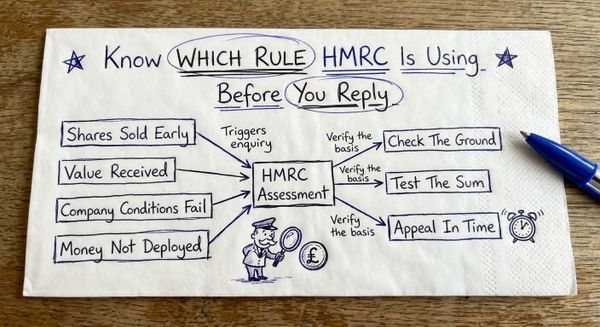
A refusal does not mean HMRC has already decided how the legislation applies. HMRC may prefer to examine the facts when the compliance statement is filed (VCM60150). Where the officer cannot give an assurance, a brief explanation of the reason is given, and it is entirely the company's responsibility to decide what, if anything, to amend in its proposals (VCM60170). HMRC says it will look at new information but may decline to enter into further correspondence once a decision is given (VCM60050). Separate guides to turning a refused application around and why applications are rejected cover the common causes and the options.
How does EIS advance assurance work alongside SEIS?
The choice of which scheme or schemes to use is entirely the company's (VCM60010). A company raising SEIS and EIS money in the same period needs each issue considered on its own conditions, the funding limits and the order of the rounds.
SEIS has its own advance assurance rules and its own limits. The 6 April 2026 changes to the EIS gross assets, annual and lifetime limits and the current SEIS cap of £250,000 is unchanged (the amount was last amended in 2023). Where SEIS money is raised first and EIS money follows, the earlier round and its timing need to be taken into account in the later application. The guide to multi-round SEIS and EIS funding covers the sequencing questions that arise when one round follows another.
Frequently asked questions
Do you need advance assurance for EIS?
No. HMRC states that a company may issue shares under the EIS without advance assurance (VCM60010). Many investors ask for it, and a company without it can still file its compliance statement after the shares are issued and claim that the conditions are met.
How do you apply for EIS advance assurance?
Through the online form on GOV.UK, which HMRC says covers all the venture capital schemes (inc SEIS and EIS). The application must come from the company secretary, a director or an authorised agent, and it needs the business plan and financial forecasts.
How long does EIS advance assurance take?
HMRC aims to respond to most applications within 15 working days and to complex cases within 40 working days (VCM60170). The GOV.UK page gives no timescale. Plan the round around the longer figure.
Is there an EIS advance assurance form and checklist?
The current route is the online form on GOV.UK, which HMRC says covers all schemes. The manual refers to a completed application form linked to the same GOV.UK page. Use the form and the list of required items on the GOV.UK page, and treat any older paper form or checklist as superseded.
Do you need a solicitor to apply for EIS advance assurance?
No. A company secretary or director can apply directly. An agent such as a solicitor or tax adviser can apply if the company signs an authority dated within the last three months (VCM60030 and the GOV.UK page). Choosing an adviser is about preparation and completeness and not about eligibility to apply.
Can a company apply for advance assurance after the shares have been issued?
No. If the shares have already been issued, HMRC cannot give an advance assurance and the company should submit its compliance statement instead (VCM60010 and VCM60150).
Does advance assurance mean investors will definitely get EIS relief?
No. It is an opinion on the company and the share issue only. Additional conditions apply to each investor, and relief can still be withdrawn later if the company stops meeting the rules or the information supplied was incomplete (VCM60010, VCM60170).
What happens if HMRC refuses EIS advance assurance?
There is no right of appeal. HMRC gives a brief reason, and it is for the company to decide whether to change its proposals. HMRC will look at new information but may decline to enter into further correspondence once a decision is given. Investors can still invest, and HMRC examines the facts when the compliance statement is filed (VCM60050, VCM60150 and VCM60170).
Does an assurance given before 6 April 2026 still work?
Not automatically. HMRC is not bound where the relevant law changes before the shares are issued, and it remains the company's responsibility to take account of changes in the law (VCM60140). Check the share issue date against the current limits.
Do you need advance assurance if a company is using SEIS and EIS together?
Neither scheme requires it. If a company wants an assurance for both, the GOV.UK form allows for each proposed investment, and each issue is tested on its own conditions.
Getting an EIS advance assurance application right
The usual causes of delay are an incomplete application, a business plan that does not address risk to capital, investor details that fall short of what HMRC asks for and limits checked against the wrong date. A full check of the conditions before the form is submitted costs far less than a refusal in the middle of a round.
IP Tax Solutions prepares and submits SEIS and EIS advance assurance applications and works with founders, accountants and lawyers on the surrounding compliance. Scope and fee are agreed in writing before work starts. You can get in touch to discuss an application, read about the SEIS and EIS advisory service or see the page for accountants and lawyers.
This article is general guidance, not advice for your specific circumstances. Advance assurance is discretionary, the limits depend on the share issue date and the company's own facts, and the rules change. Take advice before applying or issuing shares.