SEIS and EIS Risk-to-Capital Condition: What HMRC Looks For
Understand the SEIS and EIS risk-to-capital condition: long-term growth, commercial loss, recurring revenue, assets, outsourcing and application evidence.

By Steve Livingston FCA, founder of IP Tax Solutions. Technical sources reviewed: 21 September 2026.
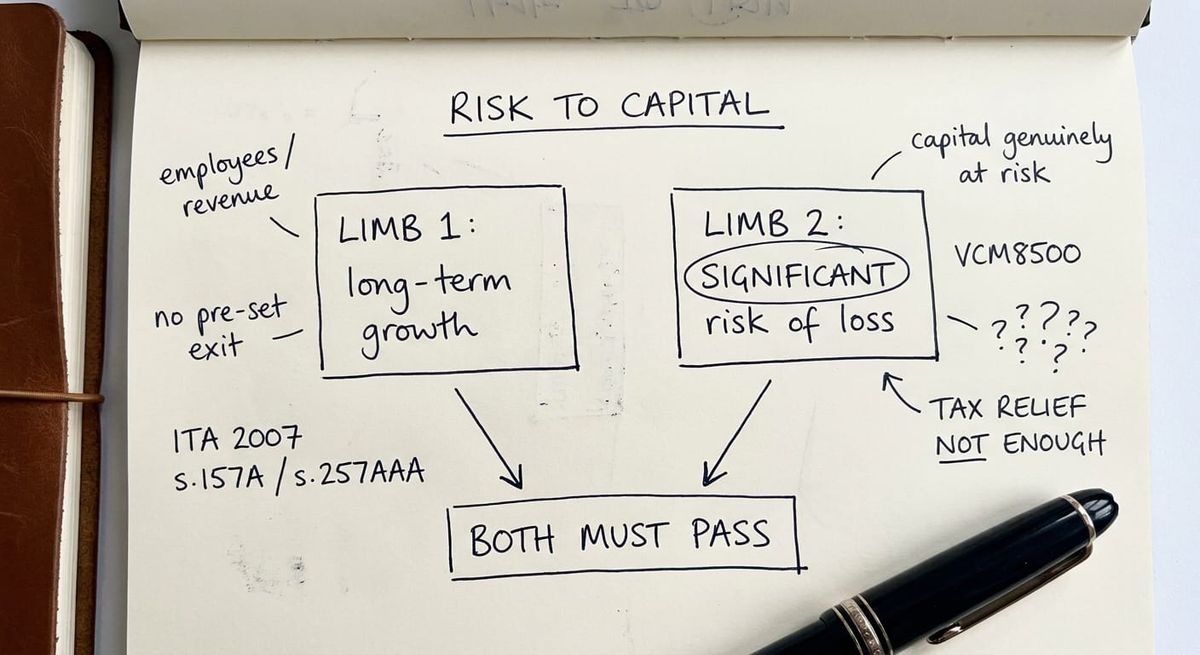
The SEIS and EIS risk-to-capital condition has two parts. The company must have objectives to grow and develop its trade over the long term, and the investment must involve a significant risk of capital loss exceeding the net investment return. Both are assessed using the circumstances at the share issue.
There is no single turnover, staffing or asset threshold that decides the answer. Existing revenue, valuable assets or subcontractors do not automatically prevent qualification. The question is whether the whole investment has genuine growth objectives and the required commercial risk.
What does the legislation require?
The condition is in ITA 2007 s.157A for EIS and s.257AAA for SEIS. It applies to relevant investments made from 15 March 2018. There is a corresponding VCT condition.
The assessment considers all circumstances existing at issue. The legislation identifies potential factors but does not turn each one into a separate pass/fail rule. Net investment return includes the value of the relevant income tax relief, alongside income and capital growth, with the statutory assessment referring to investors generally.
The condition is one requirement among many. A company can satisfy it and still fail a share-rights, excluded-activities, investor or other condition. Our SEIS eligibility guide sets those checks in context.
Part one: long-term growth and development
Explain what the company intends to build and how the money supports that objective. Relevant evidence can include planned increases in customers, output, revenue, employees, product capability, reputation or markets. The appropriate measures depend on the business.
Growth does not always mean employing more people. A company may automate its operations, reduce headcount and still develop its trade. Conversely, a modest staffing increase does not establish long-term growth on its own. The facts must be considered together. HMRC VCM8540.
A plan built only around reaching the end of the minimum holding period and returning investors' money raises a different concern from building a continuing business. Explain the ambitions beyond that period, while avoiding invented precision about distant financial forecasts. HMRC does not prescribe a universal five-year or six-year forecast as a standalone test.
The business plan supplied to HMRC should be the company's real commercial plan. A narrative created only to obtain assurance, inconsistent with the investor deck or board's intentions, is not a sound basis for the application.
Part two: significant risk of capital loss
The condition concerns commercial risk, such as the risk that the company's growth plans fail in the market. Risk that an investor loses tax relief because the company misses a compliance requirement is not the required commercial risk.
Potentially high returns do not themselves make an investment ineligible. A genuine growth company may offer substantial upside while leaving investors exposed to significant loss. The distinction is between possible rewards for taking risk and arrangements that substantially preserve capital or package a protected return. HMRC's explanation of the two parts.
Do not replace this assessment with an invented percentage of money “at risk”. Examine the share terms, expected returns, commercial contracts, assets, financing and connected arrangements together. Guarantees, put options, pre-arranged repayments or side letters deserve particular attention, and may also fail other scheme conditions.
Existing contracts and recurring revenue
Secured future income is not automatically disqualifying. HMRC expressly recognises that a contract to supply customers regularly does not necessarily indicate capital preservation. The company may still face significant delivery, cost, customer, competitive or expansion risk. VCM8542.
For a SaaS company, explain retention, customer concentration, contract termination rights, servicing costs and the proposed use of new capital. For a project business, explain obligations, contingencies and how revenue supports a lasting trade. The size of contracted revenue relative to the proposed raise can be relevant evidence, but it is not a standalone statutory limit.
The software and SaaS guide applies these questions to subscription businesses.
Assets and subcontracting
Assets required for the trade are not inherently problematic. The assessment asks how they affect the investors' exposure and the company's growth plans. A specialist production asset with uncertain resale value is different from an arrangement designed to preserve capital through readily realisable assets, but the conclusion remains fact-specific.
Outsourcing is also compatible with genuine entrepreneurial activity. Explain which functions are outsourced, why that is normal commercially and who owns the customer relationships, directs the work and takes the business risk. A shell delivering projects designed and controlled by others raises different issues from a company contracting for specialist support while developing its own trade.
A low current headcount is not an automatic failure. The application's job is to explain the operating model and credible development plan, not to inflate staffing forecasts to fit an assumed HMRC preference.
Special purpose vehicles and groups
A standalone vehicle created only to complete a limited project and return proceeds may struggle to demonstrate long-term development. But subsidiaries used for separate projects can form part of a qualifying growth group.
For example, the assessment can consider whether a parent retains capital and profits to develop an ongoing group trade, rather than organising an investor exit after each project. Explain the group's activities, ownership, decision-making and reinvestment plans. The parent's risk-to-capital assessment uses the statutory group approach, and the separate subsidiary and trading conditions also remain relevant. HMRC group/SPV guidance.
Marketing and investor documents
Read the pitch deck, term sheet, articles, shareholder agreement and any side letters together. A statement in an assurance application that capital is at risk is difficult to reconcile with a sales presentation promising a protected return or a fixed exit.
Correct inaccuracies in both directions. Do not describe a low-risk investment as high-risk merely to obtain relief, and do not market an uncertain investment as protected to attract subscriptions. If the underlying arrangements fail, rewriting the application alone will not fix them.
How to build the evidence
An application file should explain:
- The business and its intended development beyond the minimum holding period.
- The specific expenditure and milestones funded by the raise.
- The commercial risks capable of causing capital loss.
- Existing revenue, contracts, assets and financing, including any protective arrangements.
- The role of employees, contractors, founders and investor representatives.
- Why any group or project-company structure exists commercially.
Support those explanations with consistent forecasts, contracts and investment documents. Separate facts from forecasts and identify assumptions that could change the outcome.
Advance assurance and later HMRC review
HMRC can consider this condition when reviewing an advance assurance application. A refusal may reflect incomplete evidence, a misunderstanding or substantive capital-preservation arrangements. Those require different responses. There is no basis for promising that most refusals can be rescued.
Use our advance assurance application guide to assemble the submission and understand the scope of HMRC's letter. After investment, follow the relevant compliance process, including the SEIS1 statement for SEIS.
Distinguish three situations in any later review: a proposal changed before issue; later evidence revealing what was actually intended at issue; and a genuinely subsequent change affecting another continuing condition. Risk to capital is assessed at issue. A later change does not automatically prove the earlier test failed, but the evidence may be relevant and other conditions can remain at risk.
Frequently asked questions
Does recurring revenue prevent relief?
No. Consider whether the investment still has the required significant commercial risk and long-term growth objectives in the context of all the arrangements.
Must the company plan to increase headcount?
Not necessarily. Headcount is one possible indicator. Explain the growth measures appropriate to the trade and how the proposed investment supports them.
Can a refusal be corrected with a better business plan?
Sometimes clearer evidence resolves an uncertainty. It cannot cure every substantive defect in the company or investor arrangements. Identify the actual reason for refusal before revising the submission.
Discuss a difficult application
Contact IP Tax Solutions if an application involves significant contracted income, outsourcing, project companies, protective investor rights or a risk-to-capital refusal. We can review the facts and documents and agree what further work is needed.
This article provides general information. The statutory condition requires a fact-specific assessment of the proposed investment.