SEIS compliance enquiry after advance assurance: a case study
What a multi-round SEIS compliance review teaches about evidence, share issue timing, continuing conditions and the limits of advance assurance.

Reviewed and updated: 21 September 2026.
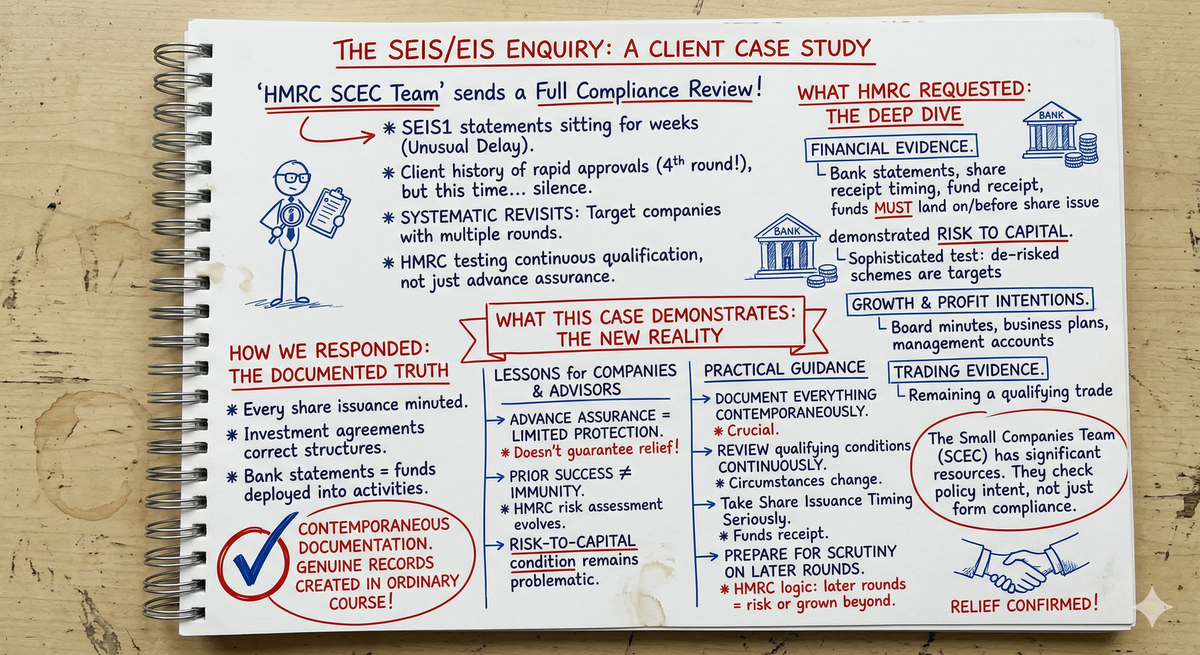
A client with advance assurance and three previously processed SEIS rounds received a detailed HMRC review when it submitted compliance statements for a further round. The earlier statements had been processed quickly. This time HMRC asked for more evidence.
The statements were ultimately processed as filed, without amendments, denials or withdrawal of relief. This is a report of one engagement, not evidence that HMRC has adopted a particular campaign or that every later round receives the same treatment.
What HMRC asked to see
The review covered the receipt of investment funds, share issue timing, the business's activities, its growth intentions and the risk-to-capital condition. Financial records, investment documents and the company's commercial plans were relevant to explaining the position.
We had contemporaneous records: properly documented share issues, investment agreements, bank statements and board records. These helped us reconcile what had actually happened with the original proposal and the conditions relevant to each issue.
What does advance assurance establish?
An assurance is HMRC's view on a proposed investment based on the disclosed information. It is not a final determination that every investor can claim relief, or a guarantee that the relevant conditions will remain satisfied. HMRC can consider the actual facts at the compliance-statement stage. VCM60210 and VCM60270.
The same company may make several investments and submissions. Earlier successful processing does not remove the need to establish the position for a later issue.
When can SEIS1 be filed?
There is no general requirement to wait 12 to 18 months. After the relevant share issue, the statutory gate requires either 70% of the issue proceeds to have been spent on the relevant qualifying business activity or the relevant new qualifying trade to have been carried on for at least four months by the issuer or a qualifying 90% subsidiary. s.257ED.
The trading limb is not simply four months since the investment arrived. Read our SEIS1 guide for the process and certificate distinction. EIS has its own filing rules.
Which conditions continue after investment?
Different tests apply at different times. SEIS gross assets are tested immediately before the issue, and the employee limit at the issue. Risk to capital is assessed by reference to circumstances existing when the shares are issued. Other conditions, including relevant share rights and trading requirements, extend over specified periods.
A company becoming commercially successful does not automatically retrospectively fail risk to capital or an earlier size test. Later evidence can, however, illuminate the circumstances and intentions existing at issue. A fresh investment must be checked against the conditions applicable to that fresh issue. s.257AAA, s.257DI, s.257DJ and s.257CA.
This distinction matters when reviewing a growing business. “Everything must remain exactly as it was” is not the legal test; neither is “we qualified once, so nothing further matters”.
Cash, shares and advance subscriptions
Shares must be subscribed wholly in cash and fully paid on issue. Late payment can cause a problem. Money received earlier also needs to be understood properly: was it an advance subscription or a loan?
An advance subscription agreement is not a way to relabel an existing debt conversion. HMRC says an ASA must not in substance be a loan, and arrangements used to convert debt or another obligation into shares will not be eligible on that basis. It also sets conditions for the terms and its approach to the longstop date. VCM33020 and VCM33025.
Practical preparation for a review
Keep a record for each share issue covering the application and response, final agreements, cash receipt, company registers, use of funds and compliance submissions. Explain changes rather than assuming the earlier assurance covers them.
Contemporaneous evidence is valuable because it records intentions and events at the relevant time. Later explanations can still have evidential value, but should be candid about when they were prepared and be supported by reliable records. Do not manufacture or backdate documents.
If HMRC asks questions, identify which statutory condition and which period are in issue. Reply to the actual questions, reconcile inconsistent documents and separate established facts from assumptions. That approach was more useful in this case than relying on the speed of earlier approvals.
What this case demonstrates
Advance assurance and a good compliance history are useful, but neither replaces evidence for the relevant investment. The positive outcome here illustrates the value of accurate records and a focused response. It does not predict the result of another enquiry.
For a proposed round, start with our advance assurance guide. For an existing HMRC question, establish the issue dates, the condition being tested and the available contemporaneous evidence before deciding how to respond.
For help with a proposed investment, discuss your SEIS or EIS position with IP Tax Solutions. We can agree the scope of a review around the facts and the point causing concern.
This article provides general information. Company, share and investor conditions require separate consideration.