Founders' Relief and R&D: Where the Innovation Test Could Catch Founders Out
Founders' Relief needs £1.5m of qualifying R&D within a three-year window before sale. Where the proposed innovation test could catch founders out, and the consultation questions to answer by 30 November 2026.

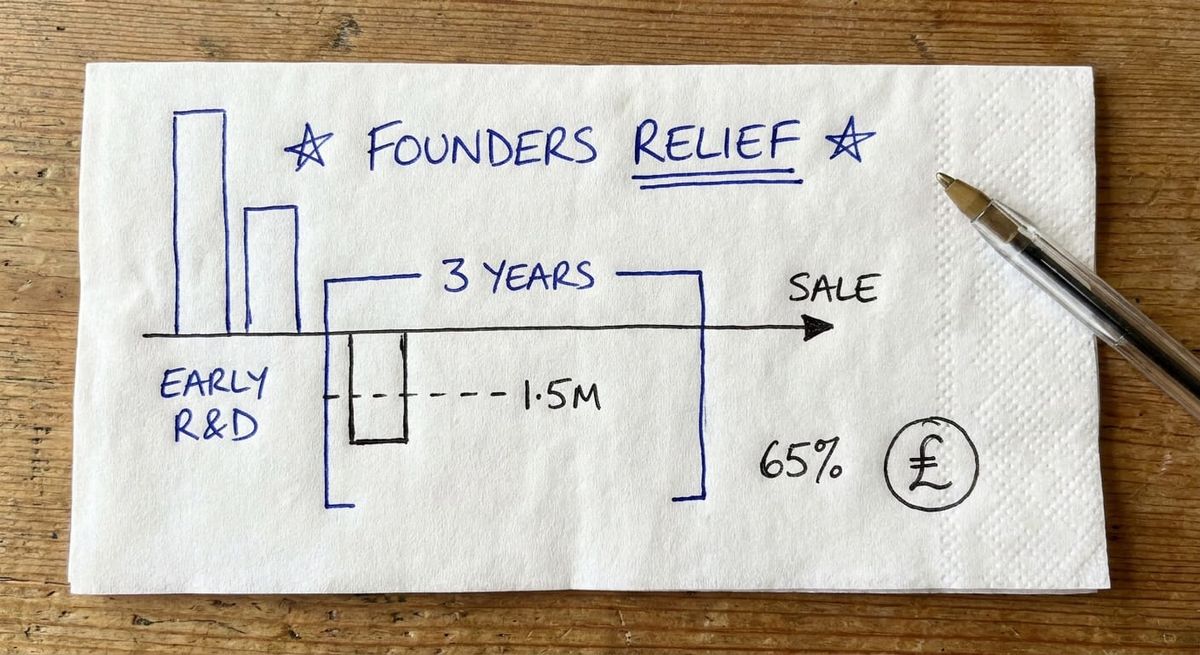
Founders' Relief is worth up to £1.4 million of Capital Gains Tax against the 24% main rate. A company only needs to pass two of three growth and innovation tests, and one of them uses the R&D tax relief system as its measure.
In this article, we look at the possible problems that this R&D tax relief test could cause for claimants.
In this guide
- What is the Founders' Relief innovation test?
- Where could the innovation test go wrong?
- What does this mean for founders planning a sale?
- What should you say in the consultation?
- Frequently asked questions
- Want a second opinion before a sale?
What is the Founders' Relief innovation test?
The consultation says the company must have incurred qualifying expenditure of £1.5 million or more on R&D for which it met all the conditions to make an R&D tax relief claim. It must also have claimed R&D tax relief for that expenditure for an accounting period or periods ending within the three years before disposal (consultation para 3.2).
It is one of three tests, and the company must pass two. The other two are 25% annual average compound growth in turnover, or in qualifying full-time employees, across three consecutive accounting periods within the ten years before disposal. A company that does not claim R&D relief can still qualify by passing the turnover and headcount tests (para 3.5).
For the other conditions, see our guide to what Budget 2026 changed for founders.
Where could the innovation test go wrong?
Four situations deserve attention. These are our reading of the proposal as drafted, not settled rules.
1. The spend happened too early. The test looks at claims for periods ending in the three years before sale. Many companies spend most on R&D in the early years before they then move to commercialisation. A company could have spent several million on R&D and claimed relief, yet have less than £1.5 million in the relevant three year window. The consultation does not state whether earlier spend can count.
2. The contractor limit can pull the figure below £1.5 million. Under the current R&D rules, expenditure on contracted out R&D is restricted to 65% of payments to unconnected contractors. The same 65% limit applies to payments to unconnected staff providers for externally provided workers (CIRD122200, CIRD137000 and CIRD138000). A company that spends £2 million, of which £1 million goes to unconnected contractors, has qualifying expenditure of approx £1.65 million. Move the contractor share to £1.5 million and the figure falls to approx £1.475 million. The consultation does not say whether the £1.5 million is measured before or after that restriction. The answer matters for any company that outsources its research.
3. The final year is not known at the point of sale. The test needs a claim for periods ending in the window. If the sale is agreed before the last accounting period has been closed and claimed, the founder may not know whether the test is met. The consultation does not say how a claim not yet filed at the date of sale is treated.
4. HMRC opens an enquiry after the sale. The consultation says this directly. If HMRC takes compliance action on the company's R&D claim and decides a condition the individual relied on was not met, the individual loses Founders' Relief and pays the extra tax with interest (para 4.6). The founder holds the risk but does not control the claim. The consultation also notes the confidentiality question, because HMRC may not be able to tell the founder about the company's tax affairs.
What does this mean for founders planning a sale?
Whether a founder relies on the innovation test or on the turnover and headcount tests, the planning point is the same. Decide which two tests the company expects to pass well before a sale, and test the R&D figure with the 65% limit applied.
A founder who intends to use the innovation test should consider four things now:
- Total the qualifying R&D expenditure claimed for accounting periods that would end in the three years before a likely sale date.
- Apply the 65% limit to unconnected contractor and externally provided worker costs, and see what is left against £1.5 million.
- Check that each claim in the window is one that would survive an enquiry. The evidence is best built while the work is happening.
- Check the company's turnover and headcount position as a second route, so the relief does not depend on one test alone.
What should you say in the consultation?
The consultation closes on 30 November 2026. Questions 4 and 5 ask about practical difficulties and unintended consequences in the three tests and whether other criteria could identify innovative companies. The four points above are the kind of practical difficulty those questions invite. The useful responses are specific: a worked example of a company with early heavy R&D, or a company that outsources most of its research, shows HM Treasury where the test breaks.
Frequently asked questions
Is Founders' Relief law?
No. It is a proposal in a technical consultation, with legislation expected in a later Finance Bill. The start date is proposed as disposals on or after 6 April 2027.
Does a company have to claim R&D relief to qualify?
No. A company must pass two of three tests. A company with no R&D claim can qualify through the turnover and headcount tests.
Does the 65% limit apply to the £1.5 million?
The consultation does not say. Under current rules, payments to unconnected contractors count at 65% as qualifying expenditure. Until the draft legislation clarifies this, assume the restricted figure.
What happens if HMRC later challenges the R&D claim?
On the consultation's own example, a founder who relied on the innovation test can lose the relief and pay the additional tax with interest.
Want a second opinion before a sale?
IP Tax Solutions advises founders and owner managers on share disposals, reliefs and the R&D claim position behind them. If you are planning a sale in the next few years, get in touch. If you are an accountant with a client in this position, see our page for professional referrers.