Issuing or Transferring Shares to a Co-Founder: What Are the Tax and SEIS/EIS Consequences?
Issuing or transferring non-SEIS shares to a co-founder: ERS and s.431, CGT on a transfer, the SEIS 30% limit, the EIS s.164A bar, sweat equity and registers.

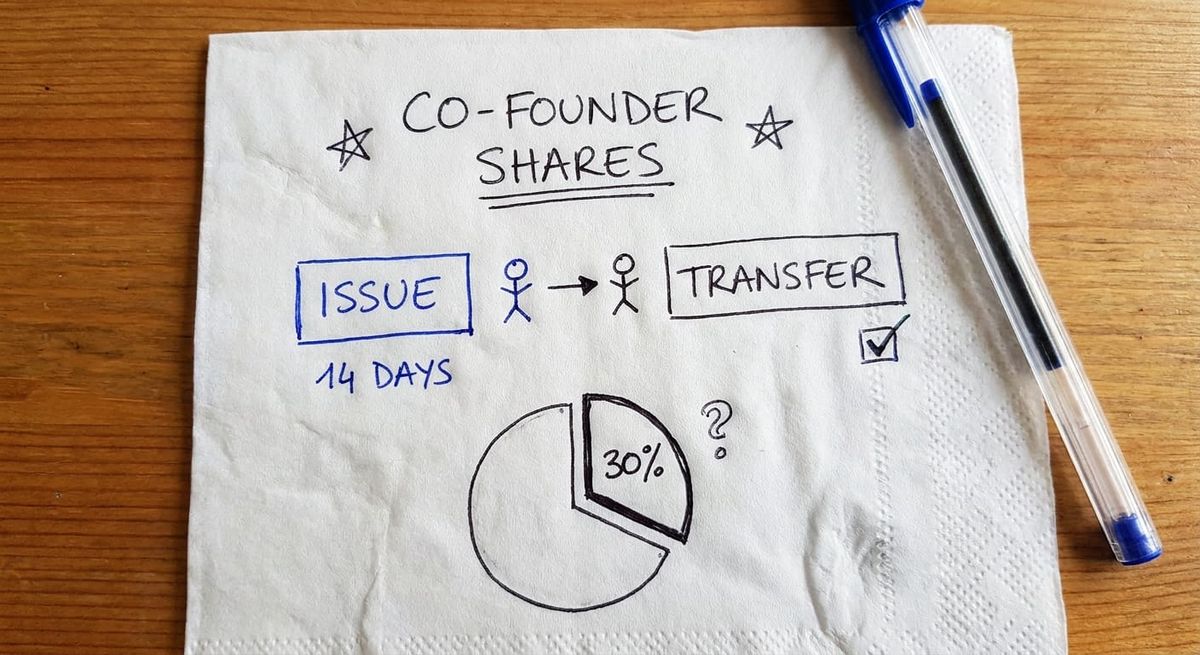
A co-founder joins after incorporation, or one founder buys out another, and the company is raising or planning to raise SEIS or EIS money. The shares involved are not SEIS shares, so most founders assume the venture capital scheme rules are not engaged. They are. This guide takes the issue and the transfer in turn and then sets out how the same shares affect SEIS and EIS status, what to do about sweat equity and what to document.
In this guide
- Is a share issue to a co-founder employment income?
- Does a co-founder share issue need to be reported if the price is full market value?
- When does a co-founder need a section 431 election?
- What are the CGT consequences when one founder transfers shares to another?
- Can the founder receiving transferred shares face an income tax charge?
- Do non-SEIS shares count towards the SEIS 30% limit?
- How do non-SEIS shares affect an EIS claim?
- Can a co-founder take shares for work instead of cash?
- What must the company do with its registers and Companies House filings?
- What should founders document before issuing or transferring shares?
- Frequently asked questions
- Getting the share position right before the round
Is a share issue to a co-founder employment income?
Short answer: it can be. Securities acquired by a director or employee are treated as employment-related when the right to acquire them is made available by the employer or a person connected with the employer (s.421B(3) ITEPA 2003). A company issuing shares to its own director is the source of that opportunity. In Vermilion Holdings ([2023] UKSC 37) the Supreme Court confirmed that this deeming rule is applied first and without a causation enquiry. A director is caught even if unpaid and with no service contract, because the office alone supplies the link.
The legislation and HMRC's manual have no category called founder shares. Tax and reporting turn on the recipient's status and the price paid. A person who holds no office or employment, and whose shares were not made available by reason of anyone's employment, sits outside the regime altogether.
Does a co-founder share issue need to be reported if the price is full market value?
Often yes. The trigger for the annual "Other" ERS return is the acquisition and not a tax charge, so a full-price subscription that produces nil tax is still reportable (ss.421K(3) and 421JA ITEPA 2003). The return is due online by 6 July after the end of the tax year. A company that has not registered an "Other" scheme must register before it can file.
HMRC's list of events that do not need reporting is narrow. ERSM140040 exempts initial subscriber shares on incorporation and further shares allotted before the company starts trading or receives a transfer of assets, in each case at nominal value to a director or prospective director. Example 3 on that page marks the cut-off. A company that began trading in July 2015 issued further shares to its two directors in August 2015, and those shares had to be reported.
The line is commencement of trading and not the first investment round. The same co-founder issue can be exempt before trading starts and reportable afterwards, with no minimum size. Late filing carries a penalty under s.421JC and an inaccurate return under s.421JD.
When does a co-founder need a section 431 election?
A section 431 election is a joint election by the company and the individual to be taxed on the unrestricted market value at acquisition and to ignore any restrictions on the shares. Most private company shares count as restricted. A board's discretion to refuse to register a transfer (Model Article 26(5)), compulsory transfer on leaving and vesting terms can all fall within s.423 ITEPA 2003 where they depress the market value of the shares.
The election must be signed jointly within 14 days of acquisition, and HMRC has no discretion to extend that window. It is kept in the company's own records and is not filed with HMRC. Investors and their lawyers usually ask to see it in due diligence.
Two points catch founders who add shares after incorporation. An election made at incorporation covers that acquisition only, so a later top-up or a new issue after a priced round needs its own election within its own 14 days. And a nominal-value issue after a priced round can create an income tax position on the gap between the price paid and the unrestricted market value.
What are the CGT consequences when one founder transfers shares to another?
A transfer between founders is a disposal by the transferor and an acquisition by the transferee. If it is not a bargain at arm's length, the disposal is treated as made at market value whatever was actually paid (s.17 TCGA 1992). Parties who are connected are treated as not dealing at arm's length. Unconnected founders who agree a genuine price at arm's length use that price.
A gift or an undervalue therefore produces a chargeable gain on market value less base cost, with no cash from the buyer to pay the tax.
A gift of shares in an unlisted trading company can typically be held over by a joint election under s.165 TCGA 1992. The gain is deducted from the transferee's base cost, so holdover defers rather than exempts. It defers the transferor's gain only. It does not protect a transferee from an income tax charge under Part 7 ITEPA 2003 if the shares are employment-related, and where such a charge arises s.119A TCGA 1992 treats the amount charged as employment income as part of their acquisition cost. Where the buyer pays more than the seller's base cost, the held-over gain is reduced by the excess (s.165(7)), and relief is not available where the transferee is a company. If the transfer is really a reward for services, s.17(1)(b) deems market value to be the consideration.
Business Asset Disposal Relief (BADR) may reduce the rate where its conditions are met. The BADR rate is 18% for disposals from 6 April 2026 (14% in 2025/26), while gains above the lifetime limit are taxed at the main higher rate of 24%. The lifetime limit is announced to fall to £500,000 from 6 April 2027, which is not yet law (see Budget 2026 for founders). For gifts within a family read transferring shares to your children.
Can the founder receiving transferred shares face an income tax charge?
It can, where the shares come to them by reason of their office or employment and they pay less than unrestricted market value. A remaining founder who is a director can be acquiring employment-related securities, so an undervalue can fall within Chapter 3C of Part 7 ITEPA 2003 (see the first section). The s.421B(3) deeming rule applies where the employer or a person connected with the employer makes the opportunity available. Otherwise the question is whether the shares are available by reason of employment at all, on the facts.
The family exception will often not help two co-founders. ERSM20220 removes the deeming where an individual makes the opportunity available in the normal course of domestic, family or personal relationships. HMRC's own example is a father transferring his family company shares to his children on retirement, even though they also work in the company. HMRC says personal relationships can include friendships, and asks whether the transfer is really a reward or incentive for an employee, so the answer turns on why the transfer is happening.
Two protective steps follow:
- Pay market value where the commercial deal allows.
- Where the shares are employment-related and restricted, consider a section 431 election within 14 days of the transfer so that future growth falls within capital gains tax.
A transfer papered as a gift that is in substance payment for liabilities taken on, or a reward for future services, can be recharacterised. Record the commercial reason at the time of the transfer.
Do non-SEIS shares count towards the SEIS 30% limit?
Yes. An SEIS investor must not have a substantial interest in the company at any time in period A, which runs from incorporation to the third anniversary of the SEIS share issue (ss.257BB and 257AC ITA 2007). A substantial interest is more than 30% of the ordinary share capital, the issued share capital or the voting power, or of the assets available on a winding up, or control of the company (s.257BF). The statute does not ask how the shares were acquired, so founder shares, sweat equity and shares received on a transfer all count. Rights to acquire shares in future count too, and an associate's holding is added to the investor's (s.257BF(7)).
The only carve-out is a company that has issued nothing but subscriber shares and has not begun to trade or prepare to trade (s.257BF(5)).
For SEIS the associates are spouses and civil partners, parents and grandparents, children and grandchildren, business partners and certain trustees. Brothers and sisters are not associates (VCM32020 and VCM32030). A co-founder who is also an SEIS investor, directly or through a family member, should be tested on every limb after any transfer or issue.
SEIS also bars an investor or associate who is an employee of the company in period B, although a person is not treated as an employee at any time when they are a director (s.257BA). Otherwise holding non-SEIS shares does not stop a person taking SEIS shares.
How do non-SEIS shares affect an EIS claim?
EIS is stricter. Under s.164A ITA 2007 an investor who holds other shares in the issuing company (or a qualifying subsidiary) when new EIS shares are issued can claim only if those other shares are a risk finance investment or qualifying subscriber shares. A risk finance investment is a holding issued to that investor and covered by a compliance statement under s.205, s.257ED or s.257PB, so shares issued to the same investor under earlier SEIS or EIS rounds do not cause a problem.
Founder shares issued after incorporation, shares received on a transfer and sweat equity are none of these. The test is applied at the time the EIS shares are issued, so the person must have ceased to hold such shares before that date. The bar applies to that investor's own claim and not to the other investors in the round.
The subscriber share exception is narrow. It covers shares issued to the investor and held continuously since issue, or acquired when only subscriber shares had been issued and the company had not begun to trade or prepare to trade (s.164A(1)(b)). A co-founder who takes shares by transfer after trading starts does not fit it.
EIS also has its own 30% connection test (s.170), and an investor who is an employee or a director can be connected with the company in other ways. A director is not connected merely because they are a director, unless they receive or are entitled to a payment from the company other than the excluded items such as expenses and necessary reasonable remuneration (s.168 ITA 2007). A paid director can still qualify under s.169 if the remuneration is reasonable for their services as director and they were never previously connected with the company or involved in its trade (conditions A to C). Run the position for each investor before the round closes.
Can a co-founder take shares for work instead of cash?
A co-founder can be issued shares for services, but those shares can never be SEIS or EIS shares. Both schemes require the shares to be subscribed for wholly in cash and fully paid when issued (s.257CA(4) and s.173(3) ITA 2007), and there must be no undertaking to pay cash at a later date (s.257CA(5) and s.173(4)).
Holding sweat equity does not withdraw SEIS relief already claimed on its own. It does count towards the 30% test, and it blocks that person from a later EIS subscription under s.164A while they hold it.
Shares issued for services to a director or employee are employment-related securities. The issue is reportable, any undervalue can be taxable and a section 431 election should be considered. An adviser who is self-employed is generally taxed on the market value of the shares received as trading income.
What must the company do with its registers and Companies House filings?
A share certificate is evidence of issue and not the act of issue. Shares are allotted when a person acquires the unconditional right to be entered in the register of members (s.558 Companies Act 2006). They are issued when the member is entered in the register (ss.112 and 554). A certificate is prima facie evidence of title (s.768) and must be ready within two months of allotment (s.769). An SH01 return of allotment is due within one month of allotment (s.555).
For a new issue to a co-founder that means a board allotment, with authority to allot and pre-emption rights dealt with (s.550 or s.551 and s.561), the register updated, the SH01 filed and a properly executed certificate. A certificate must be executed in accordance with the Companies Acts. Under s.44(2) Companies Act 2006 that means signature by two authorised signatories, or by a director in the presence of a witness who attests the signature. A certificate signed by one director with no witness is defective, so a sole director needs a witness. Check the company's articles for anything further.
A transfer is not an allotment, so the SH01 relates to new shares only. The register of members is updated for the new holder and the shareholder change is then reflected in the company's confirmation statement. A new certificate is due within two months of the transfer being lodged (s.776), and a transfer for more than £1,000 generally attracts stamp duty at 0.5% of the price.
If the paper trail is wrong, a late SH01 must carry the true allotment date and earlier confirmation statements may need correcting.
The date of issue decides the ERS tax year and the SEIS and EIS position, so a back-dated or forward-dated record causes problems in due diligence.
What should founders document before issuing or transferring shares?
Settle the following before the shares move, because several cannot be repaired afterwards.
- The date of the issue or transfer and the tax year it falls in.
- The basis of the price, with a written market value where the price is not full value.
- The recipient's status on that date (director, employee, adviser or pure shareholder) and whether the company had commenced trading.
- The board minute, authority to allot, pre-emption waiver and any deed of adherence. A deed of adherence the incoming party has not signed means they never adhered.
- The register entry and a certificate executed under s.44 Companies Act 2006 (two authorised signatories, or one director with an attesting witness).
- Signed section 431 elections within 14 days, held in the statutory books.
- The "Other" ERS registration and the return due by 6 July.
- On a gift, the holdover decision and whether crystallising the gain is cheaper over the life of the shares.
- A fully diluted cap table with associates aggregated, tested against 30% on every limb through period A.
- A list of everyone who holds non-SEIS shares and plans to invest in a later EIS round.
Frequently asked questions
Do we need a section 431 election when we issue shares to a co-founder at full market value?
It is usually advisable. At full market value the election costs nothing and locks future growth into capital gains tax rather than leaving restricted shares exposed to an income tax charge on a later event. It must be signed jointly within 14 days of the acquisition and kept in the company's records. It is not filed with HMRC.
Is a co-founder share issue before trading starts reportable to HMRC?
Not if it falls within HMRC's exemption. Initial subscriber shares on incorporation and further shares allotted before the company commences trading are exempt, provided they are at nominal value and go to a director or prospective director (ERSM140040). Once trading has commenced a further issue to a director is reportable on the "Other" return even if no tax is due.
Does a founder gifting shares to another founder trigger capital gains tax?
Usually yes. A gift is treated as a disposal at market value (s.17 TCGA 1992), so the transferor has a gain without receiving cash. A joint holdover election under s.165 can defer it for shares in an unlisted trading company, but holdover needs a genuine gift and only defers the gain.
Can a co-founder who holds non-SEIS shares still invest under SEIS?
Yes, subject to two tests. The investor and their associates together must not hold more than 30% on any limb during period A, and neither the investor nor an associate may be an employee in period B, although a person is not treated as an employee while they are a director. SEIS has no rule barring other shares.
Does holding sweat equity stop a founder investing under EIS later?
Yes if they still hold it when the EIS shares are issued. Sweat equity is neither a risk finance investment nor qualifying subscriber shares, so under s.164A ITA 2007 it blocks that person's EIS claim on that subscription. Earlier SEIS or EIS shares issued to the same investor do not cause the same problem.
Does a share transfer between founders need an SH01?
An SH01 reports an allotment of new shares (s.555 Companies Act 2006). A transfer moves existing shares, so the register of members is updated and the change is reflected in the company's confirmation statement. Check the current Companies House guidance for the route that applies to your company.
What if a certificate was produced before the board allotted the shares?
The certificate does not prove the shares were issued. Issue happens on entry in the register of members. If there is no board minute and no register entry, the certificate is an anticipatory draft and a fresh allotment should be made with a new, properly executed certificate. If a valid earlier allotment lies behind it, file a late SH01 dated to that allotment.
Getting the share position right before the round
The common mistakes are issuing shares at nominal value after a priced round, missing the 14-day election window and forgetting that a co-founder's non-SEIS shares count towards the 30% limit and can block an EIS claim. Each is avoidable if the issue or transfer date, the price basis and the cap table are checked before the shares move.
If you are about to issue shares to a co-founder or move shares between founders ahead of a SEIS or EIS round, you can get in touch to discuss it. The work is scoped and priced in writing before it starts.
This article is general guidance, not advice for your specific circumstances. Tax and SEIS/EIS treatment turn on the date of the issue or transfer, the recipient's status and the company's own facts. Take advice before issuing or transferring shares.