Am I too late to claim R&D tax credits? How far back can I claim?
Many company founders mistakenly believe that they are too late to make a claim for R&D tax credits because they have already filed their tax return - this could be a costly mistake...

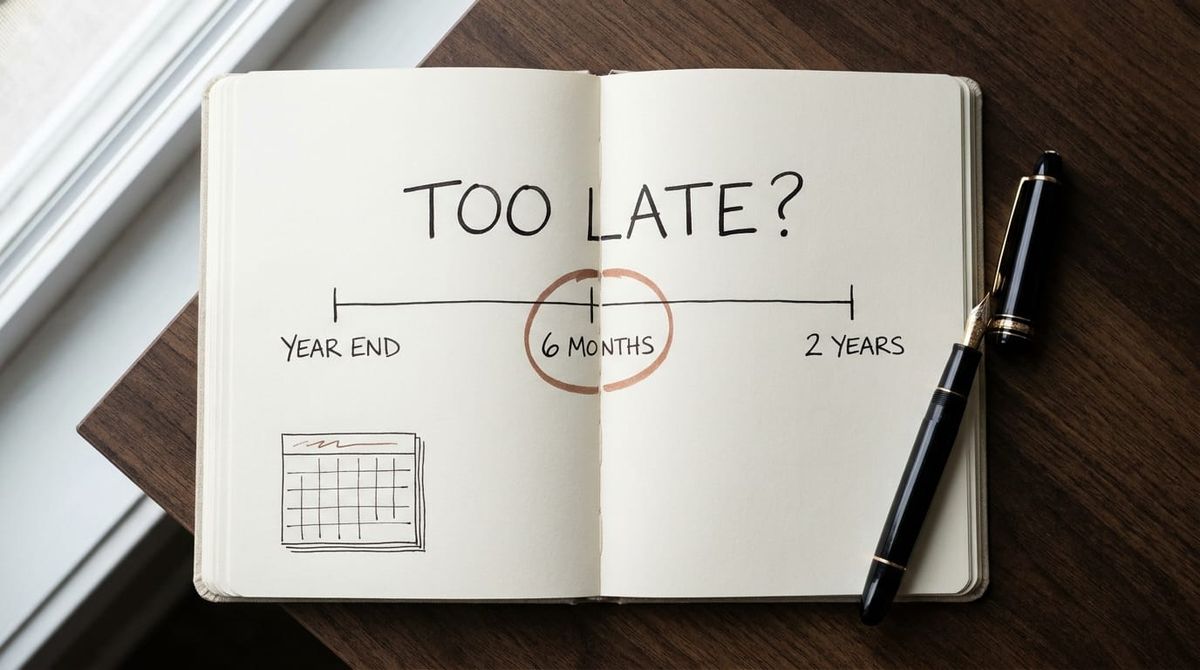
If your company has been carrying out research and development and has only now come across R&D tax relief, you may be able to claim for earlier periods. Two separate rules decide whether you can.
- the statutory time limit for making the claim.
- the claim pre-notification rule, which is shorter and easy to miss - although legislation is currently before Parliament to remove it from 1 April 2027.
This article covers accounting periods beginning on or after 1 April 2024. For accounting periods beginning before that date the previous rules apply, and HMRC enquiries into those periods are still live.
How is an R&D claim made?
A claim is made in the company tax return, or by amending a return that has already been filed.
What if the return for the period has already been filed?
The claim can be included in an amended return, provided both rules below are met. Amended returns that include an R&D claim must be filed online.
Rule 1: how long do you have to make the claim?
A claim can be made, amended or withdrawn up to the last day of:
- two years beginning with the last day of the period of account, where the period of account is not longer than 18 months
- 42 months beginning with the first day of the period of account, in any other case
The period of account is the period for which the company draws up its accounts.
Example
A company draws up accounts for the year ended 31 December 2026. The two years begin with 31 December 2026, so the last day for the claim is 30 December 2028. That is one day earlier than the second anniversary of the year end, because the two years include the last day of the period.
HMRC has a discretion to accept a late claim, but it is exercised only within the terms of a published Statement of Practice. It should not be relied on.
Rule 2: did you need to notify HMRC first?
Until 1 April 2027, this is the rule to check first.
A company cannot make a claim after the end of the claim notification period unless one of these applies:
- the company has made an R&D claim during the three years ending with the last day of the claim notification period
- the company made a claim notification within the claim notification period - or submitted the R&D claim itself - within the claim notification period
- the accounting period falls within the same period of account as another accounting period for which the company has made an R&D claim or a claim notification
The claim notification period begins on the first day of the period of account. It ends on the last day of the six months that begin with the first day after that period of account.
A claim notification is made through HMRC's online service. It asks for details of the company, a responsible officer and any agent, the dates of the accounting period and the period of account, the number of R&D projects and an overview of them. When the tax return is subsequently filed, the company must also confirm the notification position on the CT600 (Box 656) or HMRC may automatically remove the claim.
What is changing from 1 April 2027
In the Autumn Budget on 28 October 2026, the government announced - and in Finance Bill 2026–27 (published 4 November 2026) introduced legislation - to remove the claim notification requirement for R&D claims made on or after 1 April 2027, including claims made by amended return.
The cut-off turns on the date the claim is made, not the accounting period it relates to:
- For any claim submitted on or before 31 March 2027, the existing notification rule remains in force. Companies with notification deadlines falling before April 2027 should continue to notify on time until the Bill receives Royal Assent.
- Assuming Finance Bill 2026–27 is enacted as introduced, a company that missed an earlier notification deadline will be able to submit a valid claim on or after 1 April 2027, provided its underlying Rule 1 claim window has not yet expired.
Example
For the year ended 31 December 2026, the claim notification period ends on 30 June 2027.
- If the company made an R&D claim at any point in the three years ending on 30 June 2027, no notification is needed (subject to the exception explained below). It can claim up to 30 December 2028.
- If it did not, it must notify HMRC by 30 June 2027 if it wishes to claim before 1 April 2027 - and we recommend meeting that deadline until Finance Bill 2026–27 receives Royal Assent.
- Once the 1 April 2027 repeal takes effect, a claim made on or after that date will no longer depend on prior notification, leaving the company until 30 December 2028 to file
What counts as an earlier R&D claim?
An R&D claim means a claim for the R&D expenditure credit, for the additional deduction for SMEs, or for the payable R&D tax credit. Two points need care.
- an R&D claim for an accounting period beginning before 1 April 2023 is ignored if it was included in the return only by an amendment made on or after that date. A company whose only recent claim was made that way should treat itself as needing to notify for any claim made before 1 April 2027
- if the company's only earlier claims were of another kind, for example under the RDEC rules that applied before the merged scheme, check the position before relying on them for pre-April 2027 filings.
How far back can you go today?
Take a company with a 31 December year end, looking at its position in late November 2026.
- Year ended 31 December 2025. The Rule 1 time limit runs to 30 December 2027. The claim notification period ended on 30 June 2026. To file a claim today (in November 2026), the company must have made an R&D claim in the three years ending on 30 June 2026, or notified HMRC by that date. However, if it missed the 30 June 2026 notification deadline and Finance Bill 2026–27 is enacted as introduced, it should be able to submit an amended return between 1 April 2027 and 30 December 2027 without having notified
- Year ending 31 December 2026. The claim notification period is still open and runs to 30 June 2027.
What if the period of account is longer than 12 months?
A long period of account is one where the accounts are drawn up for more than 12 months. The legislation recognises that one period of account can contain more than one accounting period.
Both rules are measured from the period of account, not from each accounting period. So the dates are the same for every accounting period within it.
Example
A company is incorporated on 26 September 2026 and draws up its first accounts to 30 September 2027. That period of account is not longer than 18 months.
- The claim notification period ends on 31 March 2028.
- The last day for a claim is 29 September 2029.
Where a period of account is longer than 18 months, the 42-month limit applies instead. It runs from the first day of the period of account.
A notification or claim for one accounting period also covers another accounting period in the same period of account (see point 3 above).
Does choosing a year end affect R&D relief?
It moves both dates. The claim notification deadline is counted from the end of the period of account, and the time limit for the claim is counted from the same period. A new company expecting to claim before 1 April 2027 should diarise the notification deadline when it sets its year end.
Is an amended return a problem?
No. The legislation provides for claims to be made by amendment. The practical points are that the amendment must be filed online, the additional information form (AIF) must be submitted on or before the date the claim is made (this requirement continues even after claim notifications are removed in April 2027), and the amount claimed must be quantified.
Does the same time limit apply to both reliefs?
Yes, with the following exceptions.
- The standard time limit and (until 1 April 2027) the claim notification rule apply to claims for the R&D expenditure credit and for enhanced R&D intensive support (ERIS).
- The election that a pre-trading company makes under ERIS has its own limit: two years beginning immediately after the end of the accounting period. If the company wishes to surrender that deemed loss for a payable R&D tax credit, the payable credit claim itself remains subject to the standard Rule 1 time limit, the AIF requirement, and (for claims made before 1 April 2027) the claim notification rule.
- Where HMRC disallows an ERIS claim by closure notice because the company was not entitled to that relief (for example, because it did not meet the R&D intensity, SME size or loss-making conditions), the company has 30 days from the closure notice - or from the final determination of an appeal - to claim the merged-scheme R&D expenditure credit instead, provided the underlying expenditure qualifies.
Do not leave it to the deadline
A claim needs the project work identified, the costs analysed and the additional information form completed before it can be filed. Records and recollections are also better when the work is recent. If you think you may have a claim for an earlier period, check the claim notification position first.
For help with a claim, see our R&D tax relief page or contact us.