Is Your Company Too Old for EIS? The Seven-Year Age Limit and the Three Conditions That Get Past It
Can an established company raise EIS money? How the seven-year age limit in s.175A ITA 2007 is counted, and the three conditions that let an older company qualify.

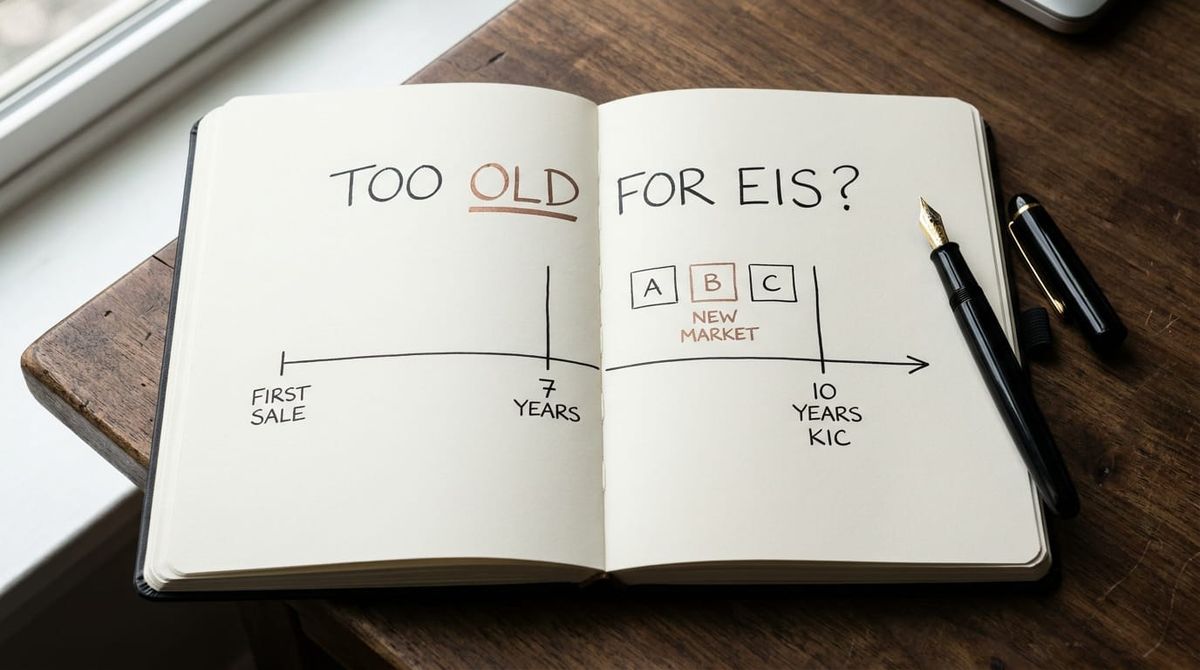
The short answer: EIS shares issued more than seven years after a company's first commercial sale qualify only if one of three conditions in s.175A ITA 2007 is met. The period is ten years for a knowledge-intensive company. An established company with no earlier scheme funding usually has to rely on condition B, which is limited to entering a new product or geographic market.
Written 20 November 2026. This reflects the legislation and the HMRC manual as held at that date.
The Enterprise Investment Scheme (EIS) is usually described as a relief for younger companies. This is with good reason as there has been a long-held expectation that more established businesses could turn to more traditional finance such as bank loans. However, this has led to many owners of established businesses often wrongly assuming that the EIS relief is closed to them.
This guide explains how the age rule works, how the period is counted and what an older company has to show.
In this guide
- What is the EIS age limit?
- When does the seven-year period start?
- Whose first sale counts in a group or after an acquisition?
- What is condition A, the follow-on funding rule?
- What is condition B, the new market rule?
- What counts as a new product or geographic market?
- What is condition C?
- Does knowledge-intensive status help an older company?
- Frequently asked questions
- What should an established company check first?
What is the EIS age limit?
The rule is called the permitted maximum age requirement and it sits in s.175A ITA 2007. It does not ban older companies. It states that if the shares are issued after the company's "initial investing period", one of three conditions (A, B or C) must be met.
The initial investing period is seven years beginning with the relevant first commercial sale. For a company that is knowledge-intensive (at the date of the share issue) it is ten years (s.175A(2)).
When does the seven-year period start?
It starts with the first commercial sale. The legislation takes that term from the European Commission's risk finance guidelines as they applied in the UK immediately before the end of the Brexit implementation period (s.175A(8)). HMRC summarises it as the first sale on a product or service market, leaving out limited sales made to test the market (VCM8151).
The date is usually at or around the time the company starts to trade, and can be later. It does state that:
A company may use the date of commencement of trade, or the date the business was started, rather than the date of the first commercial sale for the purposes of applying the maximum age rules if it wishes.
It is clearly in the best interests of the company to identify the first commercial sale as being as late as possible to maximise the 7 year rule.
In one of its examples a company is incorporated in January 2015, develops a prototype by December 2016, which it supplies to a hospital for testing for a token fee and which is not successful, and makes its first commercial sale on 1 June 2019. HMRC treats the period as running from the 2019 sale, so the company has until 31 May 2026, or 31 May 2029 if it is knowledge-intensive when it raises the money (VCM8151, example 17).
HMRC also says a short, one-off transaction that is minor compared with the company's other activities would not be regarded as a commercial sale. Activities that give a more regular income stream, or form a substantial part of what the company does, would start the clock (VCM8151, example 18).
Whose first sale counts in a group or after an acquisition?
Not only the issuing company's. The "relevant first commercial sale" is the earliest of several dates listed in s.175A(6). They include the first commercial sale of any company that is, or has been, a 51% subsidiary of the issuing company, including sales it made before it joined the group. They also include the first commercial sale of any person who previously carried on a trade that the issuing company or such a subsidiary later carried on.
HMRC's manual says the rules look at every business of every company that has ever been a member of the group, including businesses acquired, and take the earliest date (VCM8152). It does not matter that the companies carry on different activities, and selling the older subsidiary does not reset the date (VCM8152, examples 22 and 23).
The same rule applies where an owner plans to raise EIS money through a new company. If the new company acquires a subsidiary or a trade whose first commercial sale was many years ago, the new company takes that date. HMRC states that the purpose is to stop established businesses being moved into a newer company wrapper (VCM8152).
The rule also looks forward. If money raised by the share issue is used for a subsidiary or trade acquired after the issue date, that business's first commercial sale is brought in (s.175A(6)(d) to (f)).
What is condition A (the follow-on funding rule)?
This is perhaps the most commonly applied condition - repeat or follow-on funding from previous qualifying SEIS or EIS funding.
Condition A is met where a relevant investment was made in the company before the end of the initial investing period, and some or all of the money raised by that earlier investment was employed for the same qualifying business activity that the new money will fund (s.175A(3)).
A relevant investment is defined in s.173A(3). It includes an issue of shares for which the company has provided an EIS or SEIS compliance statement, and any investment made by a venture capital trust. HMRC confirms that the earlier investment need not be under the same scheme, so SEIS money raised early can support later EIS funding (VCM8154).
HMRC adds a point that is not in the wording of the section.
The need for follow-on funding must have been foreseen in the company's business plan at the time of the first investment, although exact amounts and dates are not expected (VCM8154 and VCM8160).
HMRC says this comes from the State aid rules and is not specified in the domestic legislation (VCM8160). HMRC also says the money cannot be used for a new project or for the company's other activities (VCM8154).
Where the first investment was made before 18 November 2015, HMRC says the company must show that it would have met condition A or condition B if the rules had applied at that time (VCM8160).
HMRC gives an example of what does not work. A company takes a £1,000 EIS investment early to fund one app, then tries more than seven years after its first commercial sale to raise £1 million for a different product. Condition A is not met, and HMRC says a company cannot use an early investment to "bookmark" unspecified future funding (VCM8160, example 41).
What is condition B, the new market rule?
Condition B is the route for a company that has never had a relevant investment (condition A, above), or is changing direction. It has two parts (s.175A(4)):
- The 50% turnover test. The total relevant investments made in the company in a period of 30 consecutive days that includes the issue date must be at least 50% of the company's average turnover amount.
- The new market test. The money raised by those investments must be employed for the purpose of entering a new product or geographical market.
The average turnover amount is one fifth of the turnover for a five-year period. That period ends immediately before the start of the company's last accounts filing period, or 12 months before the issue date if the last filing period ended more than 12 months before the issue (s.175A(7) to (7B)). For a parent company, the turnover of its qualifying subsidiaries is included (s.175A(8)).
HMRC's example shows the scale. A company with average annual turnover of £1 million needs relevant investments of at least £500,000 within the 30 days. An investment by a company that is not a relevant investment does not count towards the total, and earlier investors have no certainty until the later money arrives (VCM8156, examples 26 and 27).
For a profitable company with turnover in the millions, the 50% test alone means condition B is only available for a substantial raise. HMRC says a number of smaller unconnected initiatives cannot be combined to reach the threshold (VCM8155).
What counts as a new product or geographic market?
A new product is not the same thing as a new product market. HMRC describes a product market as all the products or services that customers regard as interchangeable, and says the idea relates more to the customer base (VCM8158). A geographic market is an area where the conditions of competition are sufficiently similar and appreciably different from neighbouring areas. Opening in a new area is not, on its own, entering a new geographic market. These are HMRC's descriptions. The legislation itself gives the phrase the meaning it has in the General Block Exemption Regulation, as that regulation had effect in the UK immediately before the end of the Brexit implementation period (s.175A(8)).
HMRC's view is that condition B is for a step comparable to setting up a completely new business, where the company's track record does not help an investor assess the new activity. It is not for growth in small incremental steps (VCM8158).
Three further points from the manual:
- All the money goes to the new activity. HMRC says none of the investments qualify if the money is spent on existing activities, and the money cannot be recycled if the new venture stops early (VCM8155).
- The investment comes first. HMRC says the investment must be made before the company embarks on the new activity. Test sales do not count against the company, but definite steps such as setting up processes and delivery chains to supply at scale do (VCM8158).
- The company has to explain it. HMRC expects detail of what the company has done and where, what it will do and where, and why that is a new market (VCM8158).
HMRC's examples include a medical products manufacturer adapting a product for air pollution monitoring, which it accepts as a new product market, and a teashop supplying nearby shops and restaurants, which it regards as natural expansion (VCM8158, examples 36 and 37).
What is condition C?
Condition C is follow-on funding after condition B. It is met where condition B (or the equivalent venture capital trust condition in s.294A(4)) was previously met for one or more relevant investments in the company, and some or all of that money was employed for the same qualifying business activity the new money will fund (s.175A(5)).
HMRC says the rules are the same as for condition A, including the expectation that the need for further funding was foreseen in the business plan (VCM8159 and VCM8160).
Does knowledge-intensive status help an older company?
Yes, a knowledge-intensive company has an initial investing period of ten years in place of seven. It can also elect to start the ten years from the date it is treated as reaching annual turnover of £200,000, in place of the first commercial sale (s.175A(2)(a) and s.252B). HMRC says that election is available for investments made on or after 6 April 2018 (VCM8168).
The company must meet at least one operating costs condition:
- at least 15% of relevant operating costs spent on research and development or innovation in one of the three relevant preceding years, or
- at least 10% in each of them.
It must also meet the innovation condition or the skilled employee condition. The skilled employee condition requires at least 20% of full-time equivalent employees to hold a relevant higher education qualification and be engaged directly in research and development or innovation.
The status is tested at the date the shares are issued. For a company built on its own intellectual property and still spending heavily on development, the extra three years can decide whether a round qualifies without relying on conditions A to C.
Frequently asked questions
Can a company more than seven years old raise EIS investment?
Yes, in limited cases. Shares issued more than seven years after the relevant first commercial sale (ten years for a knowledge-intensive company) qualify only if condition A, B or C in s.175A ITA 2007 is met. All the other EIS conditions still apply.
Is the EIS age limit measured from incorporation?
No. It is measured from the relevant first commercial sale, which can be later than incorporation and later than the start of trading. In a group, or where a trade has been acquired, it is the earliest first commercial sale across the companies and trades listed in s.175A(6).
Did Finance Act 2026 change the EIS age limit?
No. Finance Act 2026 changed the EIS gross assets, annual and lifetime limits with effect from 6 April 2026. The seven and ten year periods in s.175A were not amended.
Can an established company use EIS money to grow its existing business?
Not under condition B. HMRC says condition B does not allow a company beyond the age limit to raise tax-advantaged funding for its existing activities, even where that would help it grow (VCM8155). Follow-on funding under condition A or C must be for the same activity as the earlier qualifying investment.
How much must an older company raise under condition B?
Relevant investments of at least 50% of the company's average annual turnover over the relevant five-year period, made within a period of 30 consecutive days that includes the share issue date (s.175A(4) and (7)).
Does putting the new activity in a new company avoid the age limit?
Not if the new company acquires an older subsidiary or trade, or uses the money for one acquired later. The first commercial sale of that subsidiary or trade is then taken into account under s.175A(6). Separate rules on control, independence and the use of money also need checking before any structure is chosen.
Will HMRC confirm the position before the shares are issued?
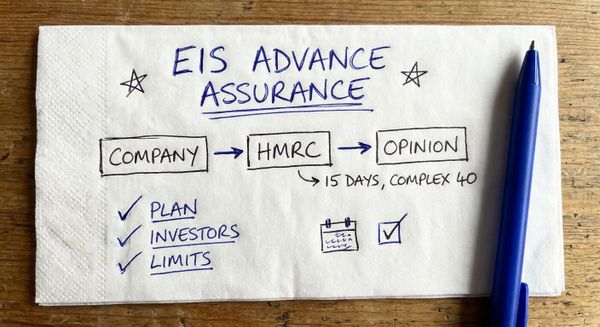
A company can apply for advance assurance, which is a discretionary, non-statutory service (VCM60110). HMRC's manual says the company will need to explain in detail why it is entering a new product or geographic market (VCM8158). An assurance is HMRC's opinion on the information supplied, and HMRC says it does not guarantee that investors can claim relief or that relief will not later be withdrawn (VCM60170).
What should an established company check first?
Start with dates and numbers before any investor conversation:
- The date of the relevant first commercial sale, across every company and trade that s.175A(6) brings in.
- Whether the company has ever received a relevant investment (SEIS / EIS), when, and what that money was used for.
- Whether the company is knowledge-intensive at the planned issue date.
- The average turnover amount for the relevant five-year period, and whether the planned raise reaches 50% of it within 30 days.
- Whether the planned activity is a new product or geographic market on HMRC's description, and whether the company has already started it.
The age requirement is one of several conditions. A round that passes it still has to meet the others, including the risk to capital condition, and a company planning more than one round should read the guide to multi-round SEIS and EIS funding.
IP Tax Solutions advises companies, and their accountants and lawyers, on SEIS and EIS eligibility, advance assurance applications and compliance statements. You can get in touch to discuss a planned round, read about the SEIS and EIS advisory service or see the page for accountants and lawyers.
This article is general guidance, not advice for your specific circumstances. Whether a share issue meets the age requirement depends on the company's own history, its group and the use of the money, and the rules change. Take advice before issuing shares.