What software development qualifies for R&D tax credits?
Software development companies can benefit from the UK Government's R&D tax credit relief incentive but it is often unclear exactly what software activities qualify for R&D tax relief - we explain here

Updated November 2026. This article describes the rules for accounting periods beginning on or after 1 April 2024. Earlier periods follow the previous rules, and HMRC enquiries into those periods are still live.
Software claims attract close attention from HMRC, which has dedicated guidance for software and its own computer specialists. The relief is available where a project seeks a genuine advance in technology. It is not available simply because a team wrote new code. This guide sets out where that line falls and which costs can be claimed.
How much can software R&D relief be worth?
For accounting periods beginning on or after 1 April 2024 there are two reliefs.
- The merged scheme R&D expenditure credit is 20% of qualifying expenditure. It is a taxable receipt, so the value after tax is lower than the headline rate.
- Enhanced R&D intensive support (ERIS) is for loss-making small or medium-sized enterprises whose relevant R&D expenditure is at least 30% of total relevant expenditure, measured together with any connected companies. It gives an additional deduction of 86% and a payable credit of 14.5% of the loss surrendered, which is a maximum of 26.97% of qualifying expenditure.
For most software companies the main qualifying cost is people. Staffing costs count to the extent that directors and employees are directly and actively engaged in the R&D, so a developer who spends half of their time on the qualifying project brings in half of their cost. Our page on R&D relief for loss-making companies explains how each relief turns into cash.
What type of software projects can qualify?
There is no list of qualifying project types. Software is treated like any other field of science or technology, and the test is in the government's Guidelines on the Meaning of Research and Development for Tax Purposes (the DSIT Guidelines). HMRC's manual describes two ways software can qualify:
- Software as a tool within a wider R&D project. Software created or adapted solely for use in R&D qualifies as part of that project, even if the advance being sought is in another field.
- Software as the goal of the project. Here the project itself must seek an advance in computer science or information technology.
In either case three questions decide the claim.
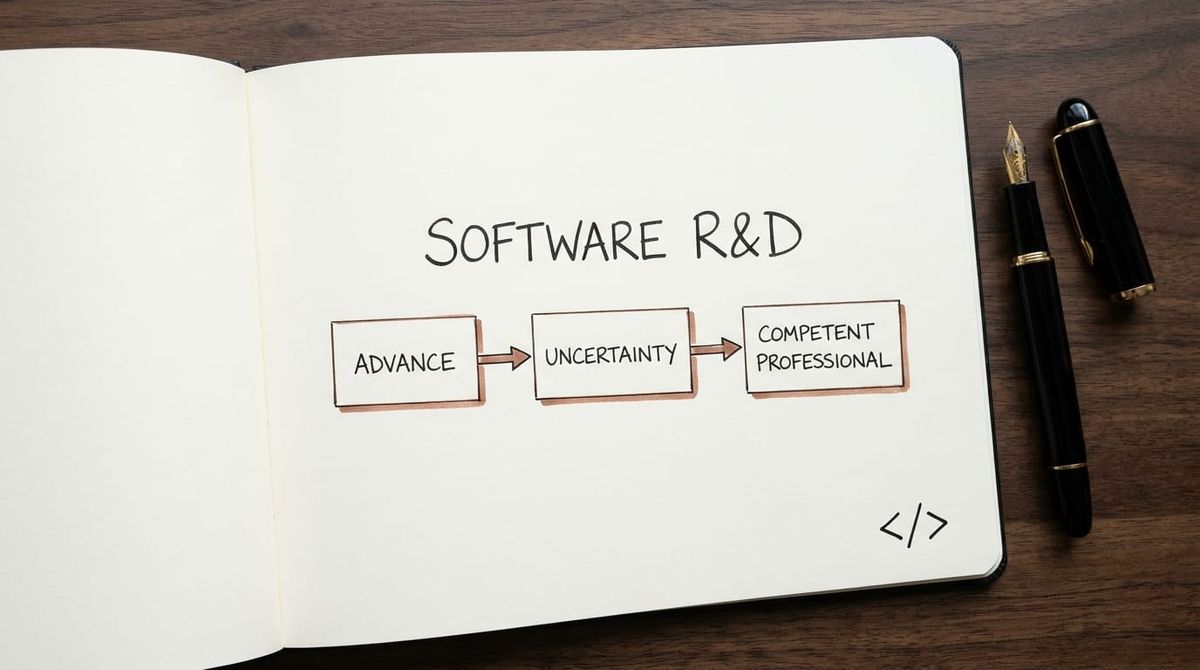
What is the advance? It must be an advance in overall knowledge or capability in a field of science or technology, not only in the company's own knowledge. An appreciable improvement can qualify if a competent professional working in the field would recognise it as genuine and non-trivial. What matters is the underlying technology, not the commercial output. HMRC also says that naming a field is not enough: a claim that states the advance as being "in artificial intelligence" or "in microservices" does not explain what is new.
What is the technological uncertainty? Uncertainty exists when knowledge of whether something is technologically feasible, or how to achieve it in practice, is not readily available or deducible by a competent professional working in the field. This includes system uncertainty, where the difficulty lies in how components behave together. Combining standard technologies can qualify if a competent professional could not readily deduce how to make them work as intended.
Where does the R&D begin and end? R&D begins when work to resolve the uncertainty starts and ends when the uncertainty is resolved or the work stops. Requirements gathering where no technological question is at issue is not R&D. Where a commercial software project contains a smaller R&D project inside it, only that part can be claimed.
HMRC caseworkers are supported by HMRC's own computer specialists. In an enquiry they may ask the company's competent professional to explain, by reference to information in the public domain, why the advance could not readily be deduced. We have written about a tribunal decision on the evidence needed in a software claim.
Which areas of software development most often contain R&D?
Qualifying work can arise in areas such as:
- novel algorithms, data structures and data processing methods
- machine learning and other artificial intelligence techniques
- image, speech and signal processing
- distributed systems, storage and real-time processing
- integration of platforms or components where the combined behaviour is uncertain
- robotics, embedded software and connected devices
Working in one of these areas does not make a project R&D. The same three questions apply to each.
What costs can be claimed?
The legislation lists the categories. Each cost must also be attributable to the R&D.
- Staffing costs. Earnings paid in money, employer's Class 1 NIC, employer pension contributions and expenses reimbursed to the employee. Benefits in kind are excluded.
- Externally provided workers. Individuals supplied through a staff provider who work under the company's supervision, direction or control. Where the parties are not connected, 65% of the payment attributable to the workers' qualifying earnings can be claimed.
- Contracted out R&D. Where the company engages another business to carry out R&D that it intended or contemplated when it entered into the contract. For an unconnected contractor the qualifying amount is 65% of the payment. For a connected contractor it is the lower of the payment and the contractor's own relevant expenditure.
- Software, data licences and cloud computing services. Cloud computing services include access to remote data storage, hardware facilities, operating systems and software platforms. The cost qualifies to the extent that it is employed directly in the R&D.
- Consumable items, including water, fuel and power used in the R&D.
Five points are often missed.
- Work done for a customer. If a customer contracts R&D out to the company, the customer is the one who can claim, not the company doing the work. R&D is contracted out where it is reasonable to assume, from the contract and the surrounding circumstances, that the customer intended or contemplated that R&D of that sort would be carried out to meet it. The developer can still claim where the customer is an ineligible body such as a charity or an institution of higher education, or is not acting in the course of a trade, profession or vocation within the charge to tax. It can also claim for R&D that the customer did not intend or contemplate.
- Freelancers and agencies. The treatment depends on the arrangement. A development agency delivering R&D under contract falls under the contracted out rules. A developer supplied through an intermediary and directed by the company is an externally provided worker. A self-employed developer engaged directly, with no intermediary, is not an externally provided worker. Their fees qualify only where the company has contracted R&D out to them.
- Work done overseas. For contracted out R&D, the cost generally qualifies only where the R&D is undertaken in the United Kingdom. For externally provided workers, it qualifies only where their earnings are subject to UK PAYE and NIC. In both cases there is a narrow exception where conditions necessary for the R&D are not present in the UK, are present where the work is done, and would be wholly unreasonable for the company to replicate here. Cost and the availability of workers do not count as such conditions.
- Cloud and data costs with wider rights. These do not qualify if the company, or another person involved in the R&D such as its contractor, obtains a right to sell the data, or to share it with third parties beyond what the R&D itself requires. They also do not qualify so far as they relate to indirect supporting activities.
- Payment. A cost can be claimed only if it has been paid before the claim is made.
Capital expenditure does not qualify. Development costs that are capitalised as an intangible asset in the accounts, such as developer salaries, can still be included, because the tax rules allow them to be deducted when incurred.
What does not qualify?
- Routine development using established methods, libraries and frameworks.
- Configuring existing software to the company's own requirements, which is generally within the capability of that software already. Customisation qualifies only where it materially affects the underlying technology.
- R&D that a customer has contracted out to the company, which is for the customer to claim (subject to the exceptions above).
- Routine fault fixing after release.
- Improvements, optimisation and fine-tuning that do not materially affect the underlying technology.
- Work on the cosmetic or aesthetic appeal of a product.
- Software built to process non-technological information, where no advance in the field of software is expected.
- Applying AI as opposed to advancing it.
The absence of an off-the-shelf product is not enough. A gap in the market may mark the start of a qualifying project, but only if filling it requires an advance in technology and the resolution of technological uncertainty. Something that is new to the company or to its trade, but routine for a competent professional, is not R&D.
What guidance has HMRC published for software?
HMRC's manual has a dedicated page applying the Guidelines to software and a set of four case studies. Both are useful for seeing how HMRC separates qualifying sub-projects from the commercial project around them. They are HMRC's view. The DSIT Guidelines remain the authority, and the version issued in 2023 applies to accounting periods beginning on or after 1 April 2023.
How do you make the claim?
The claim is made in the company tax return with the Additional Information Form, and a company that has not made an R&D claim in the three years ending six months after the end of the period of account must notify HMRC within those six months. For more on the practical side, see our article on software development R&D claims: what qualifies and what doesn't.
How we can help
IP Tax Solutions prepares and reviews software R&D claims, working with the engineers who did the work and alongside the company's existing accountant. We also act for companies and advisers whose claims are under HMRC enquiry.
For more detail see our R&D tax relief page, or contact IP Tax Solutions.